


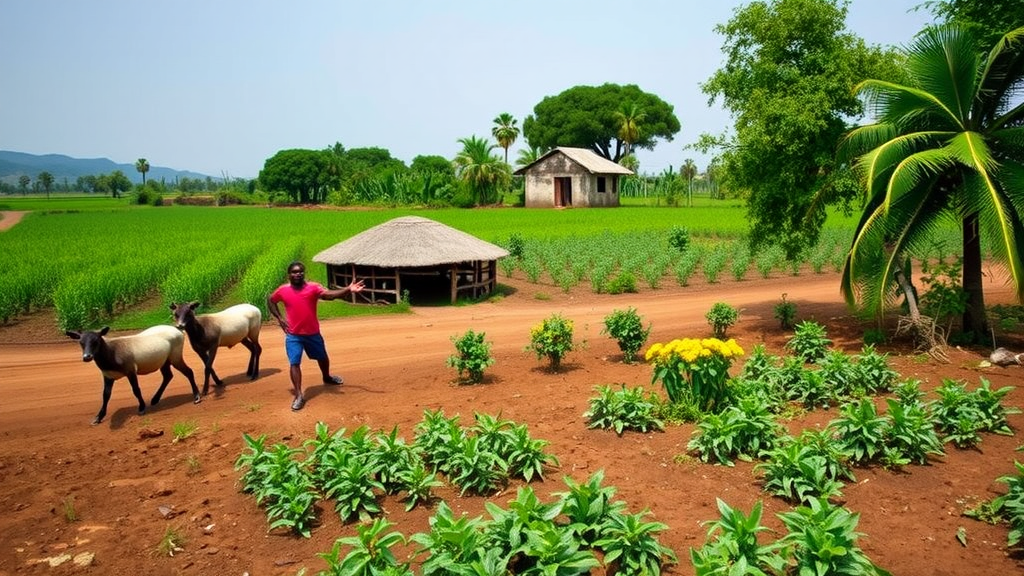
In the highlands and lowlands of rural Ethiopia, what a family grows on its own plot may matter more to the nutritional health of mothers and young children than almost any other factor researchers can measure. A large new study of more than 500 women and 250 young children across five Ethiopian regions has found that each additional food group a household produces is linked to striking increases in the intake of energy, calcium, iron, zinc, and vitamin A. Yet the same study also delivers a sobering counterpoint: even after the harvest, when granaries are fullest, diets remain dangerously inadequate, and the lean season erases much of the hard-won nutritional ground.
The research, published in BMC Agriculture, was conducted by Andinet Abera Hailu of the Ethiopian Public Health Institute and University College Cork, together with Nahom Tefera and Stephen Thornhill. The team carried out a repeated cross-sectional survey in two waves, deliberately timed to capture the extremes of the Ethiopian farming calendar. The first round took place during the pre-harvest months of August and September 2022, when food stores run low and households depend on whatever remains from the previous year. The second round followed in March and April 2023, after the main harvest had replenished food supplies. Data were collected across Amhara, Oromia, SNNP, Sidama, and Somali regions using computer-assisted personal interviewing on tablets, with a multistage sampling strategy anchored to the national Household Income and Expenditure Survey framework.
The dietary assessment relied on internationally validated tools adapted to Ethiopian food culture. Women’s diets were scored using the Diet Quality Questionnaire, which classifies everything a woman ate in the previous day and night into ten food groups, with indigenous staples such as teff and enset grouped appropriately. A woman was considered to meet the Minimum Dietary Diversity for Women, or MDD-W, if she consumed foods from at least five of the ten groups, a threshold associated with a higher likelihood of micronutrient adequacy. For children aged 6 to 23 months, the team applied the World Health Organization’s eight food groups to calculate the Child Dietary Diversity Score, alongside the Minimum Dietary Diversity and Minimum Acceptable Diet indicators, which also account for meal frequency and breastfeeding status. Nutrient intake was estimated with a food frequency questionnaire using standardized serving sizes from the national Food Consumption Survey, allowing the researchers to compute Nutrient Adequacy Ratios against Ethiopian and FAO/WHO reference values.
The seasonal contrast was dramatic. Before the harvest, only 16.8 percent of women achieved the MDD-W threshold; after the harvest, that figure rose to 25 percent. Children showed even sharper swings: the share meeting Minimum Dietary Diversity nearly doubled, from 11.8 percent to 23.3 percent, and the proportion achieving a Minimum Acceptable Diet more than doubled, from 7.6 percent to 16.5 percent. The post-harvest diet was visibly richer in pulses, other vegetables, fruits, and dairy. Yet the improvements were concentrated in foods that families grow themselves. Consumption of eggs, nuts and seeds, and meat, poultry, and fish remained strikingly low in both seasons for both women and children, with children’s flesh food consumption rising only from 1.7 percent to 6.8 percent and egg consumption from 10.9 percent to 15.5 percent after harvest.
Nutrient intake data told the same story in chemical terms. Women’s energy intake increased from an average of 1,430 to 1,589 kilocalories per day after harvest, still far below the Ethiopian Food-Based Dietary Guidelines recommendation of 2,300 kilocalories. Vitamin A intake rose from 394 to 482 micrograms of retinol activity equivalents per day but remained below the 600-microgram reference intake, and calcium stayed well under recommended levels in both seasons. Children fared similarly: energy intake climbed from 734 to 815 kilocalories per day against a guideline of 1,250, while calcium intake, even post-harvest, reached only 273 milligrams per day, barely a quarter of the recommended 1,000 milligrams. Across the whole study, the Mean Adequacy Ratio hovered around 60 percent for both women and children, with calcium emerging as the most limiting nutrient for both groups: fewer than one in five women and only 27 percent of children met adequacy thresholds.
The statistical core of the study lies in its regression models, which linked farm production diversity directly to nutrient intake. For women, each additional food group produced by the household corresponded to an increase of 103.8 kilocalories of energy, 66.9 milligrams of calcium, 101.4 micrograms RAE of vitamin A, 3.75 milligrams of iron, and 0.70 milligrams of zinc per day, all highly significant. Children in more diverse households consumed significantly more calcium, vitamin A, iron, and zinc. The marginal effects were striking: as production diversity rose from one to five food groups, predicted vitamin A intake among women more than doubled from roughly 500 to over 1,000 micrograms RAE per day, and predicted calcium intake nearly doubled from about 450 to 900 milligrams per day. Homestead land proved particularly powerful, with each additional hectare associated with more than 100 micrograms of extra daily vitamin A intake among women.
The researchers also classified households into four dominant cropping systems using hierarchical clustering of crop composition, and found that agricultural context left distinct nutritional fingerprints. Women in agropastoral households had the highest calcium intake at 560.6 milligrams per day, likely reflecting dairy access, while those in highland perennial systems achieved the best vitamin A intake at 548.1 micrograms RAE per day, probably thanks to perennial fruits intercropped with vegetables. Cereal-pulse mixed systems excelled in iron, consistent with the mineral profile of teff and legumes. By contrast, tuber-based systems consistently showed the lowest zinc intake, pointing to a widespread risk of inadequacy that no single cropping system escaped. Zinc deficiency, in fact, emerged as a systemic problem across rural Ethiopia, with intakes ranging only from 7.4 to 9.8 milligrams per day across systems.
Beyond the farm gate, the study revealed how strongly the food environment constrains diet quality. Households located more than an hour from a market had significantly lower intakes of key nutrients, particularly energy and calcium, and greater distance from roads compounded the disadvantage. Food prices exerted an equally powerful influence: every one-birr increase in the price of eggs was associated with a reduction of 62.5 kilocalories of daily energy intake, 23.9 milligrams of calcium, 2.38 milligrams of iron, and 39.5 micrograms of vitamin A among women. Rising fruit and vegetable prices were similarly linked to drops in vitamin A consumption, indicating that nutrient-dense foods are priced out of reach precisely when families need them most. Regional contrasts were also pronounced, with women in Oromia showing higher energy, calcium, zinc, and vitamin A intake than those in Amhara, while iron-rich teff consumption in Amhara boosted iron and zinc levels.
The authors conclude that farm diversification, while genuinely effective, is not sufficient on its own to close Ethiopia’s nutrition gap. Cultural factors compound the challenge: Ethiopian Orthodox Christian fasting, which can span more than 200 days a year, suppresses animal-source food consumption even among livestock-owning households, and previous research found that only a quarter of young children consumed any animal-source food during Lent despite 80 percent of their households owning animals. The study’s prescription is therefore integrated: nutrition-sensitive agriculture that promotes locally adapted, diverse crop combinations; infrastructure investments in roads and markets that make nutrient-rich foods available year-round; and complementary interventions such as biofortification, fortification, and targeted supplementation of iron, vitamin A, and zinc. Without these parallel efforts, the researchers warn, millions of Ethiopian mothers and children will continue cycling between post-harvest recovery and lean-season deficiency, no matter how varied their fields may be.
Subject of Research: The influence of farm production diversity and seasonality on dietary diversity and nutrient intake among women and children in rural Ethiopia
Article Title: The influence of farm production diversity and seasonality on dietary diversity and nutrient intake among women and children in rural Ethiopia
Article References: Hailu, A. A., Tefera, N., & Thornhill, S. (2026). The influence of farm production diversity and seasonality on dietary diversity and nutrient intake among women and children in rural Ethiopia. BMC Agriculture, 2(1), Article 5. https://doi.org/10.1186/s44399-025-00029-3
Image Credits: AI Generated
DOI: 10.1186/s44399-025-00029-3
Keywords: Ethiopia, dietary diversity, nutrition, micronutrients, farm production diversity, seasonality, women's health, child nutrition, food security, agriculture, market access, cropping systems
Cite Scienmag News
Daisy Hatcher. (September 26, 2026). Diverse Farms Bring Better Diets to Rural Ethiopia, but Seasonal Hunger Persists. Scienmag. https://scienmag.com/diverse-farms-bring-better-diets-to-rural-ethiopia-but-seasonal-hunger-persists/
Daisy Hatcher. "Diverse Farms Bring Better Diets to Rural Ethiopia, but Seasonal Hunger Persists." Scienmag, 26 September 2026, https://scienmag.com/diverse-farms-bring-better-diets-to-rural-ethiopia-but-seasonal-hunger-persists/. Accessed 4 October 2026.
Daisy Hatcher. "Diverse Farms Bring Better Diets to Rural Ethiopia, but Seasonal Hunger Persists." Scienmag. September 26, 2026. https://scienmag.com/diverse-farms-bring-better-diets-to-rural-ethiopia-but-seasonal-hunger-persists/


