


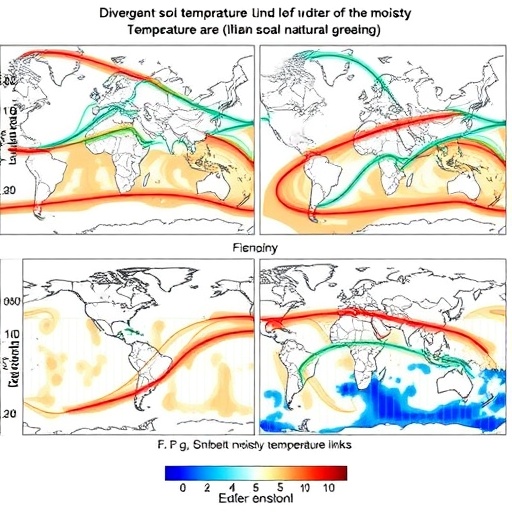
In the evolving landscape of climate science, understanding the intricate relationships between terrestrial and atmospheric systems is more critical than ever. A groundbreaking study led by Hagan, Wang, Kennedy-Asser, and colleagues, recently published in Nature Communications, offers new insights into one such relationship: the coupling between soil moisture and air temperature. Their research reveals that this coupling will exhibit markedly divergent regional behaviors under future climate scenarios, a discovery that challenges existing climate models and carries significant implications for ecological resilience and human adaptation strategies.
Soil moisture, often underestimated in its climatic role, acts as a vital mediator in the terrestrial water and energy cycles. It influences evaporation rates, plant transpiration, and ultimately, atmospheric conditions. By regulating surface temperatures, soil moisture serves as a natural thermostat that can either exacerbate or mitigate heat extremes. However, the degree to which soil moisture interacts with air temperature and how this relationship shifts with climate change has been poorly characterized until now.
The authors utilized sophisticated Earth system models to simulate future scenarios under varying greenhouse gas emission pathways. Their work stands out for its spatial resolution and the coupling metrics applied, allowing them to quantify soil moisture-air temperature feedback strength with unprecedented precision. The findings indicate not a uniform pattern, but a complex mosaic of regional divergences that reflect local climatological, hydrological, and ecological processes.
In arid and semi-arid regions, the coupling is projected to intensify, driven primarily by increased evaporative demand juxtaposed with dwindling soil water reserves. This condition leads to more severe heatwaves and drought amplification, creating a feedback loop that exacerbates regional warming. This intensification underscores the vulnerability of dryland ecosystems and the human communities that depend on them, heightening the urgency for targeted mitigation and adaptation measures.
Conversely, humid regions exhibit a contrasting trend, with soil moisture-air temperature coupling decreasing in intensity. Here, increased precipitation under some climate scenarios leads to wetter soils that buffer temperature extremes by enhancing evaporative cooling. However, these benefits may be transient or spatially patchy, as shifts in precipitation patterns and the frequency of extreme events add layers of complexity to regional responses.
In the tropics, the study reveals particularly nuanced dynamics. Tropical soils are likely to experience altered moisture regimes that disrupt the delicate balance of evapotranspiration processes. Such changes risk destabilizing monsoonal patterns and altering regional humidity, impacting both local weather and larger-scale atmospheric circulation patterns. This highlights the critical role tropical soil moisture in global climate regulation, an aspect that demands further examination.
The researchers emphasize that the divergent soil moisture-air temperature coupling is intricately linked to vegetation responses. Plants modulate soil moisture through root water uptake and canopy transpiration, processes that are themselves sensitive to temperature, CO2 concentrations, and water availability. Changing coupling strength thus has cascading effects on ecosystem productivity, carbon cycling, and biodiversity, adding urgency to integrating these feedbacks into Earth system assessments.
One of the study’s key advances is the deployment of a coupling metric that captures non-linear interactions between soil moisture and temperature, moving beyond traditional correlation-based analyses. This approach exposes subtle shifts in the feedback strength and directionality that occur seasonally and regionally, exposing new vulnerability hotspots. It offers a framework for future studies to better quantify and predict feedback mechanisms under evolving climate regimes.
The implications of these findings extend to agricultural systems as well. Soil moisture is critical for crop development, influencing yield stability and food security. Enhanced coupling in drought-prone regions could lead to increased crop failures and exacerbate socio-economic disparities, particularly where irrigation infrastructure is lacking. Understanding these dynamics will be pivotal for developing resilient agricultural strategies under climate stress.
From a policy perspective, this research underscores the necessity of region-specific climate adaptation strategies. Blanket approaches to climate mitigation fail to capture the heterogeneity of soil moisture-temperature feedbacks and their localized impacts. Instead, resource management must be tailored to address the unique vulnerabilities and adaptive capacities of different regions, informed by detailed coupling assessments such as those presented in this study.
Moreover, the study raises questions about the adequacy of current climate models to capture soil moisture-air temperature feedbacks accurately. The divergent regional patterns revealed suggest that many models may oversimplify or homogenize soil-atmosphere interactions, potentially underestimating climate risks. This indicates a pressing need for model refinement, integrating finer-scale hydrological processes and land-atmosphere coupling mechanisms.
As the global community grapples with the multifaceted challenges posed by climate change, this research highlights a critical, yet underexplored, dimension of climate dynamics. By unpicking the divergent regional responses of soil moisture-air temperature coupling, the study enriches our understanding of both the mechanisms driving climate extremes and the potential pathways to resilience.
Looking forward, the authors advocate for sustained observational campaigns and enhanced modeling efforts focused on soil moisture and temperature interactions across diverse biomes. Satellite-based remote sensing, coupled with ground-based measurements, holds promise for verifying model projections and detecting early warning signals of feedback intensification.
In sum, this study provides a compelling narrative and robust evidence that soil moisture-air temperature coupling will not evolve uniformly in the face of climate change. Instead, its regional divergence will play a pivotal role in shaping the future of ecosystems, agriculture, and human well-being. Harnessing this knowledge will be crucial for crafting effective adaptation frameworks and safeguarding the planet’s climate stability and habitability.
Hagan et al.’s work represents a transformative step in climate science, urging a paradigm shift towards more nuanced, regionally-resolved analyses of land-atmosphere interactions. Its implications resonate from scientific communities to policymakers, and ultimately, to societies worldwide striving to navigate an uncertain climatic future.
Cite Scienmag News
Violet Maxwell. (June 8, 2026). Divergent Soil Moisture-Temperature Links Under Future Climate. Scienmag. https://scienmag.com/divergent-soil-moisture-temperature-links-under-future-climate/
Violet Maxwell. "Divergent Soil Moisture-Temperature Links Under Future Climate." Scienmag, 8 June 2026, https://scienmag.com/divergent-soil-moisture-temperature-links-under-future-climate/. Accessed 4 September 2026.
Violet Maxwell. "Divergent Soil Moisture-Temperature Links Under Future Climate." Scienmag. June 8, 2026. https://scienmag.com/divergent-soil-moisture-temperature-links-under-future-climate/


