


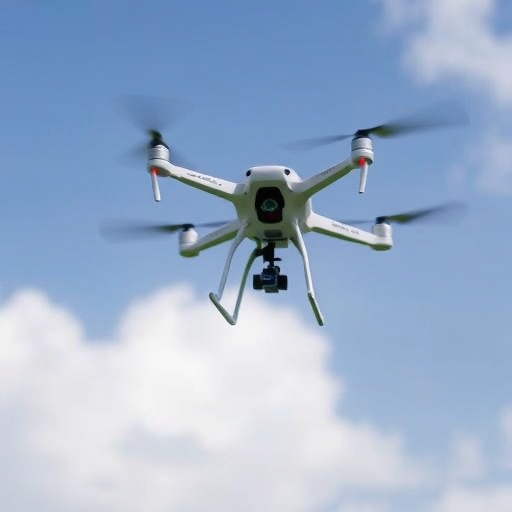
In a groundbreaking development in the realm of robotics and autonomous systems, researchers have unveiled a novel framework known as DMPC-Swarm—distributed model predictive control designed explicitly for nano unmanned aerial vehicle (UAV) swarms. This innovative methodology marks a significant leap forward in how swarms of drones can operate independently while effectively communicating and coordinating with one another. At the forefront of this research are A. Gräfe, J. Eickhoff, and M. Zimmerling, whose collaborative efforts within the realm of robotics shed light on new horizons for drone technology.
The essence of distributed model predictive control involves enabling a group of agile nano UAVs to navigate complex environments while continuously optimizing their trajectories and actions. Traditional control strategies often struggle with multi-agent systems due to their inherent complexity and the need for real-time decision-making. DMPC-Swarm seeks to address these challenges by harnessing the power of distributed computing, allowing each drone within the swarm to maintain a model of the environment and its peers. This decentralization fosters enhanced adaptability, particularly important for applications in dynamic or unpredictable settings.
Crucially, the researchers emphasize that the DMPC-Swarm framework is not merely about achieving individual drone autonomy but rather optimizing swarm performance as a cohesive unit. This balance is achieved through sophisticated algorithms that allow drones to predict future outcomes based on current information while also considering the actions of nearby drones. By anticipating each other’s movements, the drones can avoid collisions and optimize their paths to accomplish collective objectives effectively.
Moreover, the implications of DMPC-Swarm extend beyond mere efficiency; they also encompass safety and reliability. In scenarios where nano UAVs operate in crowded or sensitive environments—like search and rescue operations, environmental monitoring, or precision agriculture—the need for minimized risks is paramount. The authors highlight that by distributing control and decision-making, they create a more robust framework that mitigates the risks associated with single points of failure. This is pivotal in forming trust in autonomous systems that interact frequently with human operators and other technology.
The framework’s flexibility means that it can be easily adapted to various scenarios without significant re-engineering. Whether tasked with surveillance, delivery, or environmental assessment, the adaptability of DMPC-Swarm ensures that these lightweight drones can deploy effective strategies compatible with mission requirements. The researchers conducted extensive simulations, demonstrating the practicality of their approach in various dynamic contexts, which proves vital for future real-world applications.
In a world where the integration of drone technology is becoming increasingly prevalent, the potential economic and operational efficiencies that DMPC-Swarm can provide are as exciting as they are significant. Industries may find themselves reorganizing strategies as they adopt these powerful tools. The possibility of swarms of nano UAVs conducting complex surveys or deliveries could revolutionize numerous fields, from logistics to disaster response, bringing an unprecedented level of agility and thoroughness to tasks often deemed too complicated for traditional systems.
An integral part of the DMPC-Swarm framework is the communication protocol through which these drones interact with each other and their environment. Unlike traditional UAV systems, which may rely on centralized control and linear communication chains, the distributed design promotes a more fluid and resilient communication network. This innovation allows drones to share data in real time, continuously influencing one another’s decision-making processes, which significantly enhances dynamic adaptability in changing environments.
Testing for this framework utilized both theoretical models and real-world simulations, enabling the researchers to predict how swarms operated under various conditions. The outcomes displayed the remarkable capability of multiple nano UAVs to operate semiautonomously while still achieving goals that were originally designed collectively. These findings suggest a profound shift in how we understand autonomous systems and their applications—moving from isolated, rigid structures toward a more organic and responsive structure.
Furthermore, the DMPC-Swarm framework prioritizes energy efficiency, a critical factor given the limited power supply of nano UAVs. By optimizing flight paths not just for speed but also for energy consumption, the system ensures prolonged operational durations. This characteristic is invaluable for missions that extend across large areas or require prolonged periods of surveillance, further establishing the practical applications of the technology.
The research team behind DMPC-Swarm asserts that by enhancing the collaborative capabilities of these nano UAVs, the burden placed on human operators is subsequently reduced. As drones become capable of managing many autonomous processes, human oversight shifts into a more supervisory role, allowing for a higher volume of tasks to be undertaken simultaneously without compromising safety protocols.
Moving forward, the study indicates that the performance of DMPC-Swarm can only improve with advancements in computational power and artificial intelligence. As machine learning algorithms evolve, the potential for UAV swarms to adapt and learn from their environments will push the boundaries of existing frameworks, leading to more sophisticated and responsive systems.
In summary, the emergence of DMPC-Swarm represents an exciting frontier in the world of autonomous robotics, specifically in the deployment of nano UAVs. By prioritizing distributed control and collaboration, researchers have crafted a framework that aligns with the future trajectory of drone technology. The implications for both industry and society are manifold, urging stakeholders to pay attention to the profound shifts that this technology promises in the coming years.
The detailed exploration by Gräfe, Eickhoff, Zimmerling, and colleagues not only opens the door to innovations within autonomous systems but also invites wider discussions about the ethical and functional implications of deploying such technologies across various sectors. As we advance into a future filled with possibilities harnessed by such intelligent systems, the DMPC-Swarm presents a significant step forward in embracing the ubiquity of drones in daily life, challenging us to rethink what is possible when machines can communicate, collaborate, and operate as seamlessly as nature intended.
Gräfe, A., Eickhoff, J., Zimmerling, M. et al. DMPC-Swarm: distributed model predictive control on nano UAV swarms.
Auton Robot 49, 28 (2025). https://doi.org/10.1007/s10514-025-10211-w
Cite Scienmag News
Denise Maddox. (January 17, 2026). Distributed Model Predictive Control for Nano UAV Swarms. Scienmag. https://scienmag.com/distributed-model-predictive-control-for-nano-uav-swarms/
Denise Maddox. "Distributed Model Predictive Control for Nano UAV Swarms." Scienmag, 17 January 2026, https://scienmag.com/distributed-model-predictive-control-for-nano-uav-swarms/. Accessed 3 September 2026.
Denise Maddox. "Distributed Model Predictive Control for Nano UAV Swarms." Scienmag. January 17, 2026. https://scienmag.com/distributed-model-predictive-control-for-nano-uav-swarms/


