


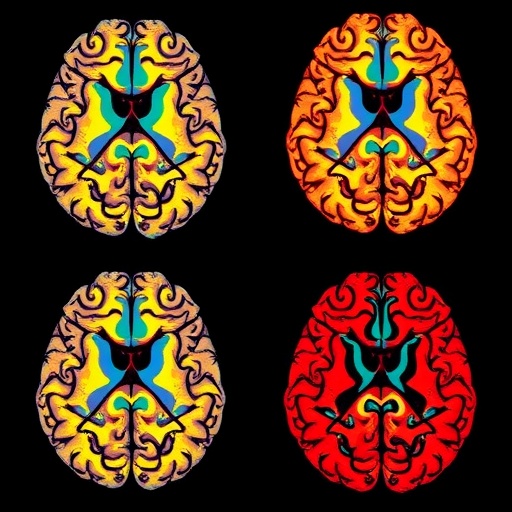
In a groundbreaking study that could reshape the understanding of neurodegenerative diseases, researchers have uncovered compelling evidence pointing to distinct patterns of cortical organization in Parkinson’s disease (PD) and Lewy Body Dementia (LBD). This new insight into the divergent neuropathological mechanisms underlying these two related yet clinically overlapping disorders promises to open novel avenues for diagnosis, prognosis, and targeted therapies.
Parkinson’s disease and Lewy Body Dementia are conditions primarily characterized by the abnormal accumulation of alpha-synuclein protein aggregates known as Lewy bodies within the brain. Despite their neuropathological commonality, they manifest with differing clinical trajectories and symptom profiles. Traditionally, they have been considered points along a spectrum; however, the precise ways in which cortical brain organization diverges between them have remained elusive until now.
The research, led by Zarkali, Thomas, Hannaway, and colleagues and published in Nature Communications, utilized advanced neuroimaging modalities combined with detailed computational analyses to interrogate cortical network architecture in vivo. By integrating high-resolution MRI scans with functional connectivity mapping, the team was able to delineate the intricate cortical circuitry signatures associated with each condition, revealing clear differential patterns that contradict the previously held notion of a singular pathophysiological continuum.
Their methodological approach involved recruiting cohorts of clinically diagnosed PD and LBD patients alongside age-matched healthy controls. Employing resting-state functional MRI (rs-fMRI), they mapped the brain’s spontaneous activity fluctuations, which serve as markers of network integrity and functional communication. This approach is particularly suited to studying neurodegenerative diseases where diffuse cortical involvement complicates region-specific analyses.
The team applied sophisticated network analysis metrics rooted in graph theory—a mathematical framework that models the brain as a constellation of nodes (brain regions) connected by edges (functional connections). By quantifying aspects such as modularity, node centrality, and hub integrity, the researchers painted a detailed portrait of the cortical organizational landscape unique to each disease state.
One of the most striking findings was the identification of differential hub vulnerability. In PD, the study revealed predominant disruptions in deep subcortical and sensorimotor cortical hubs, which can explain the hallmark motor deficits characteristic of the disease. Conversely, LBD exhibited pronounced alterations in associative cortical hubs, particularly in regions related to memory, visuospatial processing, and executive function, aligning with its clinical presentation emphasizing cognitive decline and hallucinations.
Furthermore, dissecting the modular architecture of the cortical networks, the team noticed that PD brains tended to retain more modular integrity with relatively preserved inter-module communication compared to LBD. This suggests that while both diseases involve cortical breakdown, the topological reorganization in LBD reflects a more profound and widespread cortical network disintegration, potentially accounting for its severe cognitive manifestations.
The study also ventured into exploring the temporal evolution of these network changes. Longitudinal analyses indicated that the progression rates of network degradation were faster in LBD patients, with a marked deterioration in default mode and attentional networks over time. In contrast, PD patients showed a more gradual decline centered around motor circuits, providing further evidence of fundamentally different disease trajectories at the cortical level.
Critically, these findings challenge existing diagnostic criteria based largely on clinical symptoms and structural neuroimaging alone. Incorporating network-based biomarkers could pave the way for earlier and more accurate differentiation between PD and LBD, which is essential for optimizing treatment regimes and patient management strategies.
Moreover, understanding these divergent cortical architectures offers a powerful framework for mechanistic studies. The results imply that therapeutic interventions might need to be tailored according to the distinct neuroanatomical vulnerabilities and network disruptions characteristic of each disease, rather than applying a one-size-fits-all approach to synucleinopathies.
The implications for drug development are substantial. Targeting the preservation or restoration of specific cortical hubs and network modules could become a novel strategy, potentially slowing or mitigating symptom progression. Additionally, the use of non-invasive neuromodulatory techniques like transcranial magnetic stimulation (TMS) or transcranial direct current stimulation (tDCS) could be fine-tuned based on the identified dysfunctional networks.
Importantly, the research design also underscores the utility of integrating multimodal data. Beyond rs-fMRI, the team suggests that future studies incorporating diffusion tensor imaging (DTI), positron emission tomography (PET) for molecular markers, and electrophysiological recordings will further unravel the complexities of cortical reorganization in synucleinopathies.
This study also highlights how technological advancements in computational neuroimaging and machine learning are transforming neuropathology from static, region-centric models to dynamic, network-based paradigms. This shift not only enhances our understanding of disease mechanisms but also promises to revolutionize clinical neurodiagnostics and therapeutic monitoring through personalized brain network profiling.
In summary, Zarkali and colleagues’ landmark investigation reveals that Parkinson’s disease and Lewy Body Dementia, despite shared pathological hallmarks, engage fundamentally different patterns of cortical network disruption. These findings demand a reassessment of how these diseases are conceptualized, diagnosed, and treated, anchoring future research in the domain of brain network neuroscience.
With neurodegenerative disorders increasingly burdening aging populations worldwide, such nuanced insights provide a beacon of hope for the development of precision medicine approaches that could vastly improve patient outcomes. By elucidating the unique network signatures of PD and LBD, this study represents a significant step toward decoding the brain’s complex response to progressive synuclein pathology.
Ultimately, ongoing research building on these discoveries will likely redefine therapeutic horizons, encouraging the design of intervention strategies that align closely with the biophysical realities of each disorder’s cortical architecture. This evolving understanding brings the neuroscience community closer to unraveling the intricate mysteries of brain degeneration and crafting targeted, effective solutions against these debilitating illnesses.
Cite Scienmag News
Cassandra Pierce. (November 25, 2025). Distinct Cortical Changes in Parkinson’s and Lewy Body Dementia. Scienmag. https://scienmag.com/distinct-cortical-changes-in-parkinsons-and-lewy-body-dementia/
Cassandra Pierce. "Distinct Cortical Changes in Parkinson’s and Lewy Body Dementia." Scienmag, 25 November 2025, https://scienmag.com/distinct-cortical-changes-in-parkinsons-and-lewy-body-dementia/. Accessed 4 September 2026.
Cassandra Pierce. "Distinct Cortical Changes in Parkinson’s and Lewy Body Dementia." Scienmag. November 25, 2025. https://scienmag.com/distinct-cortical-changes-in-parkinsons-and-lewy-body-dementia/


