


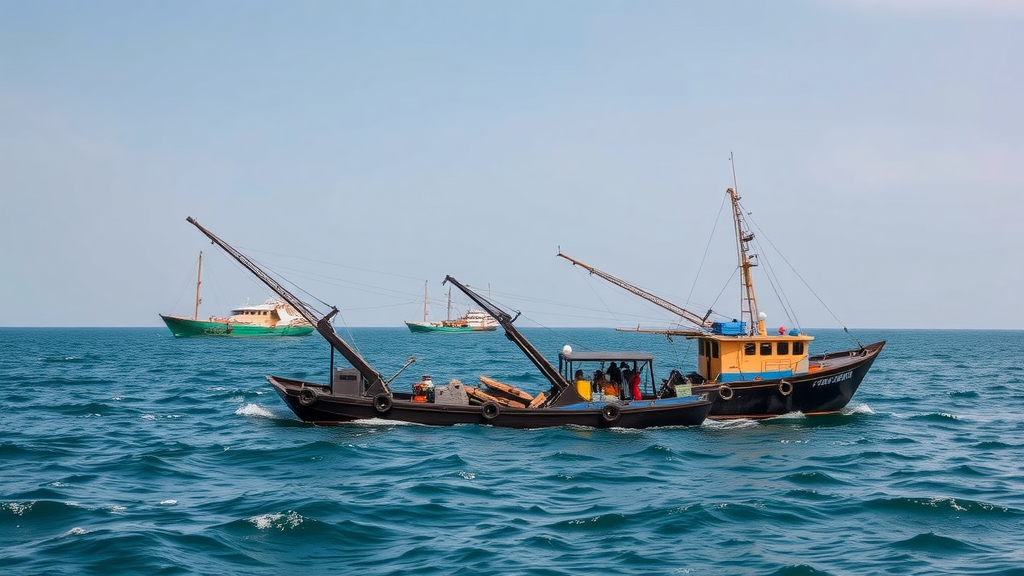
The open ocean has long been treated as a commons without a census, a place where vessels can travel thousands of kilometers from their home ports and fish in waters far beyond the sight of any national regulator. A new study published in npj Ocean Sustainability, an open-access journal in the Nature Portfolio, turns a careful analytical eye on one of the most consequential and least visible segments of this global system: the dynamics of distant water fishing fleets operating from Southeast Asian countries. By tracing how these fleets move, expand, and respond to pressure at home, the research offers one of the most detailed pictures yet of how a region’s fishing power projects itself across the world’s oceans, and why that projection matters for the sustainability of fisheries everywhere.
Distant water fishing, by definition, describes fleets that harvest marine resources outside their own exclusive economic zones, often under access agreements, joint ventures, or flag arrangements with coastal states in Africa, the Pacific, and Latin America. For Southeast Asian nations, whose own waters are among the most productive and most heavily exploited on the planet, distant water operations have become both an economic outlet and an ecological escape valve. When domestic stocks are depleted or domestic licensing becomes restrictive, vessels and their investors look outward. The new research examines this outward push not as a static fact but as a dynamic system, one that shifts with fuel prices, bilateral agreements, enforcement regimes, and the health of the fish stocks themselves.
The study’s central contribution lies in treating fleet behavior as something that can be characterized quantitatively over time rather than described anecdotally. Rather than simply counting vessels, the analysis focuses on the patterns of activity that emerge when large numbers of fishing vessels operate in concert: where they concentrate, how long they remain in particular grounds, how their presence changes in response to regulatory signals, and how the composition of the fleet evolves as older vessels retire and newer, often larger and more technologically capable ships enter service. This kind of systems-level view is essential because distant water fishing is not merely a collection of independent boats. It is an industry organized around supply chains, processing capacity, ports of convenience, and market demand that spans continents.
Southeast Asia provides a particularly revealing setting for this kind of analysis. The region contains some of the world’s largest fishing nations, with enormous domestic fleets that have historically been supported by fuel subsidies, loan programs, and development policies aimed at expanding seafood production. Those same policy instruments, designed to strengthen food security at home, have inadvertently fueled the capacity that now seeks opportunity abroad. The research highlights this feedback loop: capacity built for domestic waters spills into international ones, and the resulting pressure on foreign stocks can replicate abroad the very overfishing problems the fleets were escaping. Understanding this dynamic is critical for any honest assessment of global fishing effort, because vessels that leave home waters do not simply disappear from the global ledger of exploitation.
The technical challenge of studying distant water fleets has always been data. Fishing vessels operating in remote waters, sometimes under flags of convenience and sometimes with limited transponder coverage, are notoriously difficult to track. The study engages with this problem by synthesizing available information on fleet composition, operational ranges, and the institutional arrangements that govern access to foreign waters. Such synthesis work matters because policy debates about distant water fishing frequently proceed from fragmented or outdated information. Without a coherent picture of how fleets are actually distributed and changing, attempts at regulation, whether by flag states, coastal states, or regional fisheries management organizations, risk targeting the wrong vessels in the wrong places at the wrong times.
One of the most striking themes the research surfaces is the role of governance asymmetry. Coastal states in the waters where Southeast Asian distant water fleets operate often possess limited monitoring, control, and surveillance capacity, while the vessels themselves may be registered in jurisdictions with minimal oversight obligations. This mismatch creates conditions in which illegal, unreported, and unregulated fishing can flourish, and it places honest operators at a competitive disadvantage relative to those willing to cut corners. The study situates fleet dynamics within this institutional landscape, showing that the movement and behavior of vessels cannot be understood purely in terms of fish abundance or economics. Where the rules are weak, the fleets concentrate; where enforcement tightens, activity shifts to new grounds. The geography of fishing, in other words, mirrors the geography of regulation.
The implications of these dynamics extend well beyond the fishing industry itself. Distant water fishing touches on food security for coastal communities that depend on fish as a primary source of protein, on the livelihoods of small-scale fishers who compete with industrial vessels for shared stocks, and on the marine ecosystems that absorb the cumulative pressure of decades of industrial extraction. When highly migratory species such as tuna are harvested across vast ocean basins by fleets from many nations, the sustainability of the resource becomes a collective action problem. The research’s systematic account of how Southeast Asian distant water fleets fit into this equation helps clarify which actors bear which shares of the pressure, a necessary precondition for fair and effective international management.
The findings also speak to an ongoing transformation in how the global fishing industry is monitored. Satellite-based vessel tracking, automatic identification systems, and machine-learning analyses of vessel behavior have begun to peel back the opacity that once shielded distant water operations from scrutiny. Studies like this one demonstrate the value of bringing such analytical tools to bear on specific regions and fleet segments. As more nations adopt requirements for electronic monitoring and as regional fisheries management organizations expand their data collection, the possibility of genuine, evidence-based management of high-seas and foreign-access fisheries moves from aspiration toward practice. The Southeast Asian case examined here suggests both the promise of that trajectory and the distance still to be traveled.
For policymakers in the region, the research carries a pointed message: distant water fleets are not an externality of domestic fisheries policy but a direct product of it. Decisions about subsidies, licensing, fleet modernization, and labor standards at home reverberate through fishing grounds on the other side of the world. Conversely, international agreements on fisheries access, port state measures, and transshipment regulation shape the economic calculus of fleet owners in Southeast Asian ports. The study’s systemic framing underscores that meaningful reform requires coordination across this entire chain, from the shipyards and banks that finance vessels to the markets in Europe, North America, and East Asia that consume their catch. Sustainability, in this view, is not a property of individual fishing trips but of the whole interconnected system.
As global demand for seafood continues to rise and wild-capture fisheries approach or exceed their biological limits, the behavior of distant water fleets will only grow in importance. The analysis of Southeast Asian fleet dynamics published in npj Ocean Sustainability provides a rigorous foundation for understanding one of the major forces acting on the world’s ocean resources. It replaces a vague sense of concern about far-water fishing with a structured account of how these fleets operate, where they concentrate, and how they respond to the shifting landscape of regulation and opportunity. In doing so, it gives scientists, managers, and the public something increasingly rare in ocean governance: a clear view of an industry that has spent decades just beyond the horizon.
Subject of Research: The operational dynamics of distant water fishing fleets based in Southeast Asian countries
Article Title: Dynamics of distant water fishing fleets in Southeast Asian countries
Article References: Alam, L., Teh, L., Teh, L., Palomares, M. L., Skerritt, D. J., Issifu, I., Lam, V. W. Y., Villasante, S., Lazzari, N., Kinds, A., Carvalho, A. R., Majluf, P., Aheto, D., Mokhtar, M., & Sumaila, U. R. (2026). Dynamics of distant water fishing fleets in Southeast Asian countries. npj Ocean Sustainability. https://doi.org/10.1038/s44183-026-00242-w
Image Credits: AI Generated
DOI: 10.1038/s44183-026-00242-w
Keywords: distant water fishing, Southeast Asia, fisheries, ocean sustainability, overfishing, IUU fishing, fleet dynamics, fisheries management, maritime governance, satellite vessel tracking, tuna fisheries, flag states
Cite Scienmag News
Violet Maxwell. (September 12, 2026). Distant Water Fishing Fleets in Southeast Asia Are Shifting the Balance of Ocean Power. Scienmag. https://scienmag.com/distant-water-fishing-fleets-in-southeast-asia-are-shifting-the-balance-of-ocean-power/
Violet Maxwell. "Distant Water Fishing Fleets in Southeast Asia Are Shifting the Balance of Ocean Power." Scienmag, 12 September 2026, https://scienmag.com/distant-water-fishing-fleets-in-southeast-asia-are-shifting-the-balance-of-ocean-power/. Accessed 5 October 2026.
Violet Maxwell. "Distant Water Fishing Fleets in Southeast Asia Are Shifting the Balance of Ocean Power." Scienmag. September 12, 2026. https://scienmag.com/distant-water-fishing-fleets-in-southeast-asia-are-shifting-the-balance-of-ocean-power/


