


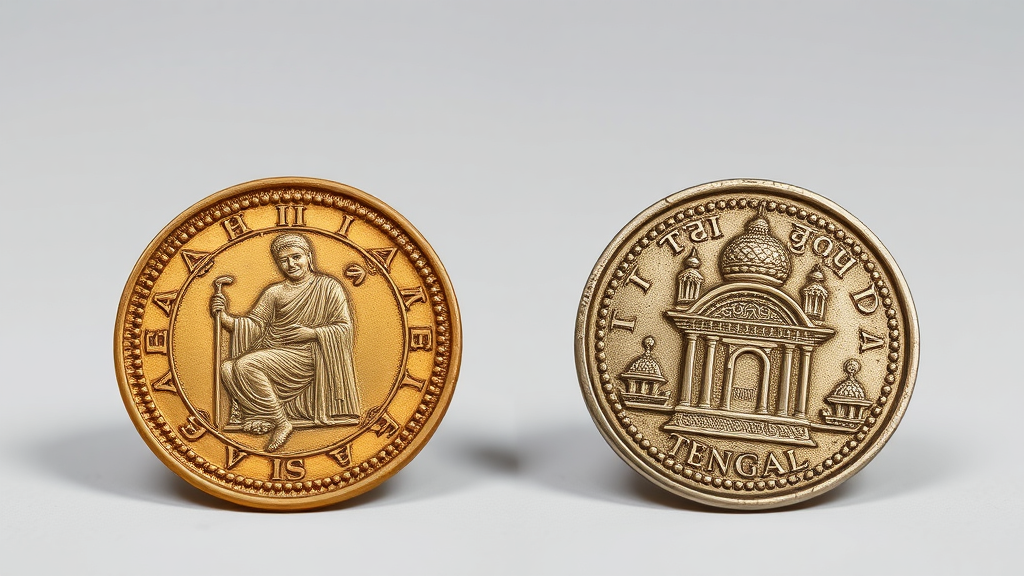
Coins are often dismissed as little more than currency, yet for historians they are among the most eloquent documents of the medieval world. Struck in metal, designed to circulate across markets and borders, and stamped with the legitimacy of a ruling house, a coin carried a political message more durable than any parchment. A new study published in Humanities and Social Sciences Communications examines the coinage of the Bengal Sultanate, the independent Muslim kingdom that dominated the eastern subcontinent between the thirteenth and sixteenth centuries, and argues that its monetary designs form a distinctive reflection of Abbasid and Turkish artistic and political traditions. The research places Bengal’s silver tankas and other denominations within a wider visual and ideological conversation that stretched from Baghdad through Central Asia to the delta of the Ganges, revealing how a distant South Asian kingdom used its money to declare its place in an Islamic political world centred far beyond its frontiers.
The Bengal Sultanate emerged in the early fourteenth century when provincial governors and local power brokers broke away from the Delhi Sultanate and established sovereign rule over one of the richest agricultural regions of the medieval world. Kings such as Shams al-Din Ilyas Shah and, later, the formidable Alauddin Husain Shah presided over a court culture that absorbed Bengali, Persianate, and Turkic influences in nearly equal measure. The sultanate’s coinage, struck principally in silver, served as the most compact expression of that composite identity. On a single tanka a ruler could inscribe his titles, invoke the caliphs of Baghdad, and commission calligraphy and ornament in styles whose ancestry lay in the imperial mints of the Abbasid world and the Turkic dynasties that inherited their authority.
Understanding why a Bengali sultan would reach back to Baghdad requires an appreciation of the Abbasid caliphate’s afterlife. The Abbasids had ruled the Islamic heartlands from 750 until the Mongol destruction of Baghdad in 1258, and even after that catastrophe their name retained an unmatched symbolic charge. The caliph was the Commander of the Faithful, the nominal head of the Muslim community, and his titles conferred legitimacy that no purely dynastic claim could match. Turkic military dynasties that rose to power in the eastern Islamic lands, from the Ghaznavids to the Ghurids and their successors, had routinely struck coins in the name of the Abbasid caliph or adopted titles such as al-sultan al-mu’azzam that embedded their own authority within the caliphal hierarchy. The Delhi Sultanate carried that convention into India, and from Delhi it travelled with the governors and soldiers who eventually founded independent kingdoms in Bengal.
The new analysis traces how these layered traditions surface on Bengal’s coins in three registers: formula, calligraphy, and design. In the register of formula, Bengali sultans repeatedly invoked the Abbasid caliphs by name, most frequently al-Mustansir and al-Musta’sim, generations after the caliphate’s collapse. The names appeared in inscriptions declaring the ruler to be the caliph’s loyal helper, a formulation that simultaneously honored a dead institution and clothed the sultan in its aura. In the register of calligraphy, Bengal’s die engravers worked in a naskh-influenced script whose proportions and phrasing echo coin types known from the Abbasid heartlands and the Turkic-ruled territories of the eastern Islamic world. In the register of design, decorative devices, ornamented borders, and the arrangement of legends on the coins replicate patterns established centuries earlier in Baghdad and transmitted through the mints of northern India and Afghanistan.
The methodological core of the study lies in comparative numismatics. Rather than treating Bengal’s coins as an isolated regional phenomenon, the research assembles them alongside the issues of the Abbasid caliphs, the Ghaznavids, the Ghurids, and the Delhi Sultans, measuring the persistence and transformation of shared inscriptions, layouts, and iconographic conventions. This comparative approach shows that Bengal’s engravers were not passively copying antiquated models. They selected specific Abbasid-Turkish formulae for specific ideological purposes, blending them with local conventions and, in some reigns, with striking innovations that acknowledged the sultanate’s own status as an independent kingdom. The result was a coinage that looked backward toward Baghdad while announcing forward that Bengal was no province of Delhi but a sovereign state in its own right.
That double message was politically essential. The Bengal Sultanate’s independence was born of rebellion against Delhi, and its rulers needed to justify their authority on grounds that transcended a quarrel with the capital they had abandoned. Invoking the Abbasid caliphs supplied precisely such a ground. A Bengali sultan who styled himself the upholder of the caliph’s cause could claim a legitimacy older and higher than any Delhi lineage. At the same time, the visual vocabulary of the coins tied Bengal to a cosmopolitan Islamicate culture of Persian letters, Turkic courtly ideals, and transregional commerce, which suited a kingdom whose prosperity depended on trade networks that ran from the Indian Ocean to the Silk Road. Money, in this reading, was diplomacy by other means: it told merchants, pilgrims, and neighboring rulers exactly where Bengal stood in the moral geography of the medieval Muslim world.
The study also illuminates the mechanics of transmission. Medieval Bengal did not need direct contact with Baghdad to inherit Abbasid conventions, because those conventions had already been absorbed and reworked by the Turkic dynasties of Afghanistan and northern India. The Ghaznavid coinage of the eleventh century, struck at Lahore and Ghazna, preserved Abbasid formulas for an Indian audience; the Ghurid issues of the twelfth century carried them further east; and the earliest Delhi Sultanate coinage of the thirteenth century standardized them in the subcontinent. Bengal’s engravers thus worked from a living tradition, mediated through Turkic hands, rather than from books or museum-like collections of old coins. The reflections on Bengal’s tankas are therefore double reflections: images of the Abbasid past refracted first through Turkish dynastic practice and then through Bengali political needs.
What makes this numismatic record particularly valuable is its survival. Paper documents of the Bengal Sultanate are vanishingly rare, monumental inscriptions are scattered and fragmentary, and literary chronicles were composed generations after the events they describe. Coins, by contrast, survive in thousands, are precisely dated by reign and Hijri year, and can be assigned to individual mints. They allow historians to reconstruct the chronology of royal titles, to map which formulae appeared when and where, and to track how quickly political changes at court registered in the design of everyday money. When a new sultan seized the throne, a shift in the coin legends often announced the change before any surviving document did. The coinage thus functions as a year-by-year barometer of the sultanate’s self-image.
The broader significance of the research lies in its challenge to the habit of studying Islamic coinage in watertight regional compartments. The coinage of the Abbasids, the Turkic dynasties, the Delhi Sultans, and the Bengal Sultans is better understood as a single evolving tradition, with each polity borrowing, preserving, and transforming the conventions of its predecessors. In Bengal’s coins, the study finds a final chapter of that story: a South Asian kingdom at the edge of the Muslim world using the oldest and most respected symbols of caliphal and Turkic authority to define its own sovereignty. As long as a Bengali tanka changed hands in a delta market, it carried, in miniature, the memory of Baghdad and the legacy of the Turkish soldier-sultans who had brought that memory to India.
Subject of Research: The reflection of Abbasid and Turkish dynastic traditions in the coinage of the Bengal Sultanate
Article Title: The numismatic reflection of Abbasid-Turkish traditions in Bengal Sultanate coinage
Article References: Fuad, A. R. (2026). The numismatic reflection of Abbasid-Turkish traditions in Bengal Sultanate coinage. Humanities and Social Sciences Communications. https://doi.org/10.1057/s41599-026-08882-6
Image Credits: AI Generated
DOI: 10.1057/s41599-026-08882-6
Keywords: Bengal Sultanate, Abbasid caliphate, Turkic dynasties, numismatics, medieval India, Delhi Sultanate, coin inscriptions, caliphal legitimacy, Ghaznavids, Ghurids, Islamic coinage, material history
Cite Scienmag News
Courtney Benton. (September 12, 2026). Bengal Sultanate Coins Reveal a Hidden Dialogue Between Abbasid and Turkish Traditions. Scienmag. https://scienmag.com/bengal-sultanate-coins-reveal-a-hidden-dialogue-between-abbasid-and-turkish-traditions/
Courtney Benton. "Bengal Sultanate Coins Reveal a Hidden Dialogue Between Abbasid and Turkish Traditions." Scienmag, 12 September 2026, https://scienmag.com/bengal-sultanate-coins-reveal-a-hidden-dialogue-between-abbasid-and-turkish-traditions/. Accessed 17 October 2026.
Courtney Benton. "Bengal Sultanate Coins Reveal a Hidden Dialogue Between Abbasid and Turkish Traditions." Scienmag. September 12, 2026. https://scienmag.com/bengal-sultanate-coins-reveal-a-hidden-dialogue-between-abbasid-and-turkish-traditions/


