


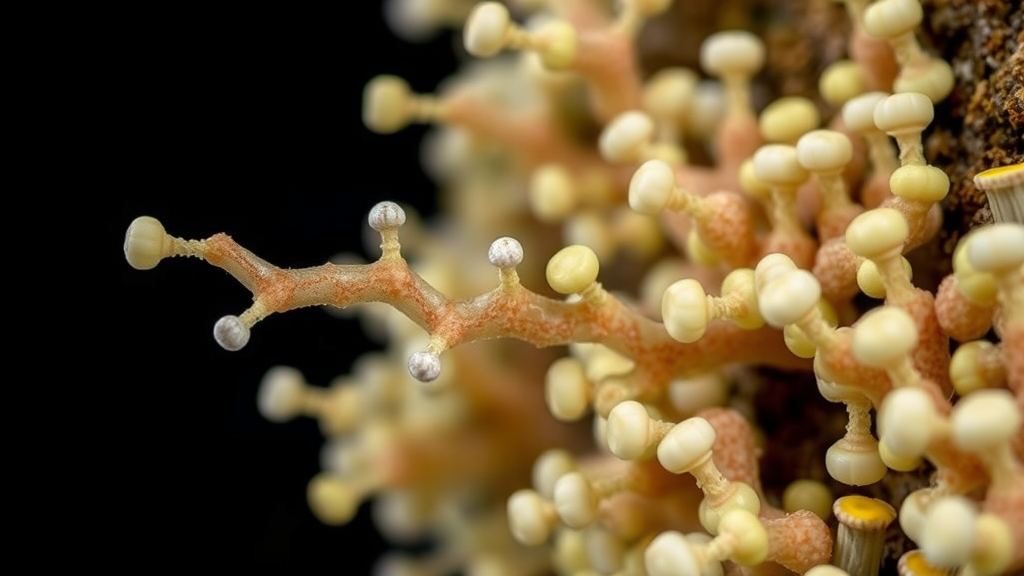
A fungal enzyme once deemed too fragile and too scarce to engineer has been transformed, through laboratory evolution, into a robust biocatalyst capable of reactions that chemists have chased for decades. In a study published in iScience, researchers report the directed evolution of an unspecific peroxygenase from Chaetomium globosum, a cellulolytic fungus known for colonizing damp walls and wallpapers, into a mutant called AckBar that can be secreted efficiently by baker’s yeast, produced at scale in a second yeast host, and stored for months without losing activity. The work converts an intriguing but impractical natural catalyst into a platform that could eventually deliver greener routes to pharmaceuticals, fragrances, and fine chemicals.
Unspecific peroxygenases, or UPOs, are heme-thiolate enzymes that use hydrogen peroxide to insert oxygen atoms into carbon-hydrogen bonds and double bonds under remarkably mild conditions. That ability makes them attractive alternatives to metal-based oxidation catalysts, which often require harsh reagents, elevated temperatures, and elaborate protecting-group strategies. Yet industrial adoption has lagged because most UPOs are difficult to produce, poorly stable, or hard to engineer. CglUPO, the enzyme from Chaetomium globosum discovered in 2017, exemplified all three problems. It oxidizes an unusually broad range of substrates, including steroids, resveratrol analogs, isophorone, fatty acids, and short-chain olefins, but the wild-type enzyme, when produced in its native fungus, loses significant activity within days even at 4 degrees Celsius.
The first hurdle was expression. When the CglUPO gene was previously expressed in Saccharomyces cerevisiae, secretion levels of roughly 0.6 milligrams per liter were far too low to support laboratory evolution, which requires screening thousands of variants, each producing measurable enzyme. The team, led by Miguel Alcalde’s group, tested signal peptides from several peroxygenase-producing fungi to drive secretion, finding that CglUPO’s own native leader sequence performed best, yielding about 3 units per liter of activity in 96-well microfermentations. That modest baseline was enough to launch a directed evolution campaign combining rounds of error-prone PCR, saturation mutagenesis, and in vivo DNA recombination, all screened with a high-throughput assay based on oxidation of 2,6-dimethoxyphenol.
An unexpected bonus appeared immediately: simply switching the expression host from the native fungus to yeast raised the enzyme’s kinetic thermostability, measured as the T50 value at which half the activity survives a 10-minute incubation, by 4 degrees, from 52 to 56 degrees Celsius. The researchers attribute this likely to yeast glycosylation, which can stabilize the secreted protein. Subsequent evolution rounds delivered mutants 9G3 and 11G4 bearing substitutions at position 210, a saturation library at that position produced variant 4B10 with a 16-fold total activity improvement thanks to an M210R mutation, and recombination of the best parents yielded the AckBar mutant, carrying F154L and M210V, with roughly 10-fold improved functional expression and secretion levels of about 6 milligrams per liter in yeast.
To move from laboratory evolution to industrial relevance, the team exploited a tandem-yeast strategy: Saccharomyces cerevisiae for building and screening mutant libraries, and Pichia pastoris, recently renamed Komagataella phaffii, for large-scale production. In a 30-liter fed-batch bioreactor, AckBar reached approximately 90 milligrams per liter, tripling the yield of the parental enzyme in the same host without any process optimization. The purified enzymes, roughly 37 kilodaltons with about 24 percent glycosylation, showed T50 values near 60 degrees Celsius, placing them among the most stable recombinant UPOs reported to date. Crucially, while the wild-type enzyme died within days at refrigeration, AckBar retained nearly full activity for months in storage. Both variants were active across a broad pH range from 5.0 to 9.0.
Then came the surprises. Screening the evolved variants against model substrates revealed that AckBar dramatically inverted the enantioselectivity of tetrahydronaphthalene oxidation, producing the S-enantiomer of the benzylic alcohol with 86 percent enantiomeric excess, whereas the parental enzyme favored the R-enantiomer. Even more striking, both the parental and evolved enzymes catalyzed the anti-Markovnikov Wacker-Tsuji oxidation of styrene to phenylacetaldehyde, a long-pursued synthetic transformation that had only very recently been reported in other peroxygenases and in engineered cytochrome P450 monooxygenases, but never before for CglUPO. In such oxidations, the oxygen lands on the terminal carbon of the alkene to yield an aldehyde rather than the more conventional epoxide, giving direct access to aldehyde building blocks under mild aqueous conditions.
Control experiments confirmed that the aldehyde forms directly from the alkene and not through rearrangement of a preformed epoxide: when styrene oxide was offered as a substrate, no phenylacetaldehyde appeared whether or not hydrogen peroxide was present. With 4-chlorostyrene, the aldehyde-to-epoxide ratio climbed as high as 0.79 for AckBar, and total turnover numbers exceeded 5,000 for epoxidation with low enzyme loadings of 0.1 micromolar. To enable future optimization of this reactivity, the team developed a high-throughput screening assay using Purpald, an aldehyde-specific colorimetric reagent previously applied to evolving anti-Markovnikov P450s. In microfermentations of yeast secreting AckBar, the assay gave a stable, quantifiable response, opening the door to dedicated evolution campaigns aimed at pushing the moderate chemoselectivity toward the levels industry demands.
The reactivity profile extended well beyond styrenes. AckBar oxidized ethylbenzene with 79 percent enantiomeric excess toward the R-alcohol, compared with 31 percent for the parental enzyme, and overoxidized alcohols to ketones to a much greater degree, a property that is useful in cases like isophorone, where the overoxidized product 4-ketoisophorone normally requires cumbersome multi-enzyme cascades. With the bicyclic terpene pinene, AckBar performed notably higher levels of direct carbon-hydrogen oxidation to verbenol and verbenone, exceeding 800 total turnover numbers, whereas limonene yielded exclusively epoxide products, with the cis-to-trans ratio flipping depending on which limonene enantiomer was supplied. This preference for epoxidation over allylic hydroxylation with limonene matches the behavior of other UPOs and underscores how substrate structure governs the reaction channel.
To explain these altered selectivities, the researchers turned to long molecular dynamics simulations, since no crystal structure of CglUPO exists. They built a structural model with AlphaFold2, aligned it to the crystal structure of a related peroxygenase from Hypoxylon sp. EC38, and docked the heme cofactor and substrates before running multiple 0.5-microsecond trajectories for each enzyme-substrate pair. For tetrahydronaphthalene, the simulations showed that the F154L and M210V mutations, both located in the heme access channel, enlarge and reshape the active-site cavity, allowing the substrate to penetrate deeper and lock into catalytically competent poses stabilized by interactions with residues His88 and Glu158. In the parental enzyme, the substrate samples non-reactive positions; in AckBar, the hydrogen atom that yields the S-alcohol sits preferentially close to the iron-oxo of Compound I, reproducing the experimentally observed inversion of enantioselectivity. For styrene, the simulations linked chemo- and enantioselectivity to the geometry of the oxo attack on the terminal versus internal carbon of the double bond, predicting predominant epoxidation with a slight S-preference consistent with the experimental data.
The authors are candid about the study’s limits: all biotransformations were analytical-scale, some products could not be resolved on chiral columns, and every structural interpretation rests on a model whose C-terminal region was predicted with low confidence and equilibrated separately. Even so, the achievement is substantial. A promiscuous but fragile enzyme from a fungus that grows on wallpaper has been re-engineered into a secretable, evolvable, bioreactor-ready catalyst that already performs one of synthetic chemistry’s most coveted reactions. With ongoing evolution of AckBar’s anti-Markovnikov activity, deliberate engineering of the signal peptide, and complementary strategies such as ancestral sequence reconstruction, the team believes the full breadth of this enzyme’s capabilities is now within reach, offering a sustainable enzymatic answer to selective oxygen insertion that chemical catalysis has struggled to provide.
Subject of Research: Directed evolution of the fungal unspecific peroxygenase CglUPO for improved expression, stability, and selective oxyfunctionalization chemistry
Article Title: Promiscuous fungal peroxygenase from Chaetomium globosum by directed evolution
Article References: Upp, D. M., Mateljak, I., Mendez-Sanchez, D., Gomez de Santos, P., Sanchez-Moreno, I., Valles, M., Świderek, K., Moliner, V., Scheibner, K., Hofrichter, M., Gonzalez-Perez, D., & Alcalde, M. (2026). Promiscuous fungal peroxygenase from Chaetomium globosum by directed evolution. iScience, 29(10), Article 117534. https://doi.org/10.1016/j.isci.2026.117534
Image Credits: AI Generated
DOI: 10.1016/j.isci.2026.117534
Keywords: directed evolution, unspecific peroxygenase, Chaetomium globosum, biocatalysis, anti-Markovnikov oxidation, enzyme engineering, Saccharomyces cerevisiae, Pichia pastoris, molecular dynamics, oxyfunctionalization, thermostability, heme-thiolate enzyme
Cite Scienmag News
Gavin Prescott. (September 23, 2026). Directed Evolution Turns a Wallpaper Fungus Enzyme into a Stable, Selective Oxidation Powerhouse. Scienmag. https://scienmag.com/directed-evolution-turns-a-wallpaper-fungus-enzyme-into-a-stable-selective-oxidation-powerhouse/
Gavin Prescott. "Directed Evolution Turns a Wallpaper Fungus Enzyme into a Stable, Selective Oxidation Powerhouse." Scienmag, 23 September 2026, https://scienmag.com/directed-evolution-turns-a-wallpaper-fungus-enzyme-into-a-stable-selective-oxidation-powerhouse/. Accessed 4 October 2026.
Gavin Prescott. "Directed Evolution Turns a Wallpaper Fungus Enzyme into a Stable, Selective Oxidation Powerhouse." Scienmag. September 23, 2026. https://scienmag.com/directed-evolution-turns-a-wallpaper-fungus-enzyme-into-a-stable-selective-oxidation-powerhouse/


