


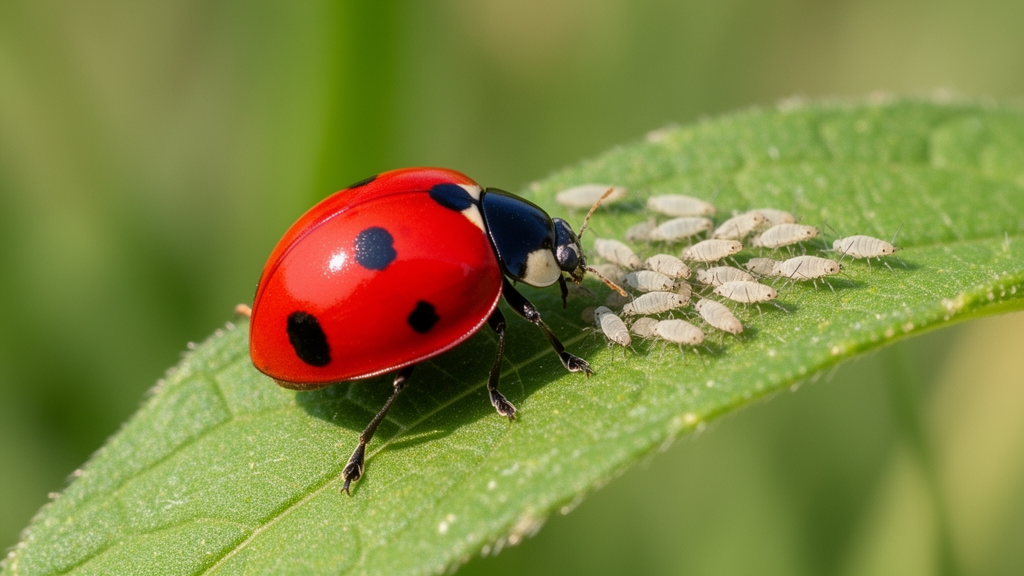
The seven-spot ladybird, Coccinella septempunctata, is one of the most recognisable insects in European farmland and one of its most valuable: a single beetle can devour thousands of aphids over its lifetime, making it a cornerstone of natural pest control. Now, a research team has taken a major step toward simulating this predator in unprecedented detail, publishing a formal model designed for implementation in the Animal Landscape and Man Simulation System, or ALMaSS, a spatially explicit agent-based modelling platform developed to predict how human landscape management affects animal populations. The work, published in the Food and Ecological Systems Modelling Journal, lays out the ecological foundations, mathematical machinery and deliberate simplifications behind what could become a powerful tool for evaluating Integrated Pest Management strategies.
The rationale for the model stems from a long-standing puzzle in biological control. Ladybirds are voracious aphid predators, but their effectiveness in suppressing aphid outbreaks varies dramatically across contexts. In 1999, Kindlmann and Dixon proposed the generation time ratio hypothesis, which holds that a predator’s efficiency as a biological control agent declines as its generation time lengthens relative to that of its prey. Because ladybird larvae have low mobility and the prey keeps reproducing, depleting an aphid colony is not necessarily in the predator’s interest. Aphid control can improve when multiple agents act together, for instance alongside parasitoid wasps, but predicting these dynamics has proven stubbornly difficult. Aphid populations fluctuate wildly under the influence of intrinsic factors such as fecundity and migration, and external drivers, particularly temperature, making forecasting models fragile and contingent on unpredictable seasonal weather.
The new formal model tackles these problems by splitting them into three parts: predicting aphid occurrence, building a multi-species system for control analysis, and capturing the environmental and ecological factors beyond aphid presence that determine where ladybirds occur, including land-use change, agricultural management, climate, and interactions with predators and diseases. The authors assume, for the moment, that aphid occurrence in time and space is predictable, because a companion spatially and temporally detailed aphid model is being developed concurrently within ALMaSS. Once the two models are coupled, the system should allow researchers to explore both optimal control strategies and the population dynamics of the ladybird itself.
What sets this effort apart from earlier ladybird-aphid models is its combination of individual-based realism and landscape detail. Previous mathematical models captured within-season dynamics in ecological patches but ignored movement between patches. Landscape-scale extensions redistributed aphids and ladybirds among patches at season boundaries, revealing the importance of scale but with little spatial realism. Later spatially explicit models, such as those of Bianchi and Van Der Werf, simulated foraging at 20-metre resolution with hourly timesteps, but treated each grid cell as a sub-population. The ALMaSS approach goes further: each ladybird is a separate code object with defined properties such as age, appetite and the number of developed ovarioles, navigating a landscape represented at one-square-metre resolution. Vegetation height and leaf cover are updated daily, crop rotations follow multi-annual farm plans, and crop distribution derives from European Common Agricultural Policy subsidy claims. Farming activities, including pesticide spraying that can kill ladybirds, unfold throughout the year according to crop-specific management plans.
The model’s daily timestep updates temperature, rainfall and local aphid abundance, with no upper limit on the interactions an individual can perform per step. Life history parameters come from laboratory and field studies of C. septempunctata where available, and from calibrated data of sister ladybird species where not. Development is driven by temperature through a day-degree framework: each juvenile stage has a lower development threshold and a sum of effective temperatures required for completion. Eggs, for example, need 42 day-degrees above 11.5 degrees Celsius, while pre-oviposition adults require 151.9 day-degrees above 12.4 degrees. Crucially, larval development is also modulated by prey density through a second-order polynomial function, so that food shortage lengthens each instar. Larvae that endure three consecutive days of starvation die. A prey quality scaler adjusts these rates when the model is coupled to specific aphid species, reflecting evidence that prey type strongly influences growth, survival and fecundity.
Feeding behaviour follows a well-established distinction in coccinellid ecology between essential food, which enables oviposition and larval development, and alternative food, which merely sustains survival. Aphids are the only known essential food for C. septempunctata, so the model links aphid intake directly to growth, development and reproduction rather than building a full energetic budget. Adults require ten aphids daily, while maximum consumption rises from 45 aphids per day for first-instar larvae to 120 for fourth instars. Foraging follows a decision framework in which ladybirds land on plants, initiate localised search upon detecting prey, and aggregate in high-density patches. The model incorporates empirical residence times proportional to aphid density, and a detection threshold of ten aphids per square metre, the minimum density known to attract the beetles. When foraging fails entirely, cannibalism kicks in as a last resort, with each stage able to consume only less advanced stages, and nutritional values assigned per life stage based on body weight comparisons with aphids.
Oviposition, the engine of population growth, is modelled as a function of temperature and prey density. Females lay clutches of roughly 20 to 40 eggs, with laboratory maxima reaching 72 eggs per day on high-quality prey, but only when temperatures exceed 11 degrees Celsius and local aphid density crosses crop-dependent thresholds, which field studies in the Czech Republic place between roughly 9 and 161 aphids per square metre. Lifetime fecundity varies enormously with prey species, from about 200 eggs on the poor-quality oleander aphid to more than 1,700 on Lipaphis erysimi, and the model captures this through a prey quality scaler applied to a saturating relationship between aphid density and egg production. Once a female has laid her full complement of eggs, she is removed from the simulation, a design choice that makes total egg count a proxy for life expectancy.
Mortality is handled through several distinct channels. Temperature-dependent survival follows a parabolic relationship for each life stage, with an optimum between 25 and 30 degrees Celsius, and supercooling points as low as minus 27 degrees for fresh eggs protect against winter extremes. Farming activities carry stage-specific mortality risks: ploughing and harrowing kill half of eggs and larvae, while insecticide applications impose 80 percent mortality on larvae, pupae and adults. Hibernation mortality depends on clump size, with smaller groups suffering twice the mortality of larger ones, and extreme temperatures add a further 25 percent chance of death. Parasitism by the braconid wasp Dinocampus coccinellae, which can strike more than 30 percent of post-dormancy adults in the wild, is simplified in this first version to a single stochastic mortality event sampled uniformly between zero and 33 percent when adults disperse from hibernacula.
The hibernation and movement modules reveal both the ambition and the acknowledged limits of the model. Hibernation is triggered by photoperiod and falling aphid densities from August onward, with beetles aggregating at forest edges, road verges and hedgerows rather than the mountain peaks documented in the literature, a simplification imposed by the 10-by-10 to 50-by-50 kilometre landscape windows the model is designed for. The model also assumes the ladybird is univoltine, producing one generation per year, which holds at the northern and central European latitudes where the tool will first be applied but would fail in warmer climates where partial multivoltinism occurs. Movement is split into short-range walking, whose speed scales linearly with temperature above 4 degrees, and long-range flight, permitted only above 15 degrees Celsius and in winds below 10 metres per second. Males are not simulated at all, on the grounds that mating opportunities are effectively unlimited.
The authors are candid about the challenges ahead. Laboratory data, the primary source for parameters, rarely captures how factors co-vary in nature, and the simple day-degree development model cannot represent the effects of temperature extremes as accurately as biophysical or thermal performance models would. Some potentially important processes, notably intra-guild predation and disease transmission, are folded into general mortality during calibration, risking the loss of deterministic population drivers. Nevertheless, the seven-spot ladybird serves as a representative species for the entire Coccinellidae family, and the model’s mechanistic structure should make it adaptable to other ladybird species as data becomes available. The next phase, implementation and calibration within ALMaSS, will determine whether this digital beetle can truly forecast how farming decisions ripple through one of agriculture’s most iconic predator-prey relationships.
Subject of Research: Agent-based modelling of the seven-spot ladybird Coccinella septempunctata for landscape-scale simulation of aphid biological control
Article Title: The Formal Model for Coccinella septempunctata for implementation in Animal Landscape and Man Simulation System
Article References: The Formal Model for Coccinella septempunctata for implementation in Animal Landscape and Man Simulation System. (n.d.). https://doi.org/10.3897/fmj.6.152914
Image Credits: AI Generated
DOI: 10.3897/fmj.6.152914
Keywords: Coccinella septempunctata, seven-spot ladybird, ALMaSS, agent-based model, biological control, aphids, Integrated Pest Management, landscape ecology, temperature-dependent development, cannibalism, hibernation, agricultural modelling
Cite Scienmag News
Gavin Prescott. (October 16, 2026). Digital Seven-Spot Ladybird: New Agent-Based Model Brings Aphid’s Fiercest Predator into Landscape Simulation. Scienmag. https://scienmag.com/digital-seven-spot-ladybird-new-agent-based-model-brings-aphids-fiercest-predator-into-landscape-simulation/
Gavin Prescott. "Digital Seven-Spot Ladybird: New Agent-Based Model Brings Aphid’s Fiercest Predator into Landscape Simulation." Scienmag, 16 October 2026, https://scienmag.com/digital-seven-spot-ladybird-new-agent-based-model-brings-aphids-fiercest-predator-into-landscape-simulation/. Accessed 16 October 2026.
Gavin Prescott. "Digital Seven-Spot Ladybird: New Agent-Based Model Brings Aphid’s Fiercest Predator into Landscape Simulation." Scienmag. October 16, 2026. https://scienmag.com/digital-seven-spot-ladybird-new-agent-based-model-brings-aphids-fiercest-predator-into-landscape-simulation/


