


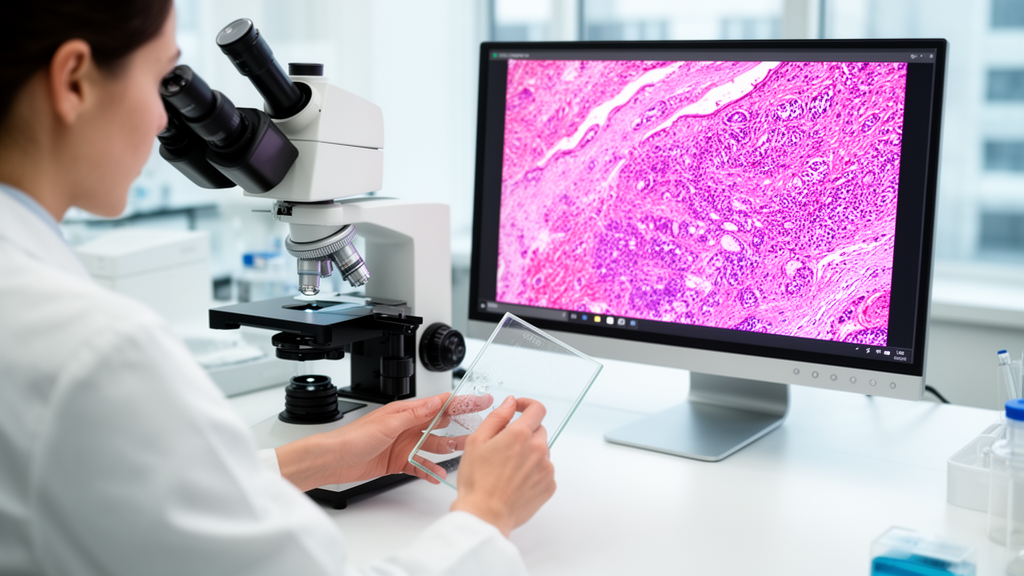
Pathologists spend their careers reading the fine textures of stained breast tissue, distinguishing normal architecture from benign change, carcinoma in situ, and invasive carcinoma. A research team from Universidad Técnica Particular de Loja and Corporación Médica Monte Sinaí-CIPAM in Ecuador has now built and tested an integrated deep learning system, called HistoBreastCAD, that brings several of these computational steps together in a single digital pathology workflow. The study, published in Frontiers in Bioinformatics, combines tissue-region segmentation, four-class histopathology classification, spatial mapping of predictions, and interactive whole-slide image review, and reports its performance under deliberately strict, leakage-safe evaluation protocols.
The motivation is straightforward. Histopathological examination of hematoxylin and eosin-stained slides remains the diagnostic gold standard for breast cancer, but it depends heavily on expert interpretation, and that interpretation is affected by workload, fatigue, and interobserver variability. As laboratories digitize their slides into whole-slide images, or WSIs, the opportunity for computational assistance grows, but so does the technical challenge. A single WSI is a gigapixel-scale image, far too large to feed directly into a neural network, so any practical system must break the slide into manageable pieces, analyze them, and then reassemble the results in a form a pathologist can inspect.
HistoBreastCAD addresses this in stages. First, a semantic segmentation model identifies tissue regions of interest, separating diagnostically relevant tissue from background. Second, a patch-based classifier assigns each analyzed region to one of four diagnostic categories: normal tissue, benign lesion, ductal carcinoma in situ, or invasive carcinoma. Third, the patch-level predictions are mapped back onto the original slide as color-coded probability overlays, so that model outputs can be reviewed in their spatial context. Finally, a web-based interface built on a React frontend and a FastAPI backend lets users pan and zoom across the gigapixel slide with OpenSeadragon, view the automated overlays, and draw their own manual annotations in a separate layer.
The segmentation module was trained and compared using three established architectures: U-Net with a ResNet-34 encoder, DeepLabV3 with a ResNet-50 backbone, and DeepLabV3+ with a ResNet-50 backbone. DeepLabV3+ combines atrous convolutions with atrous spatial pyramid pooling to capture contextual information at multiple receptive-field scales, while its decoder progressively recovers spatial detail. The models were trained on 256-by-256-pixel tiles extracted from ten annotated whole-slide images from the public BACH dataset, producing 248,501 tiles at native resolution and 16,421 tiles at the next downsampled pyramid level. Training used a combined Dice and focal loss with the AdamW optimizer, mixed precision, and early stopping.
Crucially, the evaluation was designed to prevent data leakage. Because multiple patches derive from the same source slide, the team grouped cross-validation folds by whole-slide image rather than by tile: in each of five folds, two complete slides were held out for validation while the remaining eight were used for training, and each slide appeared in validation exactly once. Under this protocol, the final DeepLabV3+ configuration at native resolution achieved an out-of-fold micro-Dice of 0.8390, an intersection-over-union of 0.7226, precision of 0.8278, and recall of 0.8505. DeepLabV3 performed closely behind, while U-Net showed markedly greater instability across folds, with fold-level micro-Dice standard deviations exceeding 0.28 at the downsampled level.
A subtle methodological finding emerged from the choice of checkpoint-selection metric. Tile-averaged Dice, the team found, can be misleadingly inflated by empty-background tiles that score perfectly while carrying no diagnostic information, potentially rewarding checkpoints with very low recall on actual tissue. When the researchers retrained DeepLabV3+ using pooled pixel-level micro-Dice directly for checkpoint selection, the aggregate Dice stayed essentially unchanged, but recall rose from 0.7828 to 0.8505 while precision fell from 0.9039 to 0.8278. In other words, the better metric did not manufacture a higher score; it shifted the operating point toward sensitivity and eliminated a silent failure mode.
For classification, the team evaluated four convolutional architectures on 400 labeled BACH microscopy images, 100 per diagnostic class, again with source-image-grouped five-fold cross-validation so that all 48 patches from a given source image stayed within the same partition. EfficientNetB0, which uses compound scaling of network depth, width, and input resolution, was the strongest individual model with a macro-F1 of 0.8142. The final system, however, uses a frozen equal-weight soft-voting ensemble of EfficientNetB0 and a ResNet18 variant with a global-average-pooling attention branch. The ensemble averages the two models’ softmax probability distributions with weights of 0.5 each, introducing no additional trainable parameters, and achieved an accuracy of 0.8283 and a macro-F1 of 0.8282, outperforming EfficientNetB0 alone in all five validation folds with a paired t-test p-value of 0.0134.
The most sobering results came from an exploratory reader study on the 100 microscopy images of the held-out BACH test set, which lack public reference labels. Two pathologists independently assigned four-class diagnoses, with 95 images receiving valid paired annotations. Interobserver agreement was moderate, with observed agreement of 66.32 percent and a Cohen’s kappa of 0.5105. Model-to-reader concordance was lower: EfficientNetB0 reached kappa values of 0.3242 against one reader and 0.2183 against the other, and the ensemble did not improve on this despite its benchmark advantage. Notably, the models assigned roughly 35 percent of the test images to the normal category, while each reader used that label for only 10 cases, a distributional mismatch that likely contributed to the disagreement.
The authors are careful about what these numbers mean. The cross-validated classification results quantify performance on held-out BACH source images, not end-to-end diagnostic accuracy of the complete pipeline, and the reader study measured concordance with individual expert opinions rather than correctness against an adjudicated reference standard. The system also relies on a single public benchmark, ten annotated slides for segmentation, and established CNN architectures rather than the large-scale pathology foundation models now emerging in the field. External multi-institutional validation, prospective multi-reader studies with consensus diagnoses, and formal explainability assessment are all listed as prerequisites before any claim of clinical generalizability.
Even with those caveats, the study offers a useful template for how computational pathology tools should be evaluated. By enforcing source-level partitioning, auditing tile metadata, confining augmentation and class balancing to training data, and separating benchmark performance from reader agreement, HistoBreastCAD demonstrates that an integrated segmentation-classification-visualization workflow is technically feasible with modest hardware, including consumer-grade GPUs, and that the discipline of leakage-safe evaluation can reveal exactly where a system’s strengths end and its open questions begin.
Subject of Research: Deep learning framework for segmentation and multiclass classification of whole-slide breast histopathology images
Article Title: HistoBreastCAD: an integrated deep learning framework for segmentation and multiclass classification of whole-slide breast histopathology images
Article References: Celi-Vega, O., Jiménez-Gaona, Y., Corral-Dominguez, P., Gutiérrez, Á., & Socola-Barzallo, Z. (2026). HistoBreastCAD: an integrated deep learning framework for segmentation and multiclass classification of whole-slide breast histopathology images. Frontiers in Bioinformatics, 6, Article 1870283. https://doi.org/10.3389/fbinf.2026.1870283
Image Credits: AI Generated
DOI: 10.3389/fbinf.2026.1870283
Keywords: breast cancer, histopathology, deep learning, whole-slide imaging, semantic segmentation, computer-aided diagnosis, ensemble classification, EfficientNet, DeepLabV3+, BACH dataset, digital pathology, interobserver variability
Cite Scienmag News
Blake Davidson. (October 16, 2026). New AI Framework Reads Whole-Slide Breast Tissue Images With Leakage-Safe Deep Learning. Scienmag. https://scienmag.com/new-ai-framework-reads-whole-slide-breast-tissue-images-with-leakage-safe-deep-learning/
Blake Davidson. "New AI Framework Reads Whole-Slide Breast Tissue Images With Leakage-Safe Deep Learning." Scienmag, 16 October 2026, https://scienmag.com/new-ai-framework-reads-whole-slide-breast-tissue-images-with-leakage-safe-deep-learning/. Accessed 16 October 2026.
Blake Davidson. "New AI Framework Reads Whole-Slide Breast Tissue Images With Leakage-Safe Deep Learning." Scienmag. October 16, 2026. https://scienmag.com/new-ai-framework-reads-whole-slide-breast-tissue-images-with-leakage-safe-deep-learning/


