
Thursday, October 29, 2026
Science
No Result
View All Result
  • Login
  • HOME
  • SCIENCE NEWS
  • CONTACT US
  • HOME
  • SCIENCE NEWS
  • CONTACT US
No Result
View All Result
Scienmag
No Result
View All Result
Home Science News Medicine

Digital mobility metrics track Parkinson decline but offer no sample-size edge

October 28, 2026
in Medicine
Diana Fleming
By Diana Fleming Scienmag Editorial Profile - Neurodegenerative Diseases
Reading Time: 3 mins read
0
Digital mobility metrics track Parkinson decline but offer no sample-size edge

Digital mobility metrics track Parkinson decline but offer no sample-size edge

65
SHARES
587
VIEWS
Share on FacebookShare on Twitter
ADVERTISEMENT

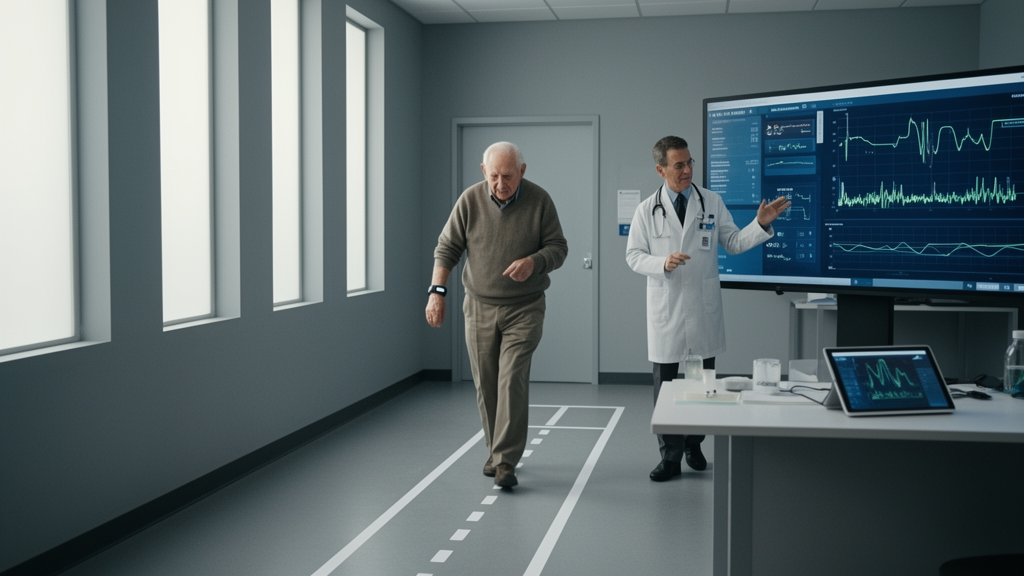
Wearable-sensor measures of everyday walking can detect small declines in people with mild-to-moderate Parkinson disease over two years, but they do not reduce the number of participants a trial would need compared with established clinical rating scales, according to an analysis published in BMC Neurology.

Researchers analysed 524 participants from the observational Mobilise-D Clinical Validation Study, which was prospectively registered with the ISRCTN registry (ISRCTN12051706) on 10 December 2020. Each participant wore a lower-back sensor for seven-day assessment periods, with up to five such assessments over 24 months, yielding 2,081 observations for the primary analysis.

The primary outcome was the weekly 90th percentile of walking speed in bouts longer than 30 seconds, a measure designed to capture the faster end of a person’s real-world walking rather than average pace. Mixed models were used to assess longitudinal change, while within-participant models assessed whether the sensor measures changed in step with clinical scores.

Over the follow-up period, the primary outcome declined by 0.0164 metres per second per year, with a 95 percent confidence interval of 0.0226 to 0.0103 metres per second per year. Walking-bout steps and stride length also declined over the same period.

The sensor measures also moved in parallel with standard clinical assessments. A within-participant reduction in walking speed equal to one baseline standard deviation accompanied a 1.10-point worsening on the MDS-UPDRS Part II, a 1.79-point worsening on Part III, and a 0.92-point reduction on the Late-Life Function and Disability Instrument function score.

Attrition shaped what could be concluded at the end of follow-up. At 24 months, 359 participants still had data for the primary outcome. Sensitivity analyses that treated missing data as not missing at random preserved the direction of the decline when unobserved values were assumed to be worse, but the magnitude of the decline remained uncertain.

Sample-size planning was conducted post hoc, under a hypothetical 24-month scenario with 80 percent power targeting a 30 percent reduction in slope. Under that scenario, the primary sensor outcome required approximately 3,450 participants per arm, compared with roughly 2,150 for MDS-UPDRS Part II and 2,550 for Part III. The sensor measure therefore showed no sample-size advantage over both clinical comparators.

The authors emphasised that the properties they examined are distinct. A digital outcome can change over time and can co-vary with clinical scores without representing a meaningful treatment benefit, a benefit patients perceive, or a reduction in the sample size a trial requires. Longitudinal responsiveness and clinical convergence, they concluded, did not establish treatment responsiveness or patient-perceived benefit.

The study’s scope matters for interpretation. The findings apply to ambulatory people with mild-to-moderate Parkinson disease assessed with lower-back sensors, and the sample-size estimates are post hoc projections rather than results from an actual treatment trial. Within those limits, the analysis suggests that continuous digital measures of real-world mobility can register small group-level changes in Parkinson disease over two years, while cautioning against assuming that such sensitivity automatically translates into smaller, faster clinical trials.

Subject of Research: Digital lower-back sensor mobility outcomes in ambulatory Parkinson disease

Article Title: Digital mobility outcomes showed responsiveness and clinical convergence without sample size advantage in Parkinson disease

Article References: Guo, W., Liu, J., Wu, Z., Xu, X., Ruan, Z., Huang, A., Xu, E., Mao, W., Chan, P., & Chan, P. (2026). Digital mobility outcomes showed responsiveness and clinical convergence without sample size advantage in Parkinson disease. BMC Neurology. https://doi.org/10.1186/s12883-026-05539-4

Image Credits: AI Generated

DOI: 10.1186/s12883-026-05539-4

Keywords: Parkinson disease, digital mobility outcomes, wearable sensors, walking speed, MDS-UPDRS, sample size, clinical trials, Mobilise-D, longitudinal decline, neurodegeneration, Digital, mobility

Cite Scienmag News

Diana Fleming. (October 28, 2026). Digital mobility metrics track Parkinson decline but offer no sample-size edge. Scienmag. https://scienmag.com/digital-mobility-metrics-track-parkinson-decline-but-offer-no-sample-size-edge/


Diana Fleming. "Digital mobility metrics track Parkinson decline but offer no sample-size edge." Scienmag, 28 October 2026, https://scienmag.com/digital-mobility-metrics-track-parkinson-decline-but-offer-no-sample-size-edge/. Accessed 29 October 2026.

Diana Fleming. "Digital mobility metrics track Parkinson decline but offer no sample-size edge." Scienmag. October 28, 2026. https://scienmag.com/digital-mobility-metrics-track-parkinson-decline-but-offer-no-sample-size-edge/

Tags: clinical trial sample size comparisonClinical Trialsdigitaldigital mobility metrics in Parkinson'sdigital mobility outcomeslimitations of digital mobility measureslongitudinal declinelongitudinal gait decline trackingMDS-UPDRSMobilise-DMobilitymobility assessment in Parkinson’sneurodegenerationParkinson diseaseParkinson's disease progression biomarkersParkinson's disease progression monitoringreal-world walking assessmentsample sizesensor-based movement measurementwalking speedwalking speed as disease progression indicatorwearable sensor gait analysiswearable sensorswearable technology in neurodegenerative diseases
Share26Tweet16
Previous Post

Seven fish-pathogen genomes from Canada and Norway reveal conserved virulence features

Next Post

AI could flood genetics with convincing false findings, governance review warns

Related Posts

Global Financing Facility falls short on adolescent health funding in three country case studies
Medicine

Global Financing Facility falls short on adolescent health funding in three country case studies

October 29, 2026
Prostate Cancer Detection Rose After MRI Arrived, But a Single-Centre Study Says the Reason Stays Unclear
Medicine

Prostate Cancer Detection Rose After MRI Arrived, But a Single-Centre Study Says the Reason Stays Unclear

October 29, 2026
Never-Smoker COPD Shows Stronger Lung Function Gains from Salbutamol and Glycopyrronium
Medicine

Never-Smoker COPD Shows Stronger Lung Function Gains from Salbutamol and Glycopyrronium

October 29, 2026
Chlorhexidine adds no benefit to oral-care bundles for preventing ventilator-associated pneumonia
Medicine

Chlorhexidine adds no benefit to oral-care bundles for preventing ventilator-associated pneumonia

October 29, 2026
Cardiovascular Disease Affects One in Twenty Asian Adults in Pooled Analysis
Medicine

Cardiovascular Disease Affects One in Twenty Asian Adults in Pooled Analysis

October 29, 2026
Climate change meets hypertension care in a South African framework
Medicine

Climate change meets hypertension care in a South African framework

October 29, 2026
Next Post
AI could flood genetics with convincing false findings, governance review warns

AI could flood genetics with convincing false findings, governance review warns

  • Mothers who receive childcare support from maternal grandparents show more optimized

    Mothers who receive childcare support from maternal grandparents show more parental warmth, finds NTU Singapore study

    27656 shares
    Share 11059 Tweet 6912
  • University of Seville Breaks 120-Year-Old Mystery, Revises a Key Einstein Concept

    1061 shares
    Share 424 Tweet 265
  • Bee body mass, pathogens and local climate influence heat tolerance

    682 shares
    Share 273 Tweet 171
  • Researchers record first-ever images and data of a shark experiencing a boat strike

    546 shares
    Share 218 Tweet 137
  • Groundbreaking Clinical Trial Reveals Lubiprostone Enhances Kidney Function

    531 shares
    Share 212 Tweet 133
Science

Embark on a thrilling journey of discovery with Scienmag.com—your ultimate source for cutting-edge breakthroughs. Immerse yourself in a world where curiosity knows no limits and tomorrow’s possibilities become today’s reality!

RECENT NEWS

  • Global Financing Facility falls short on adolescent health funding in three country case studies
  • Prostate Cancer Detection Rose After MRI Arrived, But a Single-Centre Study Says the Reason Stays Unclear
  • Midday Sunlight Yields Smaller Copper Nanoparticles With Stronger Antibacterial Activity
  • Never-Smoker COPD Shows Stronger Lung Function Gains from Salbutamol and Glycopyrronium

Categories

  • Agriculture
  • Anthropology
  • Archaeology
  • Athmospheric
  • Biology
  • Biotechnology
  • Blog
  • Bussines
  • Cancer
  • Chemistry
  • Climate
  • Earth Science
  • Editorial Policy
  • Marine
  • Mathematics
  • Medicine
  • Pediatry
  • Policy
  • Psychology & Psychiatry
  • Science Education
  • Science News
  • Social Science
  • Space
  • Technology and Engineering

Subscribe to Blog via Email

Enter your email address to subscribe to this blog and receive notifications of new posts by email.

Join 5,150 other subscribers

© 2025 Scienmag - Science Magazine

Welcome Back!

Login to your account below

Forgotten Password?

Retrieve your password

Please enter your username or email address to reset your password.

Log In
No Result
View All Result
  • HOME
  • SCIENCE NEWS
  • CONTACT US

© 2025 Scienmag - Science Magazine

Discover more from Science

Subscribe now to keep reading and get access to the full archive.

Continue reading