


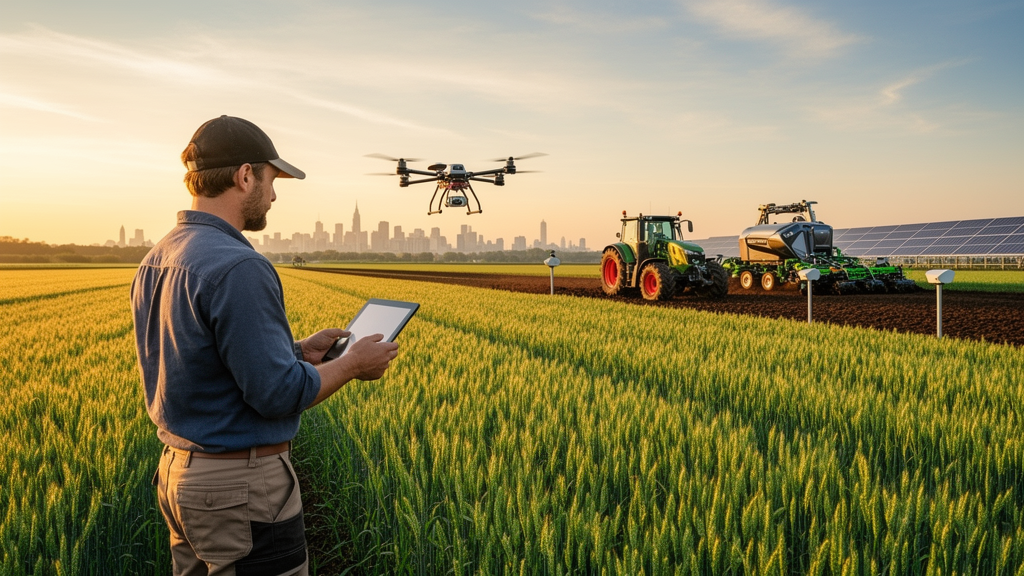
Digital agriculture has been heralded as one of the most powerful levers for building a green economy: sensors, satellite data, and farm robotics promise to squeeze more food from every hectare while cutting the chemicals and emissions that agriculture pumps into the environment. But a sweeping new study suggests that this promise comes with a sharp caveat. Analyzing data from roughly 180 countries between 2000 and 2023, researchers report that the environmental benefits of digital farming technologies are strongly conditional on national wealth. In economically advanced countries, smart farming appears to reduce emissions and optimize pesticide use; in poorer regions, the very same technologies can intensify production and actually increase environmental harm.
The study, published in Frontiers in Sustainable Food Systems, was conducted by Botond Géza Kálmán of John von Neumann University in Hungary, together with Zsuzsanna Szeiner of J. Selye University and Szilvia Valéria Módosné Szalai of Széchenyi István University. The team assembled a panel of 415 country-year observations, drawing greenhouse gas emissions data from the EDGAR database maintained by the European Commission’s Joint Research Centre and the Netherlands Environmental Assessment Agency, pesticide statistics from FAOSTAT, and digitalization measures from the United Nations’ e-government and telecommunications indices. A qualitative case study of Latin American agriculture complemented the statistical work.
The researchers framed their investigation around five hypotheses rooted in established theory. The Environmental Kuznets Curve hypothesis predicts that environmental degradation first rises and then falls with income as countries become capable of adopting cleaner technologies. Innovation diffusion theory adds that new technologies spread fastest where infrastructure and institutions are ready for them. Together, these frameworks imply that digital agriculture should deliver its greenest results in countries that already have robust digital networks, capital to invest, and the institutional capacity to steer technology toward sustainability.
The first statistical test strongly supported this logic. Spearman correlation analysis revealed a near-perfect association between the Online Services Index and the Telecommunication Infrastructure Index (a correlation coefficient of 0.954), and moderate-to-strong positive correlations of roughly 0.62 to 0.65 between these general digital infrastructure measures and the market values of smart farming equipment and agricultural robots. Countries with better connectivity and online services, in other words, are far more likely to embrace digital agriculture. Investment in smart farming was also linked to better economic performance in the agricultural sector, supporting the idea that these technologies raise productivity and resource-use efficiency.
The environmental results were more sobering. Regression models treating greenhouse gas emissions as the dependent variable produced a positive and statistically significant coefficient on smart farming investment, meaning that greater digital agricultural investment was associated with higher emissions across the full dataset. The same held for pesticides: the coefficient linking smart farming investment to pesticide use was positive and significant. On the face of it, this contradicts the widely repeated claim that precision agriculture automatically shrinks agriculture’s environmental footprint.
But a crucial interaction term changed the story. When the researchers multiplied smart farming investment by GDP, the interaction was negative and significant for both emissions and pesticide use. This means the relationship flips as national income rises: in wealthier economies, digital agriculture is associated with reduced emissions and optimized pesticide application, while in poorer ones, digitalization tends to accompany more intensive production and heavier input use. The pattern is consistent with a rebound effect, in which efficiency gains lower the effective cost of production and encourage expansion that erodes, or even reverses, the environmental savings. It also echoes earlier findings that precision spraying can sometimes increase total pesticide volumes when it enables more frequent, targeted treatments on intensifying farms.
To map these dynamics globally, the team applied K-means clustering to standardized variables including GDP, the digitalization indices, emissions, and pesticide use. The analysis revealed six distinct country profiles. The poorest cluster, with average GDP around 33 billion US dollars and weak digital infrastructure, showed low emissions and pesticide use, largely because industrial activity is limited. Two clusters of highly developed economies, averaging 4 to 5.3 trillion dollars in GDP, combined high digitalization with high emissions and heavy pesticide use, exposing the environmental costs of industrialized farming even in rich nations. Strikingly, one cluster of low-GDP countries with strong digitalization achieved moderate emissions and pesticide intensity, suggesting that technology can help mitigate environmental impacts even at modest income levels. The best-balanced group consisted of developed countries that pair high digital scores with moderate emissions and low-to-moderate pesticide use, apparently deploying digital tools sustainably. Dispersion measures confirmed enormous inequality across clusters in GDP, emissions, and pesticide use.
The Latin American case study added regional texture. Smart agriculture companies in the region are projected to nearly double by 2030, driven by precision farming, Internet of Things devices, and analytics designed to optimize fertilizers and water. Emissions are forecast to decline modestly, from about 141,488 kilotonnes of CO2 equivalent in 2020 to roughly 133,160 kilotonnes by 2030. Yet the correlation between smart agriculture and emissions in the region was weak and not statistically significant, and pesticide use is projected to climb from 47,197 tonnes in 2020 to more than 52,000 tonnes by 2030. The takeaway, the authors suggest, is that technology alone cannot deliver dramatic emission cuts without broader sustainability policies such as integrated pest management.
Methodologically, the study is exploratory rather than causal. The authors imputed missing values using a decision tree regressor, which captures non-linear relationships better than simple mean substitution, and standardized all variables before clustering. They are candid about limitations: the regression results should be read as correlations, since economic development may simultaneously drive both digital infrastructure and environmental performance, and globally consistent control variables such as agricultural land area, energy use, and population density could not be included for the entire period. Of the five hypotheses tested, three were confirmed, one was partially confirmed, and the pesticide hypothesis was rejected outright.
The implications are pointed. Digital infrastructure, the study concludes, is not sufficient for sustainable agriculture; it must be paired with environmental policy tailored to each country’s economic circumstances. High-income nations need regulations that offset the intensified production their digital farms enable, while low- and middle-income countries require financial and technical support to access the benefits of digital agriculture without simply amplifying input use. The researchers recommend targeted infrastructure investment in less digitalized regions, stricter emissions standards in high-emission clusters, international cooperation for economies in transition, and the promotion of integrated pest management wherever digitalization is expanding. If the green economy is to be built on data as well as soil, the findings suggest, equity in access to digital tools may matter as much as the tools themselves.
Subject of Research: How digital agriculture affects greenhouse gas emissions, pesticide use, and productivity across countries of different economic development
Article Title: The impact of digital technology on green economies
Article References: Kálmán, B. G., Szeiner, Z., & Módosné Szalai, S. V. (2026). The impact of digital technology on green economies. Frontiers in Sustainable Food Systems, 10, Article 1787960. https://doi.org/10.3389/fsufs.2026.1787960
Image Credits: AI Generated
DOI: 10.3389/fsufs.2026.1787960
Keywords: digital agriculture, precision farming, green economy, greenhouse gas emissions, pesticide use, smart farming, digital divide, Environmental Kuznets Curve, rebound effect, sustainable intensification, cluster analysis, Latin America
Cite Scienmag News
Alan Morgan. (October 15, 2026). Digital Farming Cuts Emissions Only Where Economies Can Afford It. Scienmag. https://scienmag.com/digital-farming-cuts-emissions-only-where-economies-can-afford-it/
Alan Morgan. "Digital Farming Cuts Emissions Only Where Economies Can Afford It." Scienmag, 15 October 2026, https://scienmag.com/digital-farming-cuts-emissions-only-where-economies-can-afford-it/. Accessed 15 October 2026.
Alan Morgan. "Digital Farming Cuts Emissions Only Where Economies Can Afford It." Scienmag. October 15, 2026. https://scienmag.com/digital-farming-cuts-emissions-only-where-economies-can-afford-it/


