


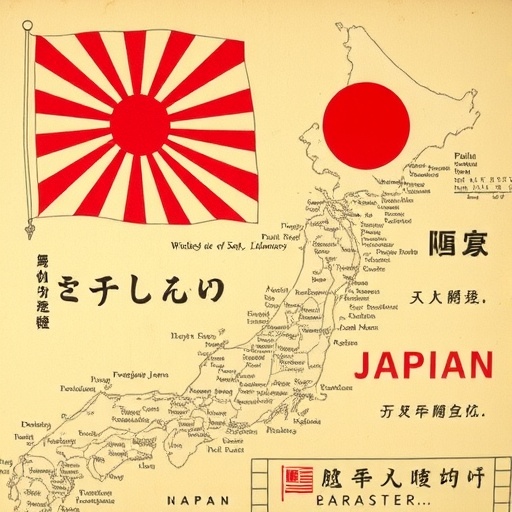
In a groundbreaking study published in PLOS One, researchers from Tokyo University of Science have unveiled a novel linguistic method to track surges in exclusionary nationalism by analyzing prewar Japanese newspapers. This approach sheds light on the complex evolution of nationalist sentiment in Japan between 1912 and 1943, revealing fluctuations rather than a linear rise leading up to World War II.
Exclusionary nationalism, the ideology asserting the superiority of one’s nation while marginalizing others, often manifests in language. The team led by Associate Professor Tomoko Matsumoto scrutinized over 300,000 Japanese newspaper articles to track how foreign place names were represented linguistically. Specifically, they examined the use of katakana, a phonetic script used for foreign words, versus ateji, a kanji-based transliteration method that phonetically adapts foreign names into traditional Chinese characters.
The significance of this research lies in the Japanese writing system’s unique ability to clearly differentiate native from foreign words. This allowed the researchers to use the preference for ateji over katakana as a proxy for rising nationalist resistance to foreign influence. The statistical tool singular spectrum transformation enabled them to monitor monthly shifts in writing styles, with a focus on countries that later became Japan’s allies (Germany and Italy) and enemies (the United States and United Kingdom).
Findings indicate that nationalist attitudes were not simply on an upward trajectory but ebbed and flowed, coinciding with major political developments such as the military coups of 1932 and 1936, withdrawal from the League of Nations in 1933, and Japan’s National Mobilization Law in 1938. Notably, the use of katakana for German and Italian place names remained prevalent, highlighting Japan’s nuanced perception of allies versus enemies well before wartime hostilities commenced.
This study demonstrates how subtle shifts in language usage serve as early indicators of societal divisions and international conflict, offering a powerful tool where traditional public opinion data may be absent. Through quantitative linguistic analysis, it becomes possible to detect the early formation of exclusionary ideologies, providing a potential early warning system for emerging geopolitical tensions.
Moreover, these results emphasize the importance of computational linguistics and political science collaboration in historical and contemporary contexts. As nations grapple with rising nationalism today, tracking language patterns in media and social platforms could help policymakers and researchers anticipate and potentially mitigate conflict.
Professor Matsumoto concludes, “Our methodology quantifies the intangible shifts in nationalism as reflected in everyday language, offering insights into the complex dynamics of friend–enemy distinctions during fraught political times.” This innovative approach opens new avenues for interdisciplinary research into the interplay between language, identity, and conflict worldwide.
Cite Scienmag News
Courtney Benton. (July 14, 2026). Detecting Exclusionary Nationalism in Prewar Japan Through Language Analysis. Scienmag. https://scienmag.com/detecting-exclusionary-nationalism-in-prewar-japan-through-language-analysis/
Courtney Benton. "Detecting Exclusionary Nationalism in Prewar Japan Through Language Analysis." Scienmag, 14 July 2026, https://scienmag.com/detecting-exclusionary-nationalism-in-prewar-japan-through-language-analysis/. Accessed 4 September 2026.
Courtney Benton. "Detecting Exclusionary Nationalism in Prewar Japan Through Language Analysis." Scienmag. July 14, 2026. https://scienmag.com/detecting-exclusionary-nationalism-in-prewar-japan-through-language-analysis/


