


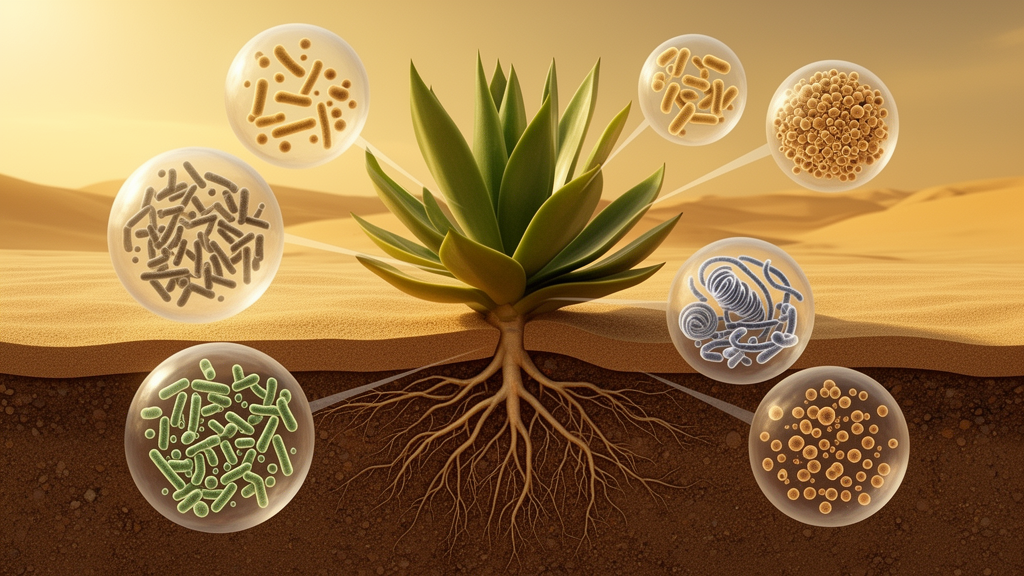
Deep in the semi-arid landscapes of Morocco, a desert plant known as Citrullus colocynthis, or colocynth, survives conditions that would kill most crops. New research published in Microbial Ecology reveals that this resilience is not the plant’s achievement alone. A team led by Khadija Ait Si Mhand and Mohamed Hijri at the African Genome Center of University Mohammed VI Polytechnic has mapped the bacterial communities living in the plant’s leaves, roots, and surrounding soil, uncovering a structured and functionally diverse bacteriome that appears tailored to life under drought, heat, salinity, and nutrient scarcity.
The study combined three complementary approaches: 16S rRNA gene amplicon sequencing to profile bacterial diversity, culture-dependent isolation to recover living bacteria from plant tissues, and genome-informed functional profiling of selected tissue-associated isolates. This triad allowed the researchers to move beyond simple taxonomic lists and ask what these desert-adapted bacteria might actually be doing for their host. The results show strong compartmentalization, meaning each plant compartment hosts a distinct bacterial community with its own composition and potential functions.
Diversity followed a clear gradient. The rhizospheric soil, the thin layer of soil directly influenced by roots, harbored the highest bacterial diversity, followed by the roots themselves, with the foliar tissues hosting the least diverse communities. This pattern mirrors what microbiologists observe in many plants, where the soil acts as a vast microbial reservoir and the plant progressively filters that reservoir as microbes move inward. Across all compartments, four bacterial phyla dominated: Pseudomonadota, Actinomycetota, Bacillota, and Bacteroidota, groups well known for their roles in plant colonization, nutrient cycling, and stress adaptation.
Several bacterial families showed compartment-specific enrichment, a signal that particular lineages are being selected for particular niches within the plant. Families enriched in roots may contribute to nutrient acquisition and root colonization, while those enriched in foliar tissues may help the plant cope with intense solar radiation and water loss. The researchers interpret these enrichment patterns as consistent with roles in plant colonization, nutrient cycling, and stress adaptation, though they emphasize that functional confirmation requires future experimental evaluation.
A key finding concerns what shapes these communities in the first place. Soil physicochemical properties were significantly associated with bacterial community composition, but they explained only part of the observed variation. The remaining variation points to host-mediated selection, the idea that the plant itself actively curates which microbes it associates with in each compartment. In other words, the desert colocynth is not a passive container for whatever bacteria drift by; it appears to assemble its own microbiome, choosing partners that may help it endure its harsh environment.
Cultivation recovered diverse bacteria from root and foliar tissues, mainly belonging to the genera Achromobacter, Pseudomonas, and Glutamicibacter. Most of these cultured isolates were also detected by amplicon sequencing, an important cross-validation that suggests the cultured strains genuinely represent the plant-associated community rather than laboratory contaminants. This congruence between culture-dependent and culture-independent methods strengthens confidence that the recovered strains are authentic members of the C. colocynthis bacteriome.
Genomic analyses of these tissue-associated isolates identified a suite of traits associated with stress tolerance, osmoprotection, nutrient acquisition, colonization, and plant growth promotion. Osmoprotective mechanisms, for example, help bacteria maintain cellular integrity under extreme water limitation, and similar traits can benefit host plants when microbes are closely associated with roots or leaves. Nutrient acquisition traits may include mechanisms for solubilizing or mobilizing limiting elements, while colonization traits enable bacteria to persist on or within plant tissues over time. Together, these genomic signatures suggest the isolates carry functional potential relevant to agriculture in water-limited regions.
The implications extend beyond basic microbial ecology. As climate change intensifies drought and heat stress in agricultural systems worldwide, researchers are increasingly looking to desert-adapted plants as sources of beneficial microorganisms for crop improvement. The authors highlight C. colocynthis as a promising source of such microorganisms for future experimental evaluation under water-limited conditions. If strains like the Pseudomonas, Achromobacter, and Glutamicibacter isolates characterized here prove effective when applied to crops, they could contribute to bioinoculant development aimed at improving drought resilience and nutrient use efficiency in semi-arid farming systems.
The research also contributes to a growing body of work on plant microbiome assembly in extreme environments. By demonstrating that soil properties alone cannot explain community structure, the study adds weight to the view that host genetics and host physiology play decisive roles in microbiome assembly, even in plants growing under severe abiotic stress. The compartment-specific enrichment patterns documented here provide a framework for future studies seeking to identify which bacterial lineages are genuinely beneficial and which are simply passengers. As the authors note, the next step is experimental evaluation of these strains under controlled water-limited conditions, work that could transform a desert plant’s hidden bacterial allies into tools for sustainable agriculture.
Subject of Research: Microbial Ecology
Article Title: Compartment-Specific Bacterial Communities and Their Functional Potential in the Desert Plant Citrullus colocynthis
Article References: Compartment-Specific Bacterial Communities and Their Functional Potential in the Desert Plant Citrullus colocynthis. (n.d.). https://doi.org/10.1007/s00248-026-02905-0
Image Credits: AI Generated
DOI: 10.1007/s00248-026-02905-0
Keywords: Citrullus colocynthis, plant microbiome, desert bacteria, drought adaptation, 16S rRNA sequencing, semi-arid agriculture, Compartment-Specific, Bacterial, Communities, Functional, Potential, Desert
Cite Scienmag News
Morgan Morrow. (October 16, 2026). Desert Plant’s Hidden Bacterial Allies Revealed in Compartment-Specific Microbiome Study. Scienmag. https://scienmag.com/desert-plants-hidden-bacterial-allies-revealed-in-compartment-specific-microbiome-study/
Morgan Morrow. "Desert Plant’s Hidden Bacterial Allies Revealed in Compartment-Specific Microbiome Study." Scienmag, 16 October 2026, https://scienmag.com/desert-plants-hidden-bacterial-allies-revealed-in-compartment-specific-microbiome-study/. Accessed 16 October 2026.
Morgan Morrow. "Desert Plant’s Hidden Bacterial Allies Revealed in Compartment-Specific Microbiome Study." Scienmag. October 16, 2026. https://scienmag.com/desert-plants-hidden-bacterial-allies-revealed-in-compartment-specific-microbiome-study/


