


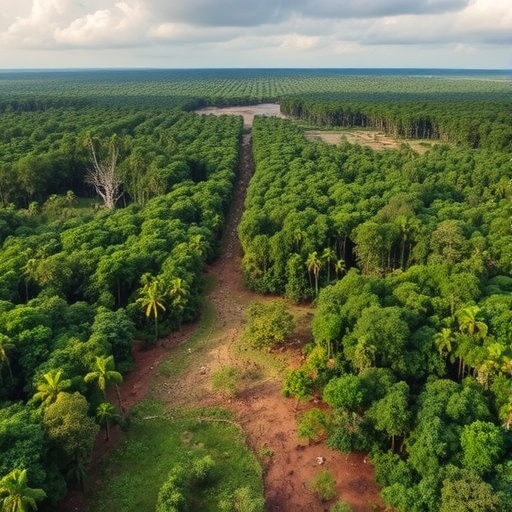
In a ground-breaking study published recently in Nature, researchers have revealed how deforestation is intricately linked to accelerating drying in the Amazon rainforest, pushing this critical ecosystem closer to a tipping point than previously understood. Using advanced atmospheric moisture tracking and sophisticated dynamical models, the study uncovers the hidden mechanisms by which human activities and climate-driven changes are eroding the resilience of the world’s largest tropical forest.
The team applied UTrack, a novel Lagrangian moisture tracking model, to follow moisture parcels as they move from evaporation sources to precipitation sinks through the three-dimensional atmosphere. Unlike conventional Eulerian models that only assess fixed grid points, UTrack simulates the trajectories of individual moisture parcels, offering an unprecedented resolution to understand moisture recycling within the Amazon basin under future climate scenarios outlined by the Shared Socioeconomic Pathways (SSPs). This approach allowed them to capture a detailed moisture flow network, crucial for assessing the forest’s stability.
Environmental forcing data was sourced from NorESM2, a medium-resolution Earth system model that has demonstrated robust performance in replicating historical hydrological patterns. By releasing over a billion moisture parcels across 416 grid cells monthly, and updating their positions every four hours, the study portrayed a highly dynamic and finely resolved moisture cycle. This meticulous tracking revealed how deforestation disrupts local and downwind moisture flows, compounding drought stress and hastening shifts in forest states.
Crucially, the study embeds local climatic adaptation of forests into its analytical framework. Unlike static thresholds, the forests’ adaptive capacities were estimated based on historical precipitation and drought variability from 1950 to 2014. This nuanced approach acknowledges that regions already accustomed to dry conditions have evolved higher resilience to moisture deficits, while wetter zones remain more vulnerable. This adaptive context allowed the researchers to derive conservative but realistic critical water availability thresholds tied to each forest cell’s historical climate.
Central to their analysis is a simplified but powerful nonlinear dynamical systems model representing each grid cell as a bistable system capable of existing in either a forested or degraded state. The model integrates local hydroclimatic variables—mean annual precipitation and moisture cumulative water deficit—and the moisture recycling network to simulate potential tipping points. When local drying exceeds adaptive thresholds and stabilizing moisture inputs wane, cells can abruptly transition to savanna-like or degraded conditions. These transitions are not isolated; instead, they can propagate as cascading effects through the moisture network, magnifying the risk of large-scale biome shifts.
The researchers conducted extensive robustness checks, confirming that their main conclusions hold under varying assumptions about local adaptive capacities, threshold formulations, evapotranspiration constraints, and the extent of moisture recycling after deforestation. Notably, even conservative scenarios assuming secondary vegetation maintains some evapotranspiration reveal similar risks, highlighting the robustness of the forest’s vulnerability under climate warming combined with deforestation pressures.
Deforestation scenarios considered include a severe pathway extending current regional trends and infrastructure-driven clearances, projecting that by 2050, up to 35% of the Amazon basin could be lost. This substantial forest loss magnifies regional drying by reducing evapotranspiration—a key moisture source for rain formation—and weakens downwind precipitation, risking a feedback loop that lowers climate thresholds for forest persistence.
The temporal horizon of analysis spans this century, with a focus on decadal averages to detect long-term climatic signals relevant to ecosystem transitions, rather than ephemeral drought years. This perspective aligns with ecological understanding that Amazonian forests respond primarily to persistent stress over multi-year periods, reinforcing the relevance of the findings for anticipating future biome shifts.
Beyond local thresholds, the study highlights the interconnectedness of the Amazon basin through moisture recycling, underlining how localized forest loss can propagate destabilization across distant regions. This supports the conceptualization of the Amazon as a network of interacting tipping elements, where loss of stabilizing atmospheric moisture in one area cascades, threatening the wider system’s integrity.
The implications of these findings extend to global climate mitigation and adaptation strategies. The Amazon’s resilience or collapse has profound consequences for carbon sequestration, biodiversity, and regional weather patterns affecting agriculture and water security for millions. This research emphasizes that unchecked deforestation not only depletes forest area but also amplifies the climatic stressors pushing the biome across critical thresholds.
Researchers propose that incorporating these mechanistic insights into Earth system models could enhance their predictive fidelity, enabling more effective policy interventions. Improved understanding of moisture recycling’s role in forest stability urges stronger integration of land use management with climate resilience planning, prioritizing the preservation of moisture sources to buffer the Amazon’s climate tipping risk.
As global temperatures rise, the planetary imperative to protect and restore the Amazon becomes ever more urgent. This study provides a stark warning that deforestation-driven drying undermines the forest’s capacity to adapt, lowering climate safety margins and elevating the risk of a widespread regime shift. Stakeholders must heed the interconnected feedbacks revealed, adopting holistic strategies to avoid pushing one of Earth’s most vital ecosystems beyond the point of no return.
Cite Scienmag News
Denise Maddox. (May 7, 2026). Deforestation Lowers Amazon’s Climate Stability Threshold. Scienmag. https://scienmag.com/deforestation-lowers-amazons-climate-stability-threshold/
Denise Maddox. "Deforestation Lowers Amazon’s Climate Stability Threshold." Scienmag, 7 May 2026, https://scienmag.com/deforestation-lowers-amazons-climate-stability-threshold/. Accessed 4 September 2026.
Denise Maddox. "Deforestation Lowers Amazon’s Climate Stability Threshold." Scienmag. May 7, 2026. https://scienmag.com/deforestation-lowers-amazons-climate-stability-threshold/


