


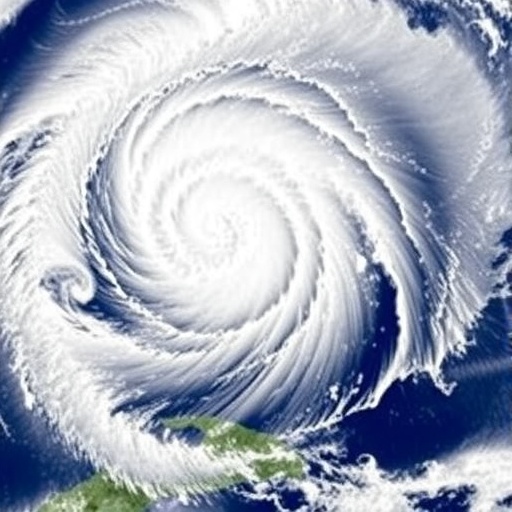
In a groundbreaking study published in Nature Communications in 2026, researchers Ni, Zhang, and Wang have unveiled a previously underappreciated driver behind the annual maximum lifetime maximum intensity (LMI) of tropical cyclones in the western North Pacific: a subsurface oceanic signal acting as a messenger from the depths. This discovery offers a transformative perspective on the predictability of some of the world’s most destructive storms, potentially revolutionizing the early warning systems and strategies for disaster preparedness in regions vulnerable to typhoons.
Tropical cyclones, known in the Pacific as typhoons, derive their immense energy from the heat stored in the ocean surface layers. Traditionally, forecasting their intensity has relied heavily on surface temperature measurements, atmospheric pressure patterns, and prevailing wind conditions. However, despite decades of advancements in meteorological modeling, predictions of the maximum intensity that these storms reach remain notoriously uncertain. The new research by Ni and colleagues delves beneath the ocean’s surface to investigate how subsurface temperature anomalies can act as precursors, influencing the amount of energy available to storms months in advance.
The concept of a “subsurface messenger” relates to variations in the heat content below the ocean’s surface, which propagate slowly through ocean dynamics and can significantly affect surface conditions later on. In their comprehensive analysis, Ni and co-authors utilized high-resolution oceanographic data combined with sophisticated coupled atmosphere-ocean models to reveal a recurrent subsurface temperature pattern in the western North Pacific. This pattern, characterized by warm anomalies deep beneath the sea surface, was found to anticipate the annual peak intensity of tropical cyclones in the region.
What makes this discovery particularly exciting is the lead time it affords for forecasting. Whereas surface temperature anomalies can vary rapidly and are susceptible to atmospheric disturbances, subsurface thermal signals evolve more gradually, providing a more stable and persistent indicator. By tracking these subsurface anomalies, forecasters may gain critical insights into the energy reservoir that storms will tap into during their development, potentially extending reliable intensity forecasts by several months before a cyclone’s landfall.
The methodological approach of the study was meticulous. Employing a blend of satellite-derived ocean temperature profiles, buoy data, and reanalyzed historical cyclone intensity records, the research team correlated the subsurface heat content with observed tropical cyclone intensity metrics. Their data-driven models exhibited a robust correlation, even when controlling for atmospheric variables such as wind shear and humidity. The persistence of the subsurface heat anomalies emerged as a dominant factor influencing the maximum intensity trajectories of typhoons across multiple seasons.
Understanding the ocean’s thermal structure beneath the surface layers involves exploring the thermocline and the deeper ocean strata. These layers act as thermal buffers and can influence the surface ocean temperature over time through vertical mixing and upwelling processes. In the western North Pacific, where typhoons frequently track and intensify, the dynamic interplay of ocean currents and heat content has been notoriously complex and difficult to predict—until now. The identification of a subsurface thermal messenger simplifies this complexity into a measurable signal with direct predictive relevance.
The implications of this research stretch beyond forecasting improvements. Given that tropical cyclone intensities are increasing globally due to climate change, with more intense storms causing catastrophic damage to coastal infrastructure and ecosystems, improved prediction models are paramount for mitigation planning. Ni and colleagues suggest that incorporating subsurface oceanic data into operational forecasting systems could enable governments and disaster response agencies to allocate resources more effectively, improving resilience and reducing casualties.
Moreover, this discovery bridges a knowledge gap between oceanography and meteorology, highlighting the necessity of interdisciplinary approaches in climate science. It prompts a reevaluation of long-held assumptions that primarily surface data governs cyclone intensification. Instead, the subsurface thermal environment now takes center stage as a key regulator, influencing the energy available for storms long before they form or intensify.
Future research directions, as indicated by the authors, involve refining the spatial and temporal resolution of subsurface thermal measurements. With advancements in autonomous underwater vehicles and improved satellite remote sensing capabilities, scientists can expect to monitor these subsurface heat signals in near-real-time, enabling more accurate forecasting models. Additionally, expanding the study to other ocean basins could validate whether similar mechanisms operate globally, potentially revolutionizing tropical cyclone forecasts in the Atlantic, Indian Ocean, and beyond.
The study also emphasizes the importance of continuous long-term ocean observation networks. The gradual nature of subsurface temperature changes necessitates persistent monitoring rather than episodic measurements. Current oceanographic arrays, such as Argo floats, proved invaluable in this research but may require enhancements in density and depth profiling to optimize data collection for cyclone prediction purposes.
By illuminating the pathway of subsurface heat anomalies as a messenger, Ni, Zhang, and Wang have opened new horizons in understanding the life cycle and behavior of tropical cyclones. Their findings imply that the subsurface ocean is not merely a passive reservoir but an active participant in shaping storm dynamics, providing an oceanic memory of past climatic conditions that forecast future storm intensity.
This breakthrough also has the potential to integrate with machine learning and artificial intelligence frameworks, where complex patterns in multidimensional ocean data can be harnessed to generate probabilistic forecasts of cyclone intensity. Such integration could lead to a new paradigm in natural disaster forecasting, combining traditional meteorological parameters with deep oceanic insights to achieve unprecedented accuracy and lead time.
In regions such as Japan, the Philippines, Taiwan, and coastal China, where typhoons cause recurrent devastation, the value of this research cannot be overstated. Early detection of potential intensity may allow for timely evacuation orders, infrastructure fortification, and resource mobilization, mitigating economic losses and saving countless lives.
In conclusion, the elucidation of subsurface heat content as a messenger heralds a transformative era in tropical cyclone science. Ni and colleagues provide compelling evidence that beneath the ocean surface lies a predictive signal of storm intensity that might finally bridge the gap between meteorological uncertainties and real-world forecasting needs. This study sets a precedent for harnessing the deep ocean’s hidden knowledge to protect vulnerable communities from the growing threat of climate-enhanced tropical cyclones.
Cite Scienmag News
Violet Maxwell. (May 7, 2026). Record-Breaking Lifetime Intensity of Western Pacific Cyclones. Scienmag. https://scienmag.com/record-breaking-lifetime-intensity-of-western-pacific-cyclones/
Violet Maxwell. "Record-Breaking Lifetime Intensity of Western Pacific Cyclones." Scienmag, 7 May 2026, https://scienmag.com/record-breaking-lifetime-intensity-of-western-pacific-cyclones/. Accessed 3 September 2026.
Violet Maxwell. "Record-Breaking Lifetime Intensity of Western Pacific Cyclones." Scienmag. May 7, 2026. https://scienmag.com/record-breaking-lifetime-intensity-of-western-pacific-cyclones/


