


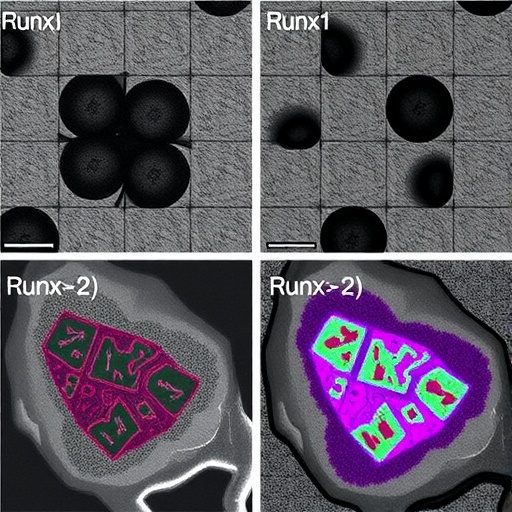
In a groundbreaking study published in the British Journal of Cancer, researchers have uncovered a critical cooperation between two transcription factors, Runx1 and Runx2, in suppressing mammary tumourigenesis driven by the Wnt/β-catenin signaling pathway. This discovery sheds light on the complex molecular interplay governing breast cancer development and offers promising directions for future therapeutic interventions targeting one of the most aggressive and prevalent cancers affecting women worldwide.
The Wnt/β-catenin pathway has long been recognized as a pivotal player in cell proliferation, differentiation, and tumorigenesis across various tissues, including the mammary gland. Aberrant activation of this signaling cascade is a hallmark of many cancers, often correlating with poor prognosis and resistance to conventional therapies. Although previous studies have identified multiple regulators of this pathway, the precise mechanisms by which tumor suppressors like Runx1 and Runx2 mitigate Wnt/β-catenin-driven oncogenesis remained poorly understood until now.
Runx1 and Runx2 are members of the Runt-related transcription factor family, which are integral to controlling gene expression programs involved in development and cellular homeostasis. While Runx1 is predominantly studied for its role in hematopoiesis and leukemia, and Runx2 is widely known for its critical function in bone formation and osteogenesis, emerging evidence has implicated both in cancer biology, especially in breast tissue. However, this study is pioneering in detailing their concerted action to restrain mammary tumorigenesis triggered by hyperactive Wnt/β-catenin signaling.
Through a combination of in vivo mouse models genetically engineered to manipulate expression levels of Runx1, Runx2, and components of the Wnt pathway, alongside sophisticated molecular and histopathological analyses, the researchers demonstrated that loss of either Runx1 or Runx2 substantially exacerbates mammary tumor development. Strikingly, when both transcription factors were simultaneously deficient, the acceleration of tumorigenesis was even more pronounced, underscoring a synergistic tumor suppressor function in breast tissue.
These findings indicate that Runx1 and Runx2 collaboratively orchestrate a transcriptional network that antagonizes Wnt/β-catenin signaling. Mechanistically, the team elucidated that Runx1 and Runx2 bind to and repress the promoters of several Wnt target genes known to promote oncogenic proliferation and survival. Additionally, the study revealed direct physical interactions between these Runx factors and β-catenin, hinting at a multifaceted regulatory mechanism where Runx proteins might sequester β-catenin away from activating transcription.
Beyond gene repression, Runx1 and Runx2 were found to influence chromatin architecture, modifying epigenetic marks at Wnt-responsive loci to maintain an anti-tumorigenic environment. This epigenetic modulation appears critical for sustaining cellular differentiation states resistant to malignant transformation. Consequently, the absence of these transcription factors unleashed a transcriptional program conducive to stemness and EMT (epithelial-to-mesenchymal transition), processes often associated with aggressive tumor phenotypes.
Importantly, the translational relevance of these findings extends toward therapeutic development. The researchers proposed that restoring or mimicking Runx1/2 function could serve as a novel strategy to curb Wnt-driven mammary cancers, which are frequently refractory to existing treatments such as hormone therapy and chemotherapy. The study opens avenues to design small molecules or gene therapies capable of enhancing the tumor-suppressive activities of Runx proteins or stabilizing their interactions with β-catenin.
The implications also suggest a need for deeper investigation into the roles of Runx family members in breast cancer subtypes, as Wnt/β-catenin activation profiles vary widely across luminal and basal-like tumors. Stratifying patients based on Runx1/2 expression and Wnt pathway status could refine prognostic tools and personalize treatment plans. Moreover, biomarkers derived from these transcription factors’ regulatory networks might enable earlier detection and intervention.
This research also prompts a re-examination of Runx proteins beyond breast cancer, considering whether their cooperative suppression of Wnt signaling represents a generalized mechanism across different tissues and malignancies. Such insights could revolutionize our understanding of cancer biology and interconnect developmental pathways with tumorigenesis, highlighting transcription factors as master regulators and potential Achilles’ heels.
Technologically, the integrative approaches employed—including genome-wide chromatin immunoprecipitation sequencing (ChIP-seq), RNA sequencing, and precise genetic manipulations—exemplify the power of combining functional genomics with animal models. These methods were essential to dissect the contextual and dynamic functions of Runx1 and Runx2 in the tumor milieu, underscoring the importance of system-wide analysis in uncovering subtle yet critical biological interactions.
Furthermore, this study addresses a critical gap in cancer research by highlighting transcriptional repression mechanisms active in suppressing oncogenic signaling, contrasting the often emphasized activation pathways in tumorigenesis. The balance between activation and repression mediated by transcription factors like Runx1 and Runx2 creates a nuanced regulatory landscape that governs the cellular decision between normalcy and malignancy.
Taken together, this discovery underscores the intricate molecular dialogue involved in mammary epithelial homeostasis and carcinogenesis. As Runx1 and Runx2 emerge as cooperative gatekeepers restraining a potent oncogenic driver, further research inspired by this study could accelerate the development of targeted therapies that reinstate these natural defenses. This could profoundly impact the management of breast cancer, offering hope to patients through precision medicine that exploits inherent regulatory circuits.
Ultimately, the identification of this Runx-Wnt/β-catenin axis represents a paradigm shift, redefining how transcription factors act not merely as isolated entities but as collaborative networks finely tuning cellular outcomes. The findings urge the scientific community to explore transcription factor partnerships more broadly and consider multi-target strategies that restore complex regulatory systems disrupted in cancer.
As breast cancer remains a formidable challenge globally, insights such as these highlight the indispensable role of fundamental research in paving the way for transformative clinical advances. With ongoing efforts to unravel the molecular intricacies of tumor suppressors like Runx1 and Runx2, the future of oncological therapeutics looks increasingly promising, offering new hope against this pervasive disease.
Cite Scienmag News
Nathaniel Bowman. (May 7, 2026). Runx1 and Runx2 Jointly Suppress Mammary Tumors. Scienmag. https://scienmag.com/runx1-and-runx2-jointly-suppress-mammary-tumors/
Nathaniel Bowman. "Runx1 and Runx2 Jointly Suppress Mammary Tumors." Scienmag, 7 May 2026, https://scienmag.com/runx1-and-runx2-jointly-suppress-mammary-tumors/. Accessed 4 September 2026.
Nathaniel Bowman. "Runx1 and Runx2 Jointly Suppress Mammary Tumors." Scienmag. May 7, 2026. https://scienmag.com/runx1-and-runx2-jointly-suppress-mammary-tumors/


