


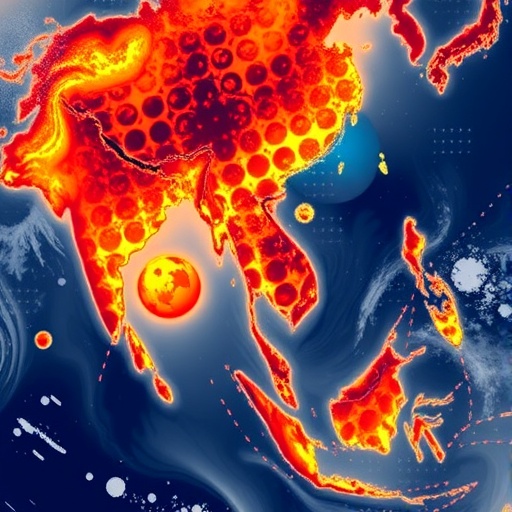
In the summer of 2023, East Asia, encompassing Japan and its neighboring regions, endured an extraordinary climatic phenomenon characterized by record-breaking heat and intensifying humidity levels. Concurrently, the surrounding seas experienced unprecedented marine heatwaves, marking one of the most severe oceanic thermal anomalies recorded in recent history. This synchronous occurrence of atmospheric and marine heat extremes has captivated climatologists and meteorologists worldwide, raising profound questions about the interconnected mechanisms driving these parallel events and the extent of the marine influence on terrestrial heatwaves.
Researchers from the University of Tsukuba undertook a rigorous investigation into the nexus between unprecedented marine heatwaves and land-based atmospheric heatwaves during this period. Employing advanced regional atmospheric modeling techniques, their study meticulously simulated the 2023 climatic events, isolating the impacts of oceanic thermal anomalies on air temperature and humidity across East Asia. Their findings elucidate a complex but critical amplification mechanism whereby elevated sea surface temperatures significantly intensified atmospheric heatwaves, exacerbating the summer heat crisis experienced across the region.
The study demonstrated that the marine heatwave not only elevated surface temperatures over the adjacent landmasses but also increased atmospheric moisture content, resulting in heightened humidity. This dual augmentation of heat and humidity compounded the discomfort and danger posed by the already abnormal heatwave conditions. Importantly, the researchers found that this amplification effect was distinct and additive to the influence of anomalous large-scale atmospheric circulation patterns, which traditionally drive heatwave development.
At the heart of the amplification process lies nuanced interactions between oceanic thermal anomalies and atmospheric dynamics involving cloud cover and water vapor. The marine heatwave altered prevailing patterns of cloud formation and dissipation in the atmospheric boundary layer. By modulating cloud cover, the anomalies facilitated enhanced solar radiation penetration to the earth’s surface, further increasing temperatures. Concurrently, increased water vapor from the warm seas augmented greenhouse effects locally, creating a feedback loop that sustained and intensified atmospheric heatwave conditions.
East Asia’s unique summer climate—characterized by abundant clouds and elevated moisture levels—proved particularly susceptible to this marine-atmospheric coupling. The rich cloud and water vapor environment acted as an amplifying lens, magnifying the effects of marine heatwaves on land-based temperature extremes. This interplay underscores the critical role of regional climatic characteristics in modulating how oceanic conditions influence terrestrial weather phenomena, beyond the impacts of global atmospheric circulation.
The findings of this research have profound implications for understanding how ongoing trends in ocean warming due to climate change influence extreme weather events on adjacent continents. As sea surface temperatures continue to rise globally, marine heatwaves are becoming increasingly frequent and intense. These oceanic changes not only disrupt marine ecosystems but also possess the capacity to substantially exacerbate terrestrial heat extremes, thereby escalating human health risks, agricultural stress, and infrastructure vulnerabilities across East Asia.
By advancing the understanding of marine heatwave-atmosphere interactions, this study presents new pathways for improving seasonal weather forecasts for East Asia. Incorporating marine thermal anomaly data into atmospheric models could enhance the predictive skill of heatwave forecasts, giving policymakers and the public crucial lead times for heat mitigation strategies and disaster preparedness. This capability is increasingly vital given the escalating frequency and severity of extreme heat events driven by anthropogenic climate change.
Furthermore, the research highlights the imperative to integrate oceanographic observations with atmospheric monitoring in a holistic manner. The feedback mechanisms uncovered between warm seas and atmospheric heatwaves represent a coupling domain that has been underexplored until now. Addressing this data and modeling gap could unlock deeper insights into climate variability and improve resilience planning for coastal and inland urban centers facing climate extremes.
The research was supported by prominent Japanese scientific and environmental agencies including the Ministry of Education, Culture, Sports, Science and Technology (MEXT), Japan Science and Technology Agency, and the Environmental Restoration and Conservation Agency, reflecting the high priority accorded to climate change challenges in the region. The collaborative nature of the study, involving experts from the University of Tsukuba, The University of Tokyo, and the Japan Agency for Marine-Earth Science and Technology, exemplifies the integrative approach necessary to tackle complex climate phenomena.
In sum, the summer of 2023 defied historical norms in East Asia by exhibiting an exceptional synergy between land and marine heatwaves, propelled by escalating ocean temperatures and complex atmospheric interactions. This unprecedented marine heatwave served as a catalyst that significantly exacerbated the terrestrial heatwave, creating a climatic event of profound intensity. The meticulous numerical modeling performed by Japanese researchers provides compelling evidence of the mechanisms amplifying these heatwaves, highlighting pathways by which ocean warming intensifies atmospheric extremes.
As the world’s oceans warm with accumulating greenhouse gases, such intersecting extremes are likely to become more commonplace, posing daunting challenges for climate adaptation. This research stands as a critical alert and an invaluable scientific advance, emphasizing the urgent necessity to deepen our understanding of air-sea interactions and their cascading impacts on human and ecological systems in vulnerable regions such as East Asia.
News Publication Date:
2 September 2025
Web References:
https://doi.org/10.1029/2025AV001673
Cite Scienmag News
Violet Maxwell. (September 26, 2025). Decoding the Record-Breaking 2023 East Asian Summer Heatwave: The Crucial Impact of Unprecedented Marine Heatwaves. Scienmag. https://scienmag.com/decoding-the-record-breaking-2023-east-asian-summer-heatwave-the-crucial-impact-of-unprecedented-marine-heatwaves/
Violet Maxwell. "Decoding the Record-Breaking 2023 East Asian Summer Heatwave: The Crucial Impact of Unprecedented Marine Heatwaves." Scienmag, 26 September 2025, https://scienmag.com/decoding-the-record-breaking-2023-east-asian-summer-heatwave-the-crucial-impact-of-unprecedented-marine-heatwaves/. Accessed 4 September 2026.
Violet Maxwell. "Decoding the Record-Breaking 2023 East Asian Summer Heatwave: The Crucial Impact of Unprecedented Marine Heatwaves." Scienmag. September 26, 2025. https://scienmag.com/decoding-the-record-breaking-2023-east-asian-summer-heatwave-the-crucial-impact-of-unprecedented-marine-heatwaves/


