


In the world of competitive tenpin bowling, where precision and consistency are paramount, scientists have long sought a comprehensive model that accurately predicts the behavior of a bowling ball as it travels down the lane. Despite the sport’s massive popularity—with over 45 million regular participants in the United States alone and millions of dollars at stake in professional tournaments—no unified physical model has until now effectively captured the complex dynamics of a bowling ball’s motion. This scientific gap is finally being bridged by a groundbreaking study published in AIP Advances, where a team of researchers from leading institutions including Princeton, MIT, the University of New Mexico, Loughborough University, and Swarthmore College unveil a detailed physics-based simulation that reveals the optimal strategies for targeting in competitive bowling.
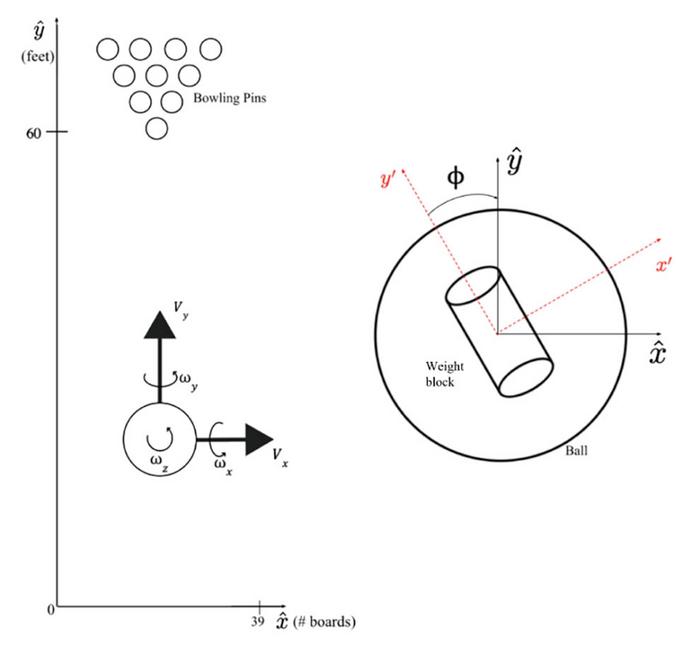
The new model stands apart from previous methods that mainly focused on analyzing the statistics of bowlers’ performances. Traditional predictive approaches have struggled to deliver consistent results when bowlers make slight variations in their throws. Instead of relying solely on player data, the research team employed a rigorous application of physics, specifically Euler’s equations for rotating rigid bodies, to represent the bowling ball’s trajectory. This approach culminated in a set of six coupled differential equations that precisely simulate the rotational dynamics influenced by frictional forces, lane conditions, and ball asymmetries, making it the most detailed and predictive model in this field to date.
One of the key innovations of the model is its incorporation of real-world variables that have eluded simplified treatments in prior studies. A major challenge was accounting for the lane’s surface condition, particularly the application of oil. Bowling lanes are coated with a thin layer of oil to protect the wood and influence ball movement, but the thickness and distribution of this oil layer vary significantly from tournament to tournament and even lane to lane. The oil does not spread uniformly, creating an uneven frictional landscape that directly affects the ball’s path and ultimate success in knocking down pins. This model integrates detailed descriptions of oil patterns, allowing predictions to adapt to the unique conditions of any given competition.
Another complexity addressed by the simulation is the subtle asymmetry of modern bowling balls. Unlike perfect spheres, these balls contain a weight block whose orientation affects their moments of inertia—how they resist rotational acceleration around different axes. Recognizing this nuance, the researchers aligned the model’s coordinate system with the ball’s minimum moment of inertia axis, enabling more precise calculations of how the ball’s spin evolves as it moves down the lane. This level of detail is essential for understanding the nuanced "hook" that expert bowlers achieve, dramatically improving the model’s predictive power over prior methods.
Beyond the physics-driven trajectory, the model also introduces the concept of a “miss-room”—a quantified buffer zone that accounts for human inconsistency. Bowlers invariably have slight inaccuracies in delivery, from release speed to angular orientation. The miss-room allows users to understand how much leeway they have in targeting strategies to still maximize their chances for a strike. This practical addition transforms the model from a purely theoretical exercise into a valuable coaching and training tool, bridging the gap between complex physics and actionable insight for players of all skill levels.
The model’s practical applications extend beyond coaching to equipment manufacturers and tournament designers. By predicting how different bowling balls behave under varied lane conditions, manufacturers can refine ball designs to exploit optimal dynamics. Tournament organizers can tailor lane oil patterns to adjust difficulty strategically or maintain fairness among competitors, informed by hard data rather than guesswork. Such applications have the potential to revolutionize how professional bowling is played and managed worldwide.
Creating this comprehensive model was not without its challenges. Translating the intricate physics into inputs accessible to bowlers required careful abstraction. The researchers prioritized parameters that are measurable with standard bowling accessories, such as speed, spin rate, and initial ball orientation, facilitating real-world usage. This deliberate design foresight enables the model to seamlessly integrate into existing practice routines and analytic technologies without demanding specialized or prohibitive equipment.
Looking ahead, the research team aims to refine their model by incorporating additional environmental factors, such as uneven lane surfaces caused by wear over time or different manufacturing processes. These variables introduce further complexity and unpredictability to ball trajectories, and capturing them would elevate the model’s realism and utility. The researchers also plan close collaborations with professional bowling coaches and equipment specialists to validate model predictions and tailor features to real-world tactical needs.
The implications of this model extend well beyond the bowling alley. It stands as a seminal example of how physics simulations can transform sports strategy by replacing empirical guesswork with scientifically grounded analysis. This interdisciplinary approach, combining applied mathematics, classical mechanics, and material science, demonstrates how even established sports can benefit from fresh insights offered by fundamental physics. Moreover, the open accessibility of the research encourages further innovation and adoption within the global bowling community.
Central to the study is the recognition that accurate prediction in sports must integrate human variability with mechanical precision. By explicitly accounting for how minor adjustments impact outcomes, the model respects the artistry and subtlety of bowling as much as the science. This marriage of human skill and rigorous physical understanding holds promise for enhancing player performance, deepening spectator engagement, and elevating the overall competitive landscape in tenpin bowling.
Ultimately, this research ushers in a new era for bowling, where players and coaches no longer have to rely on intuition alone but can leverage a scientifically derived roadmap for game-winning strategies. The team’s simulation not only predicts ball paths with unprecedented accuracy but also empowers bowlers to customize their approach based on individual strengths and lane idiosyncrasies. As these tools become integrated into training regimens and tournament setups, the sport will likely witness innovative techniques and equipment reshaping competitive bowling dynamics for years to come.
News Publication Date: April 15, 2025.
Web References: https://doi.org/10.1063/5.0247761
Keywords
Sports, Trajectories, Physics
Cite Scienmag News
Bethany Barker. (April 15, 2025). Decoding the Perfect Strike: The Science Behind Ideal Bowling Conditions. Scienmag. https://scienmag.com/decoding-the-perfect-strike-the-science-behind-ideal-bowling-conditions/
Bethany Barker. "Decoding the Perfect Strike: The Science Behind Ideal Bowling Conditions." Scienmag, 15 April 2025, https://scienmag.com/decoding-the-perfect-strike-the-science-behind-ideal-bowling-conditions/. Accessed 3 September 2026.
Bethany Barker. "Decoding the Perfect Strike: The Science Behind Ideal Bowling Conditions." Scienmag. April 15, 2025. https://scienmag.com/decoding-the-perfect-strike-the-science-behind-ideal-bowling-conditions/


