


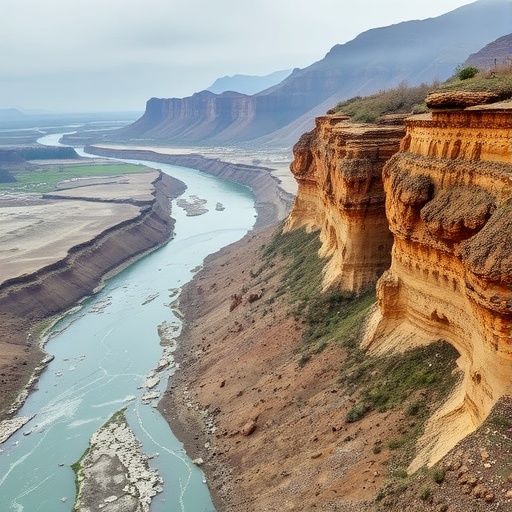
In the hidden layers of river sediment lie powerful narratives of human activity, etched meticulously through decades and centuries. These geological records provide scientists with invaluable chronicles of environmental changes and anthropogenic impacts. A pioneering research team led by Jing Chen of Beijing Normal University has recently decoded one such enduring diary from the Orkhon River Basin in Central Asia, revealing precisely how sprawling economic development and escalating vehicular emissions have progressively infused the river’s sediment with persistent toxic pollutants known as polycyclic aromatic hydrocarbons (PAHs).
Rivers, often perceived solely as conduits of water, serve fundamentally as natural archives, preserving a comprehensive history of surface transformations through the deposition of sediment. These sediment layers act as time capsules, accumulating chemical signatures that correspond to specific periods of human industrial and economic activity. Chen’s group utilized sediment core samples extracted from the Orkhon River Basin to map the temporal distribution of PAHs, chemical compounds produced primarily via the incomplete combustion of coal, petroleum, wood, and fossil fuels.
What sets this investigation apart is the meticulous application of radioisotopic dating methods, particularly leveraging the naturally occurring lead-210 isotope to achieve precise chronological resolution. This approach allowed researchers to construct a time-calibrated chemical profile of the sediment, correlating pollutant concentrations with historical economic data. Such a temporal alignment unveiled a distinct and direct relationship between socio-economic factors — such as GDP growth and population size — and the accrual of toxic chemicals within the sediment matrix.
The complexity of pollutant sources necessitated the use of advanced analytical frameworks. The research team employed sophisticated statistical models, including random forest machine learning algorithms and structural equation modeling, to dissect the multifaceted drivers behind PAH presence. These models parsed through 26 environmental and anthropogenic variables, deciphering the relative contributions of fossil fuel combustion, vehicular emissions, coal burning, and biomass combustion, distinguishing their unique “chemical fingerprints” embedded within the sediment layers.
One profound revelation from the study involves the spatial dynamics dictated by sediment properties themselves. Sediment grain size, organic matter content, and hydrodynamic conditions were shown to control the local deposition patterns of PAHs within the riverbed. This insight underscores that while the chemical burden reflects outward socioeconomic influences, its spatial manifestation remains tied inextricably to natural sedimentary processes, forming a complex interplay between anthropogenic pressures and physical geology.
Further differentiation was uncovered by directly linking the unique sedimentary PAH profile to combined effects of energy consumption and traffic emissions, a nuance not commonly observed in broader air pollution studies. Traditional assessments often attribute pollutants simply to generalized fossil fuel use; however, this research emphasizes that in riverine sedimentary records, the synergistic impact of transportation-related emissions is a critical and defining factor. This indicates that policies addressing energy use alone may overlook the substantial role of rising vehicle numbers in driving sediment pollution.
The implications of these findings transcend academic interest, providing policymakers with a rigorous, data-driven foundation for environmental regulation. Understanding how macroeconomic growth cascades down to tangible chemical residues in riverine sediment sharpens the focus on comprehensive environmental stewardship. Local and regional governments across Central Asia are now equipped with concrete evidence to reimagine water resource management, emission controls, and urban planning through the lens of multivariate pollution drivers.
This study also highlights the power of integrating environmental science with socio-economic analytics, elevating the discourse around sustainable development. By meticulously reconstructing past pollutant trends with environmental simulations and high-resolution modeling, scientists offer an unprecedented glimpse into the ecological consequences of economic choices—a tool that can anticipate future impacts and guide proactive intervention.
In broader environmental science, the sedimentary record captured here serves as a testament to the enduring imprint of human civilization on natural systems. It reminds us that the legacy of combustion-driven industrialization is inscribed not just in atmospheric change but beneath our feet, in the silent layers of sediment quietly accumulating decades of chemical history. This awareness can foster a more holistic approach to environmental monitoring, harnessing geological archives to complement atmospheric and surface observations.
Moreover, the study demonstrates the vital role of interdisciplinary collaboration, blending expertise in geochemistry, environmental simulation, atmospheric science, and data analytics. Such synergy is indispensable for tackling the multifaceted challenges posed by pollution in rapidly developing regions, where economic growth often collides with environmental sustainability.
Beyond the scientific realm, the findings provoke a deeper contemplation of humanity’s complex relationship with natural ecosystems. As traffic and industrial demands surge in tandem with prosperity, the chemical toll on vital freshwater systems becomes an urgent concern. These sedimentary revelations advocate for a balanced approach where prosperity does not compromise ecological integrity, urging societies to innovate cleaner technologies and smarter urban designs.
For Central Asia and beyond, rivers like the Orkhon symbolize more than water flow—they embody environmental memory and resilience. Unlocking their chemical stories equips us with knowledge not just to mitigate today’s pollution but to craft sustainable futures rooted in empirical insight and scientific rigor. This study stands as a luminous example of environmental detective work, where sediments become pages of historical evidence illuminating the intertwined destinies of people and nature.
News Publication Date: 18-Mar-2026
Web References: http://dx.doi.org/10.1007/s44246-026-00261-9
Cite Scienmag News
Violet Maxwell. (March 26, 2026). Decoding the Past: How Central Asia’s Rivers Reveal a Hidden History of Human Pollution. Scienmag. https://scienmag.com/decoding-the-past-how-central-asias-rivers-reveal-a-hidden-history-of-human-pollution/
Violet Maxwell. "Decoding the Past: How Central Asia’s Rivers Reveal a Hidden History of Human Pollution." Scienmag, 26 March 2026, https://scienmag.com/decoding-the-past-how-central-asias-rivers-reveal-a-hidden-history-of-human-pollution/. Accessed 3 September 2026.
Violet Maxwell. "Decoding the Past: How Central Asia’s Rivers Reveal a Hidden History of Human Pollution." Scienmag. March 26, 2026. https://scienmag.com/decoding-the-past-how-central-asias-rivers-reveal-a-hidden-history-of-human-pollution/


