


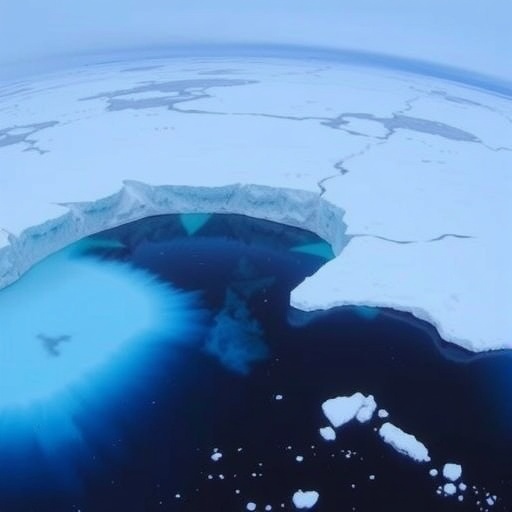
In a groundbreaking advancement for polar climatology and oceanography, a recent study has illuminated the complex and dynamic nature of the Antarctic marginal ice zone (MIZ) by unveiling an unprecedented decade-long wave-in-ice climatology. This comprehensive analysis provides an intricate understanding of the interactions between ocean waves and sea ice, shedding light on processes that govern ice edge dynamics, energy transfer, and ecosystem responses in the Southern Ocean. The research stands as a monumental stride toward deciphering the climatic behavior of one of Earth’s most remote and vulnerable environments, with implications for global climate models and maritime operations in polar regions.
The Antarctic marginal ice zone, delineated as the transitional belt between open ocean waters and consolidated sea ice, plays a vital role in modulating the polar climate system. This boundary is a hub of physical and biological activity where waves generated by distant storms propagate and attenuate through fragmented ice floes. Waves serve as energy transmitters, facilitating ice break-up, influencing melt patterns, and triggering feedback loops that impact ice extent and thickness seasonally and interannually. Prior to this study, the transient and spatially heterogeneous nature of the MIZ had rendered long-term observational datasets sparse and fragmented, limiting the resolution of wave-ice interaction models.
Leveraging a suite of remote sensing tools, buoy deployments, and wave simulation models, the research team meticulously constructed a continuous, high-resolution climatology spanning over ten years. By synthesizing satellite synthetic aperture radar (SAR) imagery with in situ wave buoy data strategically positioned near the Antarctic ice edge, the scientists captured the evolving wave spectra interacting with varying ice concentrations and thicknesses. Such integration enabled validation of the temporal variability of wave energy penetration into the MIZ and documented seasonal shifts in wave attenuation coefficients with unprecedented granularity.
One of the seminal findings from this climatology is the identification of distinct wave attenuation regimes dependent on ice type and concentration. The study demonstrated that incoming ocean waves experience exponential decay as they traverse through fragmented pack ice, with the attenuation rates accelerating significantly during the austral summer when ice floes are more fractured and dispersed. This seasonal modulation alters the mechanical stress experienced by ice floes, impacting their propensity for calving, fragmentation, and melt pond formation. Furthermore, the climatology reveals that extreme wave events, while infrequent, can induce rapid and extensive ice break-up, hinting at non-linear feedback mechanisms within the MIZ.
Further, the analysis brings to light the role of storm activity in shaping the wave climate of the Antarctic MIZ. The authors report a correlation between intensified Southern Ocean cyclones and heightened wave energy input into the ice zone, linked to atmospheric teleconnections and shifting wind patterns. This interplay underscores the sensitivity of the ice margin to both local and remote forcing factors, accentuating the need for coupled atmosphere-ocean-ice models that can accurately incorporate wave dynamics to predict ice responses under climate change scenarios.
Importantly, the developed climatology provides critical insights into the wave-induced mixing processes within the upper ocean layers beneath the ice edge. Waves penetrating the ice-covered waters enhance turbulence and vertical mixing, which influences nutrient distribution, sea ice thermodynamics, and gas exchange with the atmosphere. These biogeochemical impacts are consequential for Antarctic marine ecosystems that rely on seasonal nutrient inputs, potentially affecting primary productivity and carbon cycling in the polar regions.
The study also explores the implications of the wave-in-ice climatology for maritime navigation and operational safety in polar waters. With increasing human activities such as scientific expeditions, fishing, and even cruise tourism near the ice edge, understanding the wave climate helps in forecasting hazardous conditions associated with rogue waves, ice collisions, and rapid ice retreats. This knowledge is invaluable for designing adaptive navigation routes and for the development of early warning systems that can mitigate risks for vessels operating in these extreme environments.
Moreover, this decade-spanning climatology addresses long-standing uncertainties in how waves contribute to the seasonal evolution of the ice edge and overall sea ice variability. It illustrates that wave-induced fragmentation facilitates more efficient solar absorption through expanded lead systems and melt pond development, accelerating ice melt during warmer months. This mechanistic insight supports emerging hypotheses that wave energy dissipation is a crucial driver in the observed decline of Antarctic sea ice extent, particularly under scenarios influenced by anthropogenic climate forcing.
The integration of wave-in-ice processes into large-scale climate models could lead to substantial improvements in predicting Antarctic ice dynamics and global climate feedbacks. Traditional models often simplify ice margins as rigid boundaries, omitting crucial mechanical and thermodynamic feedbacks prompted by wave activity. By providing a robust quantitative dataset and parameterizations of wave attenuation and energy fluxes in the MIZ, this research lays the foundation for more realistic ice-ocean-atmosphere interactions within Earth system models, potentially refining projections of sea level rise and polar climate trajectories.
In addition to the physical and ecological revelations, the climatology presents an invaluable resource for satellite remote sensing validation and algorithm development. The ice edge is notoriously challenging to monitor due to its variability and heterogeneous composition. The comprehensive wave dataset enables calibration of SAR backscatter signatures and optical sensor interpretations, enhancing the accuracy of sea ice concentration and thickness retrievals. This advancement supports the broader scientific community in monitoring polar environments with greater confidence and temporal coverage.
The decade-long scope of this study also illuminates multiyear trends and variability in wave climate parameters associated with large-scale climate oscillations such as the Southern Annular Mode (SAM) and El Niño-Southern Oscillation (ENSO). By correlating wave attenuation dynamics with these oscillatory indices, the research delineates how coupled ocean-atmosphere variability manifests in the physical properties of the Antarctic sea ice margin. These connections bridge regional observations with global climate processes, offering a holistic perspective on Earth’s interconnected climate system.
Overall, this extensive wave-in-ice climatology revolutionizes our understanding of the Antarctic MIZ as a responsive, interactive interface between oceanic wave activity and the cryosphere. It highlights the critical role of waves in modulating sea ice physical state, mechanical resilience, and ecological viability, adding a vital dimension to polar research. The implications of these findings resonate across scientific disciplines, from improving climate prediction models to informing policy decisions related to polar preservation and maritime safety.
Looking ahead, the authors suggest that continued monitoring combined with emerging technologies such as autonomous wave-gliders and unmanned aerial vehicles (UAVs) equipped with wave and ice sensors could augment spatial and temporal data resolution. This will enable the capture of extreme weather events and fine-scale processes that govern ice margin evolution. Additionally, integrating molecular-scale ice fracture mechanics with large-scale wave interactions presents an exciting frontier that could unlock deeper mechanistic understanding of ice break-up.
In sum, the decade-spanning Antarctic wave-in-ice climatology marks a pivotal contribution to polar science, unmasking the intricate and potent influence of ocean waves within the fragile coastal ice environments. By distilling a complex web of physical interactions into quantifiable metrics, this study charts a new course in comprehending and forecasting the future of Antarctic sea ice amid a rapidly changing climate. As the world pays increasing attention to polar regions as barometers of global environmental health, such breakthrough research invigorates scientific inquiry and enhances our stewardship capacity for these vital yet vulnerable natural systems.
Cite Scienmag News
Violet Maxwell. (May 20, 2026). Decade of Waves Reveals Antarctic Ice Zone. Scienmag. https://scienmag.com/decade-of-waves-reveals-antarctic-ice-zone/
Violet Maxwell. "Decade of Waves Reveals Antarctic Ice Zone." Scienmag, 20 May 2026, https://scienmag.com/decade-of-waves-reveals-antarctic-ice-zone/. Accessed 4 September 2026.
Violet Maxwell. "Decade of Waves Reveals Antarctic Ice Zone." Scienmag. May 20, 2026. https://scienmag.com/decade-of-waves-reveals-antarctic-ice-zone/


