


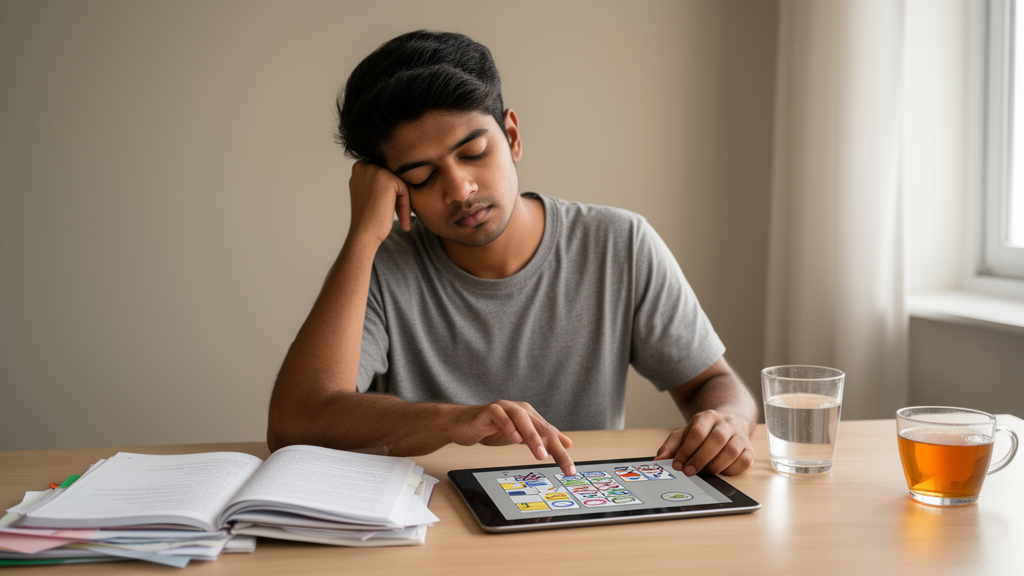
Every night, millions of young adults scroll through their phones long past bedtime, and every morning they pay for it in fog. A new cross-sectional study from the All India Institute of Medical Sciences (AIIMS) in New Delhi, published in Frontiers in Sleep, offers one of the clearest snapshots yet of how screen time, sleep quality and daytime sleepiness interact to shape working memory in Indian students aged 18 to 30. The findings are striking in their simplicity: the sleepier the student during the day, the worse their working memory, as measured through academic performance. And in a fitted regression model, average daily screen time emerged as an independent predictor of lower academic performance, even after accounting for sleep-related variables.
Sleep is far more than passive rest. It maintains homeostasis at every level of the human body, consolidates memories and restores the cognitive machinery needed for attention and learning. Modern lifestyles, with exposure to bright screens late into the night and erratic sleep schedules, have been described by the study’s authors as fueling an epidemic of adverse outcomes. Inadequate and interrupted sleep has been linked to diabetes, cardiovascular disease, accidents, depression, impaired cognition, burnout, psychoactive substance use and poor quality of life. Among students, the consequences extend directly into the classroom, where academic performance correlates positively with working memory capacity in young adults, a relationship supported by multiple studies using GPA and standardized tests as markers.
The research team, led by Ishan Gupta and Nasreen Akhtar of the Department of Physiology at AIIMS, recruited 119 young adults through convenience sampling, of whom 114 met the eligibility criteria and completed the survey. Participants were undergraduate or graduate students; anyone with a history of smoking or drug abuse, known sleep or psychiatric disorders, or chronic diseases was excluded. The study was approved by the Institute Ethics Committee at AIIMS New Delhi. Each participant completed a structured online questionnaire covering socio-demographic data, sleep-wake activity, study habits and electronic gadget usage, alongside two standardized instruments: the Pittsburgh Sleep Quality Index (PSQI) and the Epworth Sleepiness Scale (ESS).
The PSQI evaluates sleep quality across seven components, including subjective sleep quality, habitual sleep efficiency, sleep latency, sleep duration, sleep medication usage, sleep disturbances and daytime dysfunction over the past month. Each component is scored on a four-point Likert scale from zero to three, and a global score of five or greater indicates poor sleep quality. The ESS, by contrast, consists of eight questions assessing an individual’s propensity to doze off in various everyday situations. A score of ten or below falls in the normal range, while 11 to 14 indicates mild sleepiness, 15 to 17 moderate sleepiness and 18 to 24 severe sleepiness. Working memory was derived through academic performance, using anonymized self-declared marks from the last two internal university examinations, averaged into a percentage, a surrogate approach supported by previous studies showing a moderate correlation between the two constructs.
The results paint a vivid picture of a generation running on borrowed sleep. Participants had a mean age of 22.3 years, with 61 males (53.5 percent) and 91 medical students (79.8 percent). Bedtimes ranged from 8:30 PM to 4:00 AM, with 29 of 114 students going to bed after 2:00 AM. Wake-up times stretched from 4:00 AM to 2:00 PM, with 10 students rising after 10 AM. The number of electronic gadgets used varied from one to five, with 42 students using three or more. Average daily screen time ranged from one to 14 hours, with a mean of 5.8 hours, and 14 students (13.2 percent) reported nine or more hours per day. More than 60 percent of screen time involving interactive usage, such as a smartphone or video game console, was reported by 23 of 61 males and 13 of 53 females.
Sleep quality fared poorly across the cohort. The global PSQI score ranged from 0 to 18, with a mean of 6.9, and a score above five, indicating poor sleep quality, was noted in 72 of 114 students, or 63 percent, comprising 36 males (59 percent) and 36 females (68 percent). Daytime sleepiness, measured by the ESS, ranged from 0 to 19 with a mean of 7.0, and moderate to severe daytime sleepiness, a score above 14, was noted in 9 students (7.9 percent). Academic performance, the surrogate for working memory, varied from 40 to 83.5 percent, with a median of 65 percent. Study hours per week ranged from one to 56, averaging 20.5 hours.
The statistical analysis revealed a clear signal amid the noise. Spearman’s correlation showed a statistically significant negative relationship between ESS score and academic performance, with a rho of −0.2607 and a p-value of 0.0051. In other words, the sleepier the student during the day, the lower their working memory as reflected in exam marks. Daily screen time also showed a negative correlation with academic performance, with a rho of −0.1599, though this did not reach statistical significance (p = 0.0892). Interestingly, study hours per week showed virtually no correlation with performance, suggesting that how alert students are may matter more than how long they study. In a separate comparison, students who kept their phone ringer on had significantly different mean academic performance than those who kept it off (t = 2.18, df = 112, p = 0.0314).
The multiple linear regression model fitted by the researchers captured the interplay of the three sleep-related variables: Working memory = 68.8 − 0.77 × (daily average screen time) + 0.55 × (global PSQI score) − 0.47 × (ESS score). The overall model was statistically significant (R² = 0.073, adjusted R² = 0.047, F(3, 110) = 2.88, p = 0.039). Average daily screen time was independently associated with lower academic performance (β = −0.77, 95% CI −1.52 to −0.02, p = 0.044), whereas global PSQI score (β = 0.55, p = 0.158) and ESS score (β = −0.47, p = 0.116) were not statistically significant in the adjusted model. The authors caution that the positive coefficient for PSQI, an unexpected direction of association, should not be interpreted as evidence that poorer sleep quality improves performance; it may reflect sample-specific characteristics, residual confounding or shared variance among the sleep-related variables. Given the modest explanatory power of the model, with R² of just 0.073, the findings require confirmation in larger and more representative cohorts.
The broader literature reinforces the plausibility of these mechanisms. A meta-analysis of sleep quality, duration and sleepiness in children and adolescents found a significant negative association between sleep disturbances and academic performance. Sleep-deprived individuals exhibit impaired cognitive function that can adversely affect achievement, and longitudinal research has shown that higher screen time during adolescence predicts lower academic achievement in young adulthood. Media exposure may harm sleep through behavioral displacement, encroaching on time allocated for sleep, and through arousal-related mechanisms, as evening exposure heightens autonomic and cognitive arousal and impairs pre-sleep relaxation, leading to later sleep onset and shorter total sleep time. Pre-sleep electronic media use has been associated with poorer sleep quality and lower academic achievement, and a recent review of web streaming among Indian youth emphasized the need for balanced digital engagement in policy and practice.
The study’s limitations are acknowledged candidly by the authors. All data were self-reported and may be subject to recall and social desirability bias. Using academic performance as a standalone marker of working memory remains limited, often requiring direct cognitive assessments for precision, and bidirectional influences between the two constructs exist. The sample size was modest, and a larger study may better illuminate the effects of increased screen time, excessive daytime sleepiness and poor sleep quality on working memory. Nevertheless, the conclusions carry practical weight: daytime sleepiness was intricately linked to working memory in this cohort, underscoring the value of daytime alertness as a functional indicator of academic outcomes. The authors recommend interventions prioritizing regular bedtimes and reduced nocturnal electronic device usage, and future studies adopting longitudinal designs incorporating chronotype, screen use context and objective indicators of working memory. For a generation glued to glowing screens, the message is clear: the path to sharper minds may begin with putting the phone down before the lights go out.
Subject of Research: A cross-sectional study from AIIMS New Delhi links daytime sleepiness and screen time to working memory and academic performance in Indian young adults.
Article Title: Correlation of electronic gadget usage, sleep quality & daytime sleepiness with working memory in Indian young adults
Article References: Gupta, I., & Akhtar, N. (2026). Correlation of electronic gadget usage, sleep quality & daytime sleepiness with working memory in Indian young adults. Frontiers in Sleep, 5, Article 1707437. https://doi.org/10.3389/frsle.2026.1707437
Image Credits: AI Generated
DOI: 10.3389/frsle.2026.1707437
Keywords: sleep, screen time, working memory, daytime sleepiness, young adults, sleep quality, academic performance, Correlation, electronic, gadget, usage, quality
Cite Scienmag News
Glenn Wilkins. (October 17, 2026). Daytime Sleepiness Tied to Weaker Working Memory in Indian Young Adults. Scienmag. https://scienmag.com/daytime-sleepiness-tied-to-weaker-working-memory-in-indian-young-adults/
Glenn Wilkins. "Daytime Sleepiness Tied to Weaker Working Memory in Indian Young Adults." Scienmag, 17 October 2026, https://scienmag.com/daytime-sleepiness-tied-to-weaker-working-memory-in-indian-young-adults/. Accessed 17 October 2026.
Glenn Wilkins. "Daytime Sleepiness Tied to Weaker Working Memory in Indian Young Adults." Scienmag. October 17, 2026. https://scienmag.com/daytime-sleepiness-tied-to-weaker-working-memory-in-indian-young-adults/


