


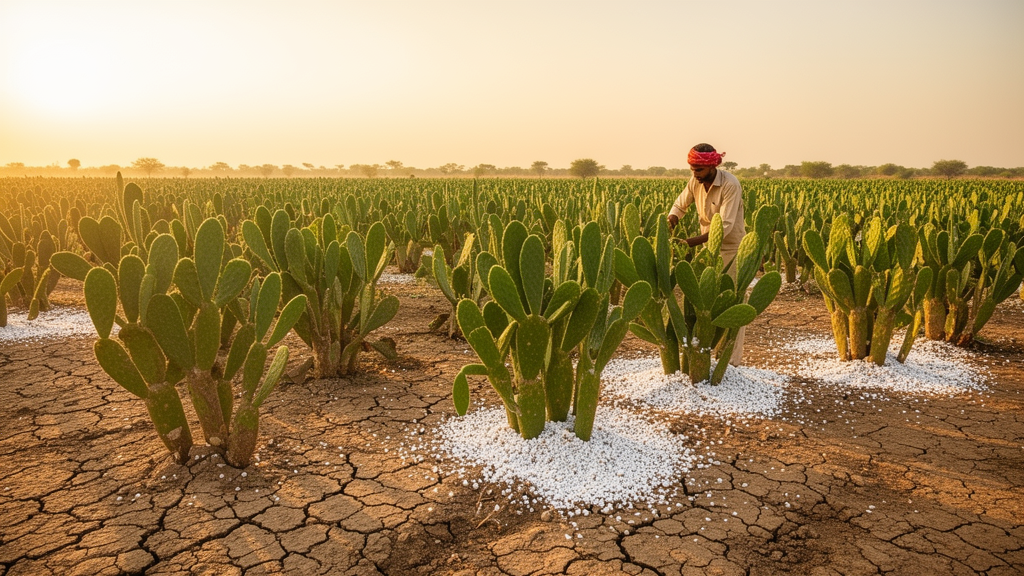
In the parched expanse of Kutch, western India, where summer temperatures scorch the sandy soil and rainfall arrives in erratic bursts, researchers have found that two often-overlooked nutrients can transform one of the world’s most drought-tolerant crops into a far more productive livestock feed. A field experiment conducted by scientists from the ICAR-Central Arid Zone Research Institute, in collaboration with the International Center for Agricultural Research in the Dry Areas, has revealed that combined calcium and potassium fertilization significantly improves the growth, biomass yield, and forage quality of Opuntia ficus-indica, the spineless cactus pear increasingly promoted as a climate-resilient forage crop. But the study also uncovered a sobering trade-off: the more productive the cactus, the more soil potassium was depleted after harvest, raising important questions about long-term nutrient management in perennial cactus systems.
The research, published in Frontiers in Soil Science, was carried out at the Regional Research Station in Bhuj, Kutch, one of the hottest arid zones in India. The experimental soil was an alkaline sandy Aridisol with a pH of 8.5, electrical conductivity of 2.78 dS m⁻¹, and organic carbon content of just 0.20 percent. Initial available potassium stood at 210 kg ha⁻¹, while available nitrogen and phosphorus were extremely low at 45 and 8 kg ha⁻¹ respectively. Over the course of a single growing season, from cladode establishment in February 2021 to final harvest in May 2022, the team imposed a factorial randomized block design with four replications, testing four calcium rates (0, 20, 40, and 60 kg ha⁻¹) crossed with four potassium rates (0, 30, 60, and 90 kg ha⁻¹), generating sixteen treatment combinations.
Calcium was supplied as agricultural gypsum, chosen because it delivers readily available calcium without substantially raising soil pH while also contributing sulfur. Potassium was applied as sulphate of potash, a chloride-free source considered more suitable than muriate of potash for moderately saline arid soils. Because both fertilizers contained sulfur, the researchers acknowledged that the individual effect of sulfur could not be separated from those of calcium and potassium, a limitation they factored into their interpretation. Fertilizers were broadcast within the root zone of each plant, incorporated into the upper 10 to 15 cm of soil, and irrigated with normal-quality groundwater at intervals of roughly 10 to 15 days in summer and 20 to 30 days in winter.
The results were striking. Potassium application significantly influenced every morphological characteristic measured, from cladode length and circumference to cladode number, thickness, and plant height. Calcium, meanwhile, significantly affected cladode circumference, cladode number, cladode thickness, and plant height, though it did not significantly alter cladode length or width. The tallest plants, reaching 65.2 cm, were recorded under the combination of 40 kg Ca ha⁻¹ and 60 kg K ha⁻¹, which also produced the highest cladode number at 22.2 per plant and the greatest cladode thickness at 2.5 cm. Notably, no significant calcium-potassium interaction emerged for any morphological trait, suggesting the two nutrients acted largely independently rather than synergistically in driving structural development.
Biomass production told a similar story of complementary roles. Fresh cladode yield, the key measure of forage output, responded significantly only to potassium, with the highest yield of 16.9 t ha⁻¹ recorded under 20 kg Ca ha⁻¹ combined with 90 kg K ha⁻¹. Dry matter yield, however, was significantly affected by both nutrients, peaking at 3.51 t ha⁻¹ under 40 kg Ca ha⁻¹ with 90 kg K ha⁻¹. The researchers attributed these responses to the distinct physiological functions of the two elements: potassium serves as the principal inorganic osmoticum in plant cells, regulating turgor, stomatal movement, enzyme activation, and assimilate transport, all critical under the high evaporative demand of hot arid environments. Calcium, by contrast, strengthens cell walls and plasma membranes through calcium-pectate cross-linking in the middle lamella, providing the structural integrity needed for rapid succulent cladode expansion.
Forage quality improved even more dramatically than yield. Crude protein concentration rose from 4.8 percent in the unfertilized control to 11.2 percent under 40 kg Ca ha⁻¹ with 60 kg K ha⁻¹, a value at the upper end of reported ranges for cactus pear cladodes. Corresponding tissue nitrogen concentration climbed from 0.768 percent to 1.79 percent. Simultaneously, neutral detergent fiber fell from 42.1 percent to 27.2 percent, and acid detergent fiber dropped from 28.3 percent to 18.2 percent, both indicators of improved digestibility. The researchers suggested that better nutrient availability may have favored metabolically active parenchymatous tissues over structural carbohydrates, reducing the proportion of indigestible cell wall constituents. Because neither calcium nor potassium supplied nitrogen, the accumulated nitrogen presumably derived from existing soil pools and mineralization of the uniformly applied farmyard manure, with fertilization potentially enhancing the plant’s capacity to acquire these sources.
Crude protein yield, the product of dry matter and protein concentration, showed an approximately 24-fold increase, from 0.0151 t ha⁻¹ in the control to 0.363 t ha⁻¹ under 40 kg Ca ha⁻¹ with 90 kg K ha⁻¹. This dramatic gain resulted from the combined increase in biomass and the smaller rise in tissue nitrogen concentration. The team emphasized that the fertilizer combination producing the highest crude protein concentration was not necessarily the same as that producing the greatest crude protein yield, underscoring the importance of considering both nutritive value and total protein production when developing nutrient management strategies for livestock feed systems.
Yet the study revealed a critical tension between productivity and efficiency. Partial factor productivity declined consistently with increasing fertilizer rates, indicating diminishing returns as nutrient supply exceeded crop demand. Agronomic efficiency of both calcium and potassium showed no significant response to treatments, suggesting that partial factor productivity was the more sensitive index for detecting treatment effects. The highest partial factor productivity for calcium, 0.845 t kg⁻¹, occurred under 20 kg Ca ha⁻¹ with 90 kg K ha⁻¹, while the maximum for potassium, 0.357 t kg⁻¹, was recorded under 60 kg Ca ha⁻¹ with 30 kg K ha⁻¹. These patterns align with well-established principles of nutrient-use efficiency, where progressively larger inputs produce proportionally smaller yield gains, and may partly reflect a shift from high-affinity to low-affinity potassium transport systems as external concentrations rise.
Perhaps the most consequential finding concerned soil potassium dynamics. The change in soil available potassium after harvest was significantly affected by calcium, potassium, and their interaction, with the largest depletion of 173 kg ha⁻¹ recorded under 60 kg Ca ha⁻¹ combined with 90 kg K ha⁻¹. Linear regression revealed a significant positive relationship between fresh cladode yield and the change in soil available potassium, with an R² of 0.77, indicating that treatments producing greater forage yields were also associated with larger reductions in soil potassium. The researchers calculated an apparent potassium removal of 263 kg ha⁻¹ under the highest combined treatment, a figure they cautioned cannot be attributed solely to crop uptake, as it may include leaching, fixation, release from non-exchangeable reserves, and potassium acquisition below the sampled 0 to 15 cm layer. In calcareous arid soils, potassium fixation and release processes can strongly influence extractable potassium following fertilization, complicating interpretation.
The implications extend beyond a single season. Because Opuntia ficus-indica is harvested repeatedly over multiple years, continued reductions in exchangeable soil potassium without adequate replenishment may gradually diminish soil fertility during successive production cycles. The maximum fertilizer rates applied in this study, 60 kg Ca ha⁻¹ and 90 kg K ha⁻¹, remain considerably lower than the seasonal calcium and potassium removal reported for high-yielding cactus pear, which can reach 464.63 kg Ca ha⁻¹ and 421.04 kg K ha⁻¹. The researchers concluded that fertilizer recommendations for this crop should integrate forage productivity with fertilizer-use efficiency and post-harvest soil nutrient dynamics rather than focusing solely on maximizing biomass. They called for long-term field studies incorporating plant nutrient uptake together with measurements of exchangeable and non-exchangeable soil potassium fractions to distinguish crop removal from soil transformations and to determine whether repeated harvesting progressively depletes soil fertility under continuous cactus production in hot arid environments.
Subject of Research: Calcium and potassium fertilization improves productivity and forage quality with implications for soil available potassium in Opuntia ficus-indica under hot arid condition
Article Title: Calcium and potassium fertilization improves productivity and forage quality with implications for soil available potassium in Opuntia ficus-indica under hot arid condition
Article References: Naorem, A., Hassan, S., Louhaichi, M., Dayal, D., Machiwal, D., Dev, R., & Singh, D. (2026). Calcium and potassium fertilization improves productivity and forage quality with implications for soil available potassium in Opuntia ficus-indica under hot arid condition. Frontiers in Soil Science, 6, Article 1950553. https://doi.org/10.3389/fsoil.2026.1950553
Image Credits: AI Generated
DOI: 10.3389/fsoil.2026.1950553
Keywords: Calcium, potassium, fertilization, improves, productivity, forage, quality, implications, soil, available, Opuntia, ficus-indica
Cite Scienmag News
Alan Morgan. (October 17, 2026). Calcium and Potassium Fertilization Boosts Cactus Forage in Hot Arid India. Scienmag. https://scienmag.com/calcium-and-potassium-fertilization-boosts-cactus-forage-in-hot-arid-india/
Alan Morgan. "Calcium and Potassium Fertilization Boosts Cactus Forage in Hot Arid India." Scienmag, 17 October 2026, https://scienmag.com/calcium-and-potassium-fertilization-boosts-cactus-forage-in-hot-arid-india/. Accessed 17 October 2026.
Alan Morgan. "Calcium and Potassium Fertilization Boosts Cactus Forage in Hot Arid India." Scienmag. October 17, 2026. https://scienmag.com/calcium-and-potassium-fertilization-boosts-cactus-forage-in-hot-arid-india/


