


For people living with Parkinson’s disease, the slow erosion of everyday movement is one of the disease’s quiet cruelties. Even when medications control tremor and stiffness, habitual physical activity inevitably declines as the disease progresses, giving way to longer and longer sedentary stretches. Dance programs have long been promoted as a way to fight back, with studies showing improvements in gait, balance, cognition, anxiety, depression, and quality of life. But whether those studio gains actually spill over into more movement during daily life has never been objectively tested—until now.
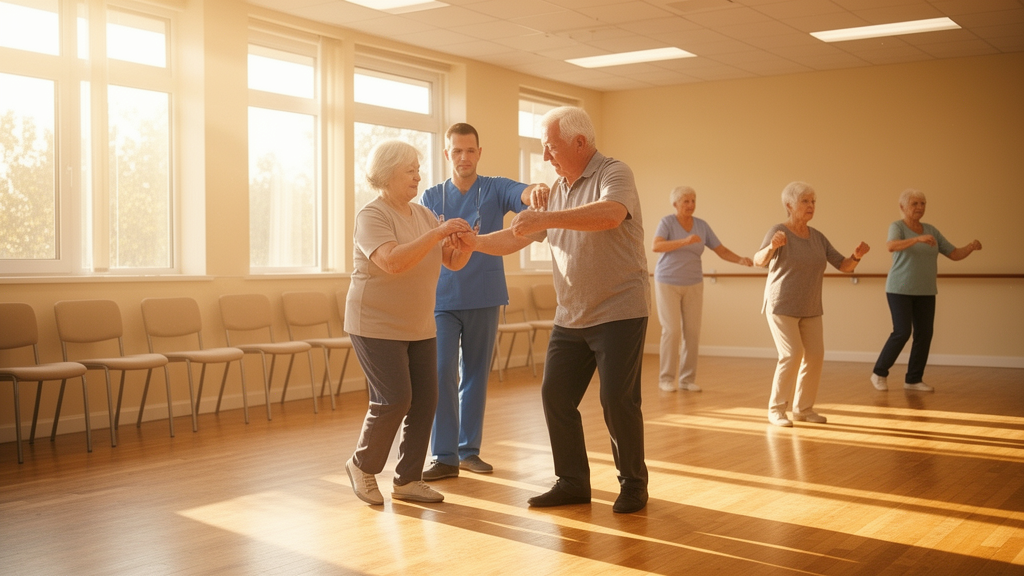
A new quasi-experimental controlled study published in Frontiers in Human Neuroscience set out to answer that question with hard numbers. Researchers at Queensland University of Technology and collaborating institutions recruited 33 people with Parkinson’s disease, all cognitively intact and in early to moderate stages of the disease, and allocated them to either a dance group or a treatment-as-usual control group. The dance group attended one-hour Dance for Parkinson’s Disease (DfPD®)-based classes twice weekly for 12 weeks, delivered by trained instructors from Queensland Ballet. The control group continued their usual care. To capture what happened outside the studio, all participants wore ActivPAL™ accelerometers—small devices strapped to the midline of the anterior thigh—for five consecutive days before and after the intervention.
The ActivPAL™ monitors passively recorded a comprehensive picture of habitual activity: sit/lie duration, standing duration, stepping duration, sit-to-stand and stand-to-sit transitions, daily step count, and energy expenditure expressed as metabolic equivalent hours per day. Participants were advised to wear the waterproof monitors continuously, including during bathing, and to maintain their usual daily routines so the devices captured typical behavior rather than a special effort. The research team then analyzed pre-post change scores using linear mixed models, treating group allocation as a fixed factor while adjusting for gender and disease severity as covariates.
The headline result was sobering: no statistically significant between-group differences emerged for any ActivPAL™ outcome. The dance group’s daily step count rose from an average of 8,354 steps per day to 9,086, while the control group’s slipped from 7,554 to 7,533. Stepping duration increased in the dance group from 103 to 115 minutes daily while remaining essentially flat in the control group. Yet when the researchers ran the formal statistical tests, these changes did not reach the threshold for significance.
But the story does not end with the p-values. When the team calculated effect sizes—Cohen’s d, a measure of the magnitude of change independent of sample size—the dance group showed moderate-to-large effects for stepping duration (d = 0.72) and daily step count (d = 0.91). Sit/lie duration showed a moderate effect (d = 0.52), while standing duration, transitions, and energy expenditure showed only small effects. In a small study like this one, with just 16 participants per group in the final analysis, such effect sizes suggest real directional changes that a larger, adequately powered trial might confirm as statistically significant.
The researchers had good reason to expect a spillover effect. In the same cohort, dance participation had previously been shown to significantly improve functional mobility and motor symptoms. The logic was straightforward: if dance classes boost physical capability under structured, supervised conditions, participants should be able to move more easily in daily life, and that ease should translate into more habitual activity. The failure to find support for that hypothesis points to a crucial gap in how rehabilitation gains are converted into everyday behavior. Physical capability improvements, the authors conclude, do not necessarily flow through to changes in habitual activity outside those environments.
There is another possible explanation worth considering: a ceiling effect. The dance group accumulated an average of 8,354 steps per day at baseline and the control group 7,554—both comfortably within the 7,000 to 10,000 steps per day range considered sufficient for healthy older adults. Participants may simply have had limited capacity to substantially increase their daily movement, a challenge familiar from exercise intervention studies where recruits are already physically active at study entry. This pattern suggests a potential selection bias: people drawn to dance programs may already be among the more active members of the Parkinson’s community, leaving little room for measurable improvement.
Several limitations shape how these findings should be read. Habitual physical activity in Parkinson’s disease is notoriously difficult to measure stably because of fluctuations in motor and non-motor symptoms, even on stable medication regimens. The five-day monitoring window may not have captured a typical week, and the ActivPAL™ placement could not distinguish between sitting and lying, potentially underestimating activity. The study was also powered based on dual-task Timed Up and Go performance rather than habitual physical activity outcomes, meaning it may have been underpowered from the start to detect differences in accelerometer measures. An unequal gender distribution between groups at baseline—82.4% female in the dance group versus 37.5% in the control group—was adjusted for statistically but leaves open the possibility of residual confounding given the small sample size.
What makes this study valuable is not a dramatic positive result but the methodological groundwork it lays. It demonstrates the feasibility of objectively measuring habitual physical activity before and after dance program participation using ActivPAL™ devices, something no previous study had done. The moderate-to-large effect sizes for stepping duration and daily step count are clearly outcomes that warrant further attention in fully powered trials. And the authors’ suggestions—longer monitoring periods, activity diaries to identify unusual demands or symptom fluctuations, inclusion criteria targeting people below a specified activity threshold, and a priori sample-size calculations based specifically on accelerometer outcomes—offer a concrete roadmap for the studies needed next.
For the Parkinson’s community, the message is nuanced. Dance for Parkinson’s disease classes have repeatedly shown benefits for gait, dual-task gait performance, cognition, functional mobility, and psychological symptoms. This study adds an important caveat: those improvements, at least over a 12-week program, did not translate into statistically significant increases in habitual daily activity once participants left the studio. Whether longer programs, behavioral strategies such as goal setting and self-monitoring, or community engagement components alongside physical training could bridge that gap remains an open question. What is clear is that converting supervised rehabilitation gains into sustainable everyday movement is one of the central challenges in Parkinson’s care—and one that science is only beginning to measure properly.
Subject of Research: Effects of Dance for Parkinson's Disease classes on objectively measured habitual physical activity in people with Parkinson's disease
Article Title: Effects of dance for Parkinson’s disease on habitual physical activity: a quasi-experimental controlled study
Article References: Kalyani, H. H. N., Sullivan, K. A., Moyle, G. M., Brauer, S. G., Jeffrey, E. R., & Kerr, G. K. (2026). Effects of dance for Parkinson’s disease on habitual physical activity: a quasi-experimental controlled study. Frontiers in Human Neuroscience, 20, Article 1962191. https://doi.org/10.3389/fnhum.2026.1962191
Image Credits: AI Generated
DOI: 10.3389/fnhum.2026.1962191
Keywords: Parkinson's disease, dance therapy, habitual physical activity, accelerometers, ActivPAL, sedentary behavior, rehabilitation, effect size, quasi-experimental study, Queensland Ballet, motor symptoms, daily step count
Cite Scienmag News
Diana Fleming. (October 16, 2026). Dance Classes Lift Daily Steps in Parkinson’s Patients, But Not Enough to Change Habitual Activity. Scienmag. https://scienmag.com/dance-classes-lift-daily-steps-in-parkinsons-patients-but-not-enough-to-change-habitual-activity/
Diana Fleming. "Dance Classes Lift Daily Steps in Parkinson’s Patients, But Not Enough to Change Habitual Activity." Scienmag, 16 October 2026, https://scienmag.com/dance-classes-lift-daily-steps-in-parkinsons-patients-but-not-enough-to-change-habitual-activity/. Accessed 16 October 2026.
Diana Fleming. "Dance Classes Lift Daily Steps in Parkinson’s Patients, But Not Enough to Change Habitual Activity." Scienmag. October 16, 2026. https://scienmag.com/dance-classes-lift-daily-steps-in-parkinsons-patients-but-not-enough-to-change-habitual-activity/


