


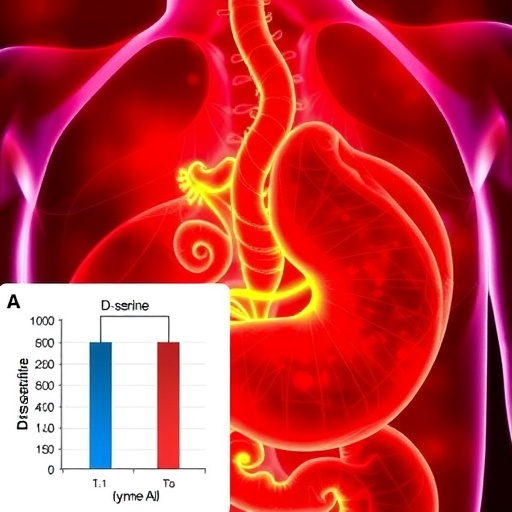
Gastric cancer may be exploiting a little-known metabolic molecule to disable the immune system, according to research from Keio University in Japan. The molecule, D-serine, appears to act as a “metabolic immune checkpoint,” reshaping the tumor microenvironment so that cancer-fighting immune cells become less effective. In mouse models, tumors exposed to D-serine grew more rapidly, while clinical data linked higher blood concentrations of the molecule to resistance against immune checkpoint inhibitor therapy.
The immune system constantly patrols the body for abnormal cells, including cancer cells. Among its most powerful weapons are CD8-positive cytotoxic T cells, which recognize tumor-associated signals and can directly destroy malignant cells. Gastric tumors, however, often create an immunosuppressive environment that prevents these lymphocytes from functioning properly. Immune checkpoint inhibitors, or ICIs, are designed to release some of the molecular brakes placed on T cells, but their success depends heavily on the signals already operating inside the tumor.
D-serine belongs to a group of molecules known as D-amino acids. Most amino acids used to build proteins in humans are L-amino acids, while D-amino acids are their mirror-image forms, or enantiomers. Although D-amino acids were once considered biologically insignificant, scientists now know that they can occur naturally in body fluids and may originate from food, intestinal microbes, or cellular metabolism. D-serine is already recognized for its role in nervous-system signaling, but the Keio team investigated whether it could also influence cancer immunity.
The researchers used mouse models of gastric cancer and introduced different D-amino acids and their corresponding L-amino acids into tumors. Among the compounds tested, only D-serine produced a clear increase in tumor growth compared with untreated controls. Detailed analysis showed that the molecule was not simply feeding the cancer cells. Instead, it altered the immune ecosystem surrounding the tumors, increasing the abundance and activity of anti-inflammatory immune cells, especially M2-like macrophages.
Macrophages are highly adaptable immune cells that can either attack tumors or support their growth, depending on the chemical signals around them. In the D-serine-treated tumors, macrophages acquired a tumor-promoting, immunosuppressive profile. At the same time, the number of CD8-positive cytotoxic T cells fell, and the T cells that remained showed markedly reduced activity. This combination—more suppressive macrophages and fewer functional killer T cells—created conditions that allowed gastric tumors to expand with less immune resistance.
The team then examined the molecular secretions of tumor-associated macrophages, commonly called TAMs. In tumors exposed to D-serine, these cells released unusually high amounts of fibronectin 1, or FN1, and secreted phosphoprotein 1, known as SPP1 or osteopontin. Both molecules have been associated with immune regulation and tumor progression. In this setting, they appeared to contribute to the suppression of CD8-positive T cells, helping the tumor maintain an immune-protected niche.
One experiment provided evidence that SPP1 was an important part of this pathway. When the researchers administered antibodies designed to neutralize SPP1 in D-serine-enhanced tumors, tumor growth slowed and approached the rate observed in mice with lower D-serine activity. The result suggests that D-serine may operate upstream of a signaling cascade in which macrophages release SPP1 and FN1, ultimately weakening the T-cell response. However, the findings do not yet establish that blocking SPP1 or D-serine will be effective as a treatment in people.
To investigate whether the mouse findings might have clinical relevance, the researchers analyzed patient data from several human cohorts. Patients with gastric cancer had higher serum D-serine concentrations than healthy controls. The highest levels were detected in people with stage IV disease whose tumors had resisted ICI treatment. This association raises the possibility that a blood test for D-serine could help identify patients whose tumors are more likely to evade immunotherapy, although larger prospective studies will be needed before such testing can guide clinical decisions.
The findings are particularly significant because ICIs are increasingly used as first-line treatment for advanced gastric cancer, yet responses vary widely and treatment can cause immune-related adverse events. Measuring D-serine in blood, and potentially in stool, could offer a way to assess the tumor’s immunological state before therapy begins. The researchers are now examining whether D-serine levels can predict treatment response and whether intestinal bacteria responsible for producing the molecule contribute to its accumulation. If future studies confirm the mechanism, therapies aimed at reducing D-serine or interrupting its downstream signals could provide a new strategy for restoring anti-tumor immunity. For now, the work identifies D-serine as a promising biomarker and a potential immune-regulatory target, but its therapeutic value remains to be tested in human clinical trials.
News Publication Date: 31-Jul-2026
Web References: https://doi.org/10.1016/j.ebiom.2026.106402; https://www.keio-sujino-lab.com/; https://researchmap.jp/tsujino
References: https://doi.org/10.1016/j.ebiom.2026.106402
Cite Scienmag News
Nathaniel Bowman. (August 10, 2026). D-serine accelerates tumor growth in gastric cancer. Scienmag. https://scienmag.com/d-serine-accelerates-tumor-growth-in-gastric-cancer/
Nathaniel Bowman. "D-serine accelerates tumor growth in gastric cancer." Scienmag, 10 August 2026, https://scienmag.com/d-serine-accelerates-tumor-growth-in-gastric-cancer/. Accessed 4 September 2026.
Nathaniel Bowman. "D-serine accelerates tumor growth in gastric cancer." Scienmag. August 10, 2026. https://scienmag.com/d-serine-accelerates-tumor-growth-in-gastric-cancer/


