


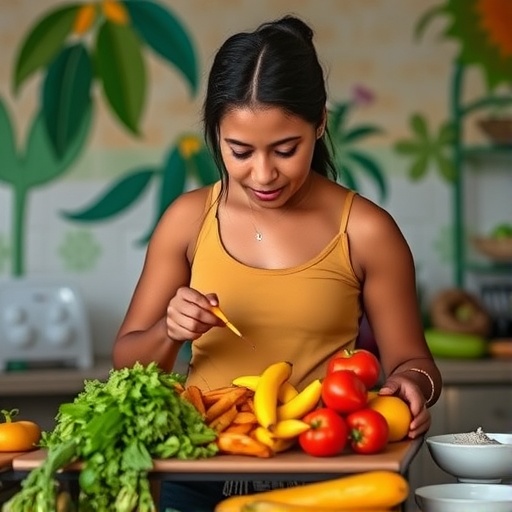
In recent years, the intricate relationship between income inequality and dietary health has captured the attention of researchers globally. A groundbreaking study led by Jia, Wang, He, and colleagues brings fresh insights into how narrowing the income gap in Brazil can serve as a crucial lever for fostering sustainable and healthy dietary transitions. Published in Communications Earth & Environment in 2026, this research emphasizes the systemic links between socio-economic factors and environmental sustainability, positioning income equality not only as a social justice imperative but also as a public health and ecological necessity.
Income inequality has long been recognized as a determinant of health outcomes. In Brazil, a country notable for its rich biodiversity, diverse agricultural base, and stark socioeconomic contrasts, this relationship manifests in complex dietary patterns. Wealth disparities influence food access, consumption choices, and nutritional quality, often privileging calorie-dense but nutrient-poor options for lower-income populations. The study’s authors delve deeply into these mechanisms, providing robust quantitative and qualitative analyses that elucidate how economic disparities translate into differential dietary behaviors across urban and rural communities.
Central to the study’s thesis is the concept that reducing income inequality fosters equitable access to diverse, nutritious, and sustainable foods. Leveraging detailed consumption data aligned with environmental impact assessments, the authors reveal pathways through which income redistribution policies can mitigate unsustainable food consumption patterns. These include shifts from ultra-processed foods toward traditional whole foods, which generally have lower environmental footprints and higher nutritional values. Through simulation models, the study predicts that addressing income gaps will precipitate measurable reductions in greenhouse gas emissions linked to food production and consumption.
The research also engages with Brazil’s unique socio-environmental context, which plays a crucial role in shaping dietary transformations. The country’s vast agricultural landscape is both a resource and a challenge. While Brazil is a global powerhouse in food production, including commodity crops like soy and sugarcane, there exist striking contrasts between export-oriented agribusiness and smallholder farming. Income inequality directly affects the capacity of various population groups to engage with and benefit from local food systems. The study meticulously documents how income improvements enable marginalized demographics to access food produced from sustainable agricultural practices, thus aligning economic equity with ecological stewardship.
Another innovative facet of the study is its interdisciplinary methodology. Combining socioeconomic data, nutritional epidemiology, and environmental science, the team applies integrated modeling frameworks to forecast future dietary trends under different income inequality scenarios. This comprehensive approach allows the researchers to explore not just immediate dietary changes but also long-term outcomes for public health and environmental sustainability. Importantly, the data suggest that policy interventions aimed at reducing income disparities can generate synergistic benefits, enhancing food security, improving population health metrics, and decreasing environmental degradation.
A particularly striking finding is the interplay between food affordability and dietary quality. The researchers demonstrate that income inequality constrains dietary choices by limiting affordability. Low-income households often resort to cheaper, energy-dense foods that are less sustainable and more harmful to health. The study argues that income redistribution policies could transform the food environment by making healthy options more financially accessible. This economic empowerment could lead to greater demand for minimally processed, nutrient-rich foods that are locally produced and environmentally benign, spurring positive shifts in agricultural production aligned with sustainable development goals.
The authors also discuss the potential for income inequality reduction to fortify traditional dietary patterns that have been eroded by globalization and urbanization. In Brazil, varied indigenous and rural food cultures embody diverse, sustainable diets rich in native fruits, vegetables, and whole grains. However, economic marginalization has often forced populations to abandon these sustainable diets for processed, imported food products. The study proposes that raising income levels can revive and sustain culinary traditions that promote both human health and biodiversity, highlighting the cultural dimensions of dietary transitions often overlooked in policy debates.
Crucially, the study contemplates policy implications, suggesting that Brazil’s social welfare programs can serve as pivotal platforms for orchestrating dietary transitions. Conditional cash transfers, minimum wage reforms, and progressive taxation are among policies that can narrow income gaps while simultaneously incentivizing sustainable food consumption. Evidence indicates that such policies can recalibrate food markets by increasing demand for healthful, sustainable products and encouraging producers to adopt environmentally sound practices. The research underscores the need for integrated policy designs that address economic, nutritional, and environmental objectives concurrently.
The environmental lens of this research is equally significant. Brazil’s role in global environmental sustainability is pivotal due to its vast biomes, including the Amazon rainforest. By linking income inequality and dietary patterns with ecological footprints, the study provides a crucial bridge between social justice and planetary health. It reveals that income redistribution not only enhances individual well-being but also mitigates pressures on land use, deforestation, and biodiversity loss. This reinforces the argument for viewing socio-economic reforms as essential components of climate change mitigation strategies.
From a technical perspective, the study utilizes novel statistical models that incorporate multi-layered datasets, including household income surveys, food consumption databases, nutritional composition tables, and environmental impact assessments. Advanced machine learning algorithms optimize predictive accuracy of dietary outcomes under income change scenarios, while sensitivity analyses ensure robustness against data uncertainties. These sophisticated analytical tools represent a step forward in understanding the feedback loops between socio-economic variables and sustainable nutrition, offering a powerful template for future interdisciplinary research.
Importantly, this research also addresses global health equity concerns. Brazil’s experience serves as a case study with broader relevance to other emerging economies facing similar challenges of high inequality coupled with nutrition-related health burdens. The authors advocate for international collaboration in designing equitable food systems, emphasizing that reducing income inequality could accelerate global progress toward the United Nations’ Sustainable Development Goals, particularly those targeting poverty alleviation, hunger eradication, health promotion, and climate action.
The study’s findings are a clarion call for reimagining food policy frameworks. Traditional approaches focusing narrowly on agricultural production or health education often fail to tackle the underlying socio-economic determinants of dietary choices. This research argues convincingly that income redistribution mechanisms must be integral to strategies aimed at transforming food systems. By doing so, policymakers can unlock co-benefits that encompass economic inclusion, nutritional security, and environmental sustainability, creating virtuous cycles of well-being and ecological resilience.
Furthermore, the investigation sheds light on consumer behavior dynamics. It reveals that increased household income not only expands purchasing power but also alters preferences toward foods valued for health and sustainability. Behavioral economic theories explain these shifts, as enhanced economic security reduces stress-related consumption of unhealthy foods and allows for more deliberate food choices aligned with personal and collective values. This nuanced understanding of consumer psychology provides a valuable dimension for designing effective interventions.
In conclusion, the research conducted by Jia and colleagues marks a significant advance in understanding the multifaceted links between income inequality, diet, and environmental footprints in Brazil. By demonstrating that reducing socioeconomic disparities can drive a triple win—improved health, social equity, and planetary sustainability—the study offers a compelling roadmap for policymakers and stakeholders. The evidence-based narrative underscores that economic justice is a foundational pillar for building resilient and equitable food systems able to meet 21st-century challenges.
As countries worldwide grapple with intersecting crises of climate change, malnutrition, and social inequality, Brazil’s experience offers profound lessons. Income inequality, often viewed narrowly through an economic lens, emerges here as a critical lever for systemic transformation of food environments and consumption patterns. Aligning social policies with environmental imperatives can unlock unprecedented opportunities for inclusive development that prioritizes both people and planet.
This pioneering work invites further research integrating socio-economic equity into sustainability science and nutrition policy frameworks globally. Innovations in data integration, interdisciplinary modeling, and policy experimentation will be essential to translate insights into action. The authors’ contribution paves the way for a new generation of research and interventions focused on bridging equity, health, and sustainability—a holistic approach urgently needed for global food systems in transition.
Cite Scienmag News
Daisy Hatcher. (April 30, 2026). Cutting Income Gaps Fuels Brazil’s Healthy Diet Shift. Scienmag. https://scienmag.com/cutting-income-gaps-fuels-brazils-healthy-diet-shift/
Daisy Hatcher. "Cutting Income Gaps Fuels Brazil’s Healthy Diet Shift." Scienmag, 30 April 2026, https://scienmag.com/cutting-income-gaps-fuels-brazils-healthy-diet-shift/. Accessed 5 September 2026.
Daisy Hatcher. "Cutting Income Gaps Fuels Brazil’s Healthy Diet Shift." Scienmag. April 30, 2026. https://scienmag.com/cutting-income-gaps-fuels-brazils-healthy-diet-shift/


