


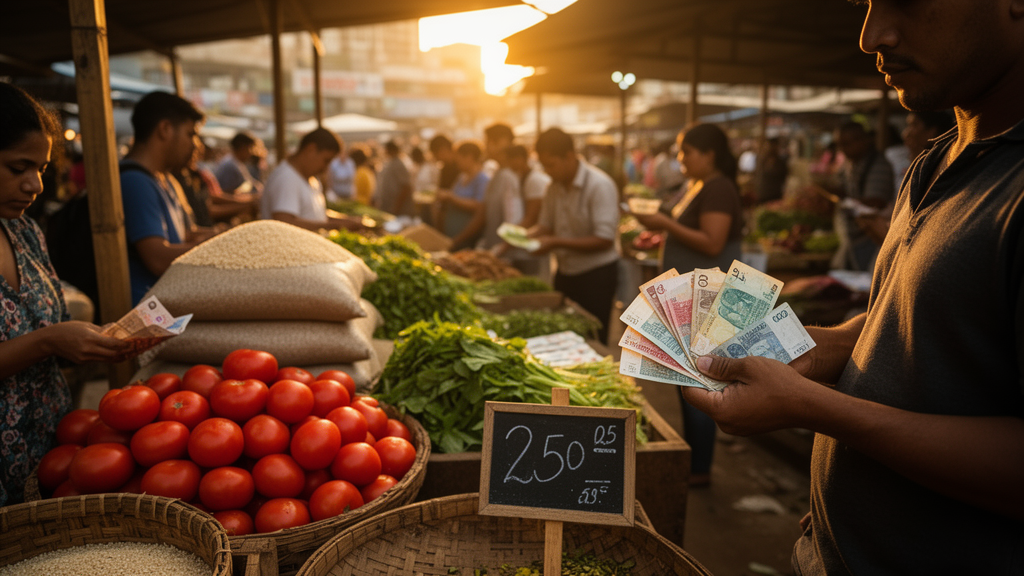
When food prices spike in emerging market economies, policymakers often blame oil. Fuel and fertilizer are the lifeblood of modern agriculture, and crude oil benchmarks have long been treated as the dominant force behind the grocery bill. A new study turns that assumption on its head. Analyzing seventeen emerging market economies month by month from January 2006 to December 2023, economist F. Ilknur Unuvar of Ankara University finds that exchange rate movements, not energy costs, are the more powerful driver of consumer food prices — and that the exchange rate effect intensifies dramatically once food inflation itself crosses a critical threshold.
The research, published in Frontiers in Sustainable Food Systems, assembles a balanced panel of 3,672 country-month observations spanning Latin America, Asia, and the Europe-Middle East-Africa region. Countries were selected using strict criteria: they had to be classified as emerging markets by MSCI or the International Monetary Fund, operate floating rather than pegged exchange rate arrangements, avoid centrally administered food prices, and offer complete monthly data. Crucially, none of the selection rules conditioned on realized inflation behavior, which guards against the sample being rigged in favor of the study’s conclusions.
The methodological architecture is deliberately layered. In the first stage, Unuvar estimates a separate distributed lag regression for each country, regressing monthly food inflation on twelve lags of currency depreciation alongside six lags of Brent crude oil prices, the FAO Food Price Index, and urea fertilizer prices. Standard errors use the Newey-West correction for heteroskedasticity and autocorrelation up to twelve months. This country-by-country approach is not a stylistic choice: formal tests rejected slope homogeneity across the panel, and because global price series take identical values in every country each month, they would be perfectly collinear with time fixed effects in any pooled specification. Only country-level regressions allow the oil, food, and fertilizer channels to be separately identified.
The headline numbers are striking. The mean cumulative exchange rate pass-through coefficient is 0.213, meaning a ten percent currency depreciation over twelve months raises consumer food prices by roughly 2.1 percent on average. But the mean conceals extraordinary heterogeneity: estimates range from essentially zero in Indonesia to 0.807 in Türkiye, where pass-through is nearly four times the group average. Hungary follows at 0.505, with Chile and Colombia near 0.34. Only seven of the seventeen coefficients are individually significant at the five percent level, a reminder that any study reporting a single pooled elasticity for emerging markets describes a central tendency that applies to very few actual economies.
By contrast, the oil channel is remarkably weak at policy-relevant horizons. The cumulative effect of crude oil prices on consumer food prices is just 0.008 over six months — statistically indistinguishable from zero — and the entire oil-only specification explains roughly 0.4 percent of within-country variation in food inflation. The effect does become detectable at longer horizons, reaching 0.045 at twelve months and 0.064 at eighteen months, suggesting that energy costs seep into retail prices slowly through production and distribution. But the comparison remains lopsided: a ten percent oil price increase is associated with about a 0.5 percent rise in food prices, versus roughly 2.4 percent for an equivalent depreciation. A formal test rejects the equality of the two channels decisively.
Why is the energy-food nexus so muted at the consumer level? The study points to the structure of retail food prices, which bundle the raw commodity with processing, packaging, distribution, rent, and labor costs. In the United States, the farm share of the consumer food dollar was just 11.8 cents in 2024, with energy entering as one of twelve supply-chain industry groups rather than a dominant cost. Strong oil-commodity relationships observed at the wholesale level are therefore diluted before they reach the checkout. The exchange rate, by contrast, hits from multiple directions simultaneously: it raises the local-currency cost of imported fertilizers, seeds, and fuel, while also lifting the domestic prices of tradable agricultural goods outright.
The study’s most consequential finding concerns state dependence — the idea, originating with John Taylor’s 2000 work, that pass-through is not a fixed structural parameter but depends on the prevailing inflation environment. When inflation is low and expectations are anchored, firms treat cost shocks as temporary and absorb them into margins. When inflation is perceived as persistent, the same shock is passed through rapidly and almost entirely. Using a threshold specification based on observed twelve-month food inflation, the study finds cumulative pass-through of 0.147 below a fifteen percent annual inflation threshold and 0.541 above it — a difference of 0.393 that survives a Bonferroni correction for multiple testing. In practical terms, a ten percent depreciation raises food prices by about 1.5 percent in calm conditions but by approximately 5.4 percent when food inflation is already elevated.
Formal threshold estimation sharpens the picture. Applying Hansen’s panel threshold method, the transition point is estimated at 7.56 percent annual food inflation using overlapping six-month windows, and 6.83 percent with non-overlapping windows, with bootstrap p-values below 0.001 in both cases. Pass-through roughly triples across this divide, rising from about 0.07 to 0.23. Quantile regressions with country fixed effects corroborate the pattern from a different angle: cumulative pass-through climbs from 0.120 at the twenty-fifth percentile of the conditional food inflation distribution to 0.277 at the ninetieth, with equality strongly rejected. Notably, the oil and global food price channels show no comparable regime dependence, suggesting the state-dependent behavior is specific to the exchange rate transmission mechanism.
A skeptic might object that the high-inflation states are simply concentrated in countries with structurally stronger pass-through, such as Türkiye, rather than reflecting a within-country behavioral shift. The study confronts this directly with mean-group estimates that compare inflation states within each economy. The estimated difference is positive in all eight economies where both states can be reliably estimated, and the mean-group difference of 0.339 remains significant even after excluding Türkiye, which contributes fifty-five of the 190 high-inflation months. Kazakhstan, Romania, and Poland — countries with modest average pass-through — show some of the largest state-dependent jumps. Meanwhile, structural exposure indicators such as food import dependence, energy dependence, and fertilizer import dependence fail to explain cross-country variation, with the apparent link between average inflation and pass-through collapsing entirely once Türkiye is removed from the cross-section.
The policy implications are pointed. If exchange rate transmission is the dominant channel, then export bans and trade restrictions are misguided levers: they depress producer incomes and risk supply contractions without touching the mechanism that actually drives prices. Instead, the findings elevate macro-financial stability — exchange rate stability, anchored inflation expectations, and hedging instruments for importers — to the center of food price policy, with agricultural subsidies playing only a complementary role. The results also align with the United Nations Sustainable Development Goal 2.c, which targets the proper functioning of food markets and limits on extreme price volatility. As the study notes, regime dependence intensified after 2015, a period encompassing emerging market currency stress, the pandemic, and the war in Ukraine, hinting that weakening monetary credibility may itself amplify the food price consequences of currency turmoil. For the billions of households in emerging economies who spend a disproportionate share of their budgets on food, keeping inflation anchored may be the most effective food security program available.
Subject of Research: Exchange rate pass-through to consumer food prices and its threshold dependence on the inflation environment in emerging market economies
Article Title: Threshold effects in exchange rate pass-through to food prices in emerging market economies
Article References: Unuvar, F. I. (2026). Threshold effects in exchange rate pass-through to food prices in emerging market economies. Frontiers in Sustainable Food Systems, 10, Article 1960606. https://doi.org/10.3389/fsufs.2026.1960606
Image Credits: AI Generated
DOI: 10.3389/fsufs.2026.1960606
Keywords: exchange rate pass-through, food inflation, emerging market economies, oil prices, threshold effects, state dependence, food security, currency depreciation, Taylor hypothesis, quantile regression, panel data, monetary policy
Cite Scienmag News
Alan Morgan. (October 16, 2026). Currency Shocks, Not Oil, Drive Food Prices in Emerging Markets Once Inflation Crosses a Critical Threshold. Scienmag. https://scienmag.com/currency-shocks-not-oil-drive-food-prices-in-emerging-markets-once-inflation-crosses-a-critical-threshold/
Alan Morgan. "Currency Shocks, Not Oil, Drive Food Prices in Emerging Markets Once Inflation Crosses a Critical Threshold." Scienmag, 16 October 2026, https://scienmag.com/currency-shocks-not-oil-drive-food-prices-in-emerging-markets-once-inflation-crosses-a-critical-threshold/. Accessed 16 October 2026.
Alan Morgan. "Currency Shocks, Not Oil, Drive Food Prices in Emerging Markets Once Inflation Crosses a Critical Threshold." Scienmag. October 16, 2026. https://scienmag.com/currency-shocks-not-oil-drive-food-prices-in-emerging-markets-once-inflation-crosses-a-critical-threshold/


