


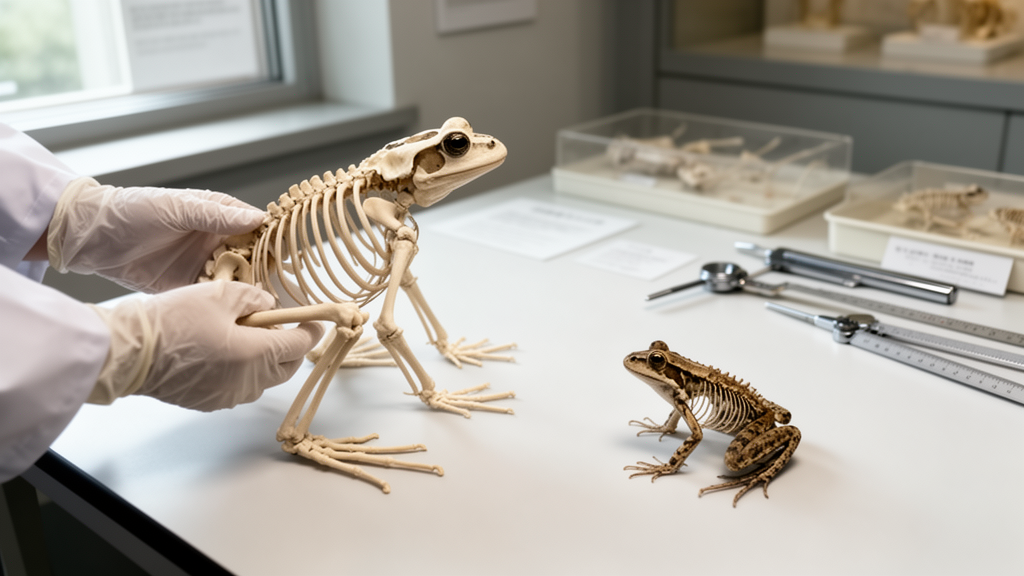
The American bullfrog is one of the world’s most successful invasive amphibians, and a new study from South Korea has now peered directly into its bones to find out why it is such a formidable ecological threat. By counting microscopic growth lines in toe bones, researchers have reconstructed the age structure and growth trajectory of bullfrog populations in southwestern Korea, revealing an animal that follows the same developmental timetable as native frogs but reaches an adult size roughly three times larger. The findings, published in the journal Herpetozoa, provide the first population-specific demographic baseline for the species in the Republic of Korea and carry sobering implications for the country’s native amphibian communities.
Aquarana catesbeiana, native to North America, was introduced into Korean natural environments in the early 1970s and has since spread widely across the peninsula. The species is officially designated as a regulated, ecosystem-disrupting invasive species in South Korea, and for good reason: with an average snout–vent length exceeding 150 millimeters, it ranks among the largest frogs on Earth. Its broad, opportunistic diet allows it to function as a novel and influential predator in invaded ecosystems, and it has also been implicated as a potential vector for amphibian pathogens. Yet despite decades of presence, detailed ecological information on Korean bullfrog populations has remained scarce, forcing managers to rely on data gathered from populations in other regions, where ecological traits may differ substantially.
To close this gap, a research team collected 49 individuals from 10 sites in southwestern South Korea between 2019 and 2023, an area where bullfrog populations are concentrated and extensive lowland plains make field surveys efficient. Specimens were captured directly or recovered from traps, including animals that had already died. Each individual was classified as male, female, or juvenile based on external morphology: males display a yellow jaw associated with vocal activity, eardrums larger than their eyes, and nuptial pads on the forelimbs, while females show white jaw coloration, smaller eardrums, and no nuptial pads. Snout–vent length was measured to the nearest hundredth of a millimeter with digital calipers before the animals were euthanized in accordance with national invasive species management protocols.
The heart of the study is skeletochronology, a technique that exploits the fact that seasonal climate variation leaves visible marks in growing bone. The researchers removed the fourth toe of the left hind limb, preserved it in 70 percent ethanol, then decalcified it in 5 percent nitric acid, dehydrated it through a graded ethanol series, and embedded it in paraffin. A microtome cut transverse sections 10 to 14 micrometers thick, which were stained with hematoxylin and eosin and examined under a light microscope at 400 times magnification. Within the periosteal bone surrounding the marrow cavity, the team counted lines of arrested growth, or LAGs, each of which marks a period when skeletal growth slowed, typically during winter hibernation. The midshaft of the second phalanx was chosen because it best preserves the first growth line, which can be erased by endosteal resorption in some individuals. Two independent researchers verified every age estimate.
The results painted a clear demographic picture. Of the 44 individuals successfully analyzed, 25 were males with estimated ages of one to five years, six were females aged zero to four years, and 13 were juveniles aged zero to two years. Males averaged 121.5 millimeters in snout–vent length, females 123.0 millimeters, and juveniles 91.3 millimeters. Statistical comparisons using nonparametric tests, chosen after Shapiro–Wilk tests showed the data departed from normality, found no significant differences in size or age between the sexes, but highly significant differences between adults and juveniles. A Spearman rank correlation confirmed that older animals were consistently larger, with a significant positive relationship between age and body size across all 44 individuals.
The bone sections also revealed the messiness of real biology. Most LAGs appeared thin and well defined, but thicker lines showed up in about 27 percent of individuals, double or false lines in roughly 14 percent, and signs of endosteal resorption in a similar proportion. Intriguingly, one individual classified as female showed no visible growth lines at all and was assigned an age of zero, while two juveniles were estimated at two years old. The authors caution that LAG formation is not always tied to winter dormancy: lines can also form during aestivation or periods of reduced foraging, and some bullfrog populations remain active under ice throughout winter, potentially suppressing line deposition altogether. Age estimates from skeletochronology, they stress, should therefore be interpreted with care, particularly in an invasive species occupying diverse environments.
To model growth, the team fitted a von Bertalanffy growth curve, but only to the male data, since females and juveniles were too few and their age classes too narrow to support reliable estimates. The model tested several fixed values for age at metamorphosis, and the best fit came with a value of 0.5 years, yielding an asymptotic snout–vent length of 143.7 millimeters and a strong pseudo-R-squared of 0.879. The curve shows rapid growth up to two years of age, followed by a steady deceleration, with males approaching their maximum size at roughly 3.8 years. Notably, the asymptotic size estimated for Korean males closely matches values reported from North American and Chinese populations, around 148 and 142.6 millimeters respectively, suggesting that bullfrogs in Korea grow along trajectories similar to those in their native and other introduced ranges.
The comparison with Korea’s native frogs is where the study becomes genuinely alarming. Drawing on a literature review of 11 skeletochronological studies covering 11 native anuran species, the researchers found that most Korean frogs live between two and seven years and reach asymptotic sizes of only 40.8 to 83.9 millimeters. The bullfrog’s estimated asymptote of 143.7 millimeters is more than triple that of the endangered Korean endemic Pelophylax chosenicus, whose males reach just 34.7 millimeters. Although the overall shape of the growth curve is similar across species, with rapid early growth followed by slowdown after age two, the bullfrog simply operates on a vastly larger scale, packing enormous biomass into the same two-year maturation window that native species use to reach a fraction of that size.
That size advantage translates directly into ecological impact. Amphibians generally eat prey smaller than themselves, and a predator three times the size of its native counterparts can consume larger and more diverse animals, including, as previous Korean research has documented, the native Asiatic toad and black-spotted pond frog. The threats do not stop at predation: native amphibians unfamiliar with the invasive predator often fail to mount effective antipredator responses, bullfrogs contribute to broader habitat disturbance, and they can carry Batrachochytrium dendrobatidis, the chytrid fungus that is frequently lethal to amphibians worldwide. A large, fast-growing, long-lived generalist predator armed with a lethal pathogen is a formidable combination for any native community.
For South Korean conservation authorities, the study delivers exactly what invasive species management has been missing: locally grounded demographic data. Because invasive populations often shift their life-history traits in response to new environments, growth and age estimates borrowed from other continents can mislead risk assessments and misdirect control efforts. The confirmation that LAGs do form in Korean bullfrogs validates skeletochronology as a monitoring tool, while the documented age structure and growth curve offer a baseline against which future population changes can be measured. The work, funded through Korea’s Exotic Invasive Species Management Program, underscores a broader lesson for invasion biology everywhere: understanding how old an invader is, and how big it gets, may be the key to understanding just how much damage it can do.
Subject of Research: Age structure and growth of the invasive American bullfrog in South Korea estimated by skeletochronology
Article Title: Estimation of age structure and growth curve of Aquarana catesbeiana ( Anura , Ranidae ) in the Republic of Korea
Article References: Park, S.-M., Park, K.-H., Cheon, S.-J., Lee, J.-A., Kim, J. H., & Sung, H.-C. (2026). Estimation of age structure and growth curve of Aquarana catesbeiana (Anura, Ranidae) in the Republic of Korea. Herpetozoa, 39, 229-238. https://doi.org/10.3897/herpetozoa.39.e182878
Image Credits: AI Generated
DOI: 10.3897/herpetozoa.39.e182878
Keywords: American bullfrog, Aquarana catesbeiana, invasive species, skeletochronology, South Korea, amphibian conservation, growth curve, lines of arrested growth, von Bertalanffy model, native amphibians, ecological impact, Herpetozoa
Cite Scienmag News
Drew Townsend. (October 16, 2026). Bullfrog Bones Reveal a Giant Among Korean Frogs Growing Three Times Larger Than Native Species. Scienmag. https://scienmag.com/bullfrog-bones-reveal-a-giant-among-korean-frogs-growing-three-times-larger-than-native-species/
Drew Townsend. "Bullfrog Bones Reveal a Giant Among Korean Frogs Growing Three Times Larger Than Native Species." Scienmag, 16 October 2026, https://scienmag.com/bullfrog-bones-reveal-a-giant-among-korean-frogs-growing-three-times-larger-than-native-species/. Accessed 16 October 2026.
Drew Townsend. "Bullfrog Bones Reveal a Giant Among Korean Frogs Growing Three Times Larger Than Native Species." Scienmag. October 16, 2026. https://scienmag.com/bullfrog-bones-reveal-a-giant-among-korean-frogs-growing-three-times-larger-than-native-species/


