

Friday, November 20, 2026
Science
No Result
View All Result
  • Login
  • HOME
  • SCIENCE NEWS
  • CONTACT US
  • HOME
  • SCIENCE NEWS
  • CONTACT US
No Result
View All Result
Scienmag
No Result
View All Result
Home Science News Biology

CRISPR centromere editing reshapes wheat chromosomes

October 28, 2026
in Biology
Alan Morgan
By Alan Morgan Scienmag Editorial Profile - Precision Agriculture
Reading Time: 2 mins read
0
CRISPR centromere editing reshapes wheat chromosomes

CRISPR centromere editing reshapes wheat chromosomes

65
SHARES
587
VIEWS
Share on FacebookShare on Twitter
ADVERTISEMENT

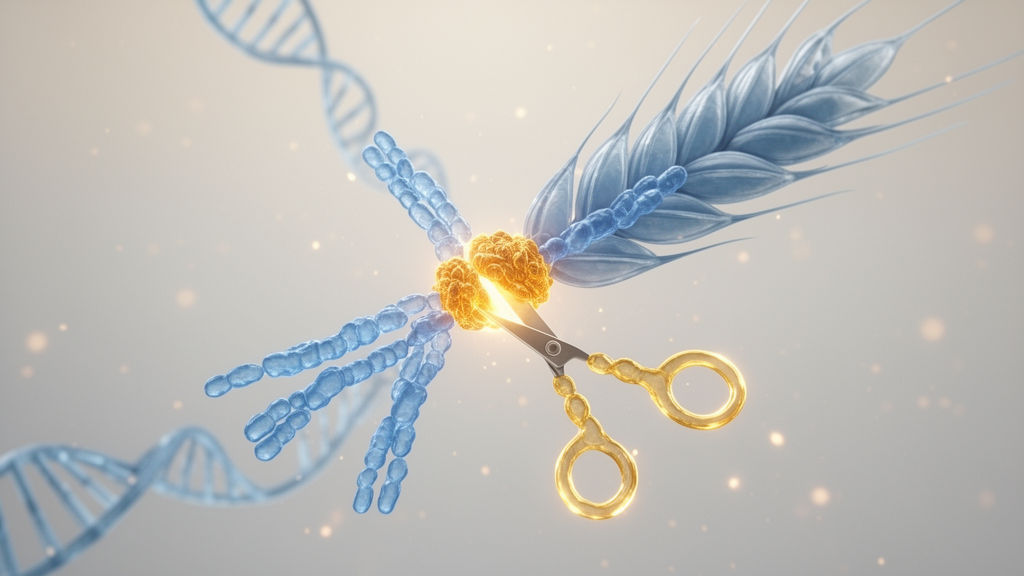
Researchers have developed a CRISPR–Cas9 strategy that restructures the karyotype of hexaploid wheat by targeting its centromeres, the regions that anchor chromosomes during cell division. The approach, called centromere editing-mediated chromosomal variation, directs the gene-editing machinery at abundant centromeric retrotransposons, repetitive sequences that populate the centromeres of wheat’s large polyploid genome. Because these repeats occur across many chromosomes at once, a single editing step can cleave several chromosomes simultaneously, something that has been difficult to achieve in genomes spanning gigabases of DNA.

The consequences of this genome-wide cleavage were extensive. In a single generation, the method generated diverse karyotypic variants and reconfigured up to 11 chromosomes at once. Among the rearrangements were widespread reciprocal translocations, exchanges of chromosome segments between different chromosomes. One line carried six such events involving seven chromosomes, an unusually extensive reshuffling for a single engineered plant.

A key question for any chromosome-engineering scheme is whether the new arrangements can survive meiosis and be passed on. The newly formed translocation chromosomes underwent centromere remodelling, a process that appears to underpin their relatively stable maintenance and heritable transmission through generations. This suggests that centromeres are not merely targets for breakage but active sites where redesigned chromosomes can be consolidated into inheritable new karyotypes.

The team also examined the functional consequences of balanced translocations, in which no genetic material is lost overall. These rearrangements imposed minimal transcriptional perturbation, and plants carrying them maintained normal growth. That combination, extensive chromosomal restructuring with minimal transcriptional perturbation and normal growth, is what makes the strategy attractive for breeding, where engineering karyotypes could expand the genetic and breeding potential of crops.

The authors position centromeres as effective sites for chromosome engineering breeding and describe the work as a scalable framework for karyotype redesign in polyploid crops.

Subject of Research: Centromere-targeted CRISPR engineering of wheat karyotypes

Article Title: Rewriting wheat karyotypes through centromere-targeted chromosome engineering

Article References: Zhou, X., Chen, Y., Li, C., Teng, W., Cui, Y., Tan, X., Hu, M., Zhou, Y., Xie, X., Guo, W., Yan, W., Sun, Q., Ni, Z., Wang, Y., Su, H., & Zong, Y. (2026). Rewriting wheat karyotypes through centromere-targeted chromosome engineering. Nature Plants. https://doi.org/10.1038/s41477-026-02441-2

Image Credits: AI Generated

DOI: 10.1038/s41477-026-02441-2

Keywords: wheat, centromere, CRISPR-Cas9, chromosome engineering, karyotype, reciprocal translocation, polyploid crops, retrotransposons, chromosome remodelling, plant breeding, Rewriting, karyotypes

Cite Scienmag News

Alan Morgan. (October 28, 2026). CRISPR centromere editing reshapes wheat chromosomes. Scienmag. https://scienmag.com/crispr-centromere-editing-reshapes-wheat-chromosomes/

Alan Morgan. "CRISPR centromere editing reshapes wheat chromosomes." Scienmag, 28 October 2026, https://scienmag.com/crispr-centromere-editing-reshapes-wheat-chromosomes/. Accessed 20 November 2026.

Alan Morgan. "CRISPR centromere editing reshapes wheat chromosomes." Scienmag. October 28, 2026. https://scienmag.com/crispr-centromere-editing-reshapes-wheat-chromosomes/

Tags: advanced wheat genome manipulation techniquescentromerecentromere remodelling during plant meiosiscentromere-targeted genome editingchromosomal variation in hexaploid wheatchromosome engineeringchromosome remodellingchromosome restructuring in polyploid wheatCRISPR-Cas9CRISPR-Cas9 wheat centromere editinggenome-wide chromosome engineeringkaryotypekaryotypeslarge-scale chromosome rearrangements in plantsplant breedingpolyploid cropsreciprocal translocationreciprocal translocations in wheatretrotransposon targeting in wheat genomeretrotransposonsRewritingstable inheritance of translocation chromosomestargeted chromosome reshuffling in crop plantswheat
Share26Tweet16
Previous Post

Neural network predicts Kerr resonator solitons 20 times faster than simulations

Next Post

AI learns to fix CT scans by protecting what algorithms actually measure

Related Posts

Ocean Current Alignment During Maiden Trips Predicts Southern Elephant Seal Pup Survival
Biology

Ocean Current Alignment During Maiden Trips Predicts Southern Elephant Seal Pup Survival

November 20, 2026
Microbial Cell-Free DNA Sequencing Detects Overlooked Pathogens in Critically Ill Children
Biology

Microbial Cell-Free DNA Sequencing Detects Overlooked Pathogens in Critically Ill Children

November 20, 2026
Fire Mosaics Differentially Shape Genetic Connectivity in Australian Woodland Bats
Biology

Fire Mosaics Differentially Shape Genetic Connectivity in Australian Woodland Bats

November 20, 2026
Letter Identifies Methodological Limitations in Study Evaluating MX3 Hydration Testing System
Biology

Letter Identifies Methodological Limitations in Study Evaluating MX3 Hydration Testing System

November 20, 2026
Engineered Monoclonal Antibody VYD222 Potently Neutralizes Broad SARS-CoV-2 Variants
Biology

Engineered Monoclonal Antibody VYD222 Potently Neutralizes Broad SARS-CoV-2 Variants

November 20, 2026
Study Reveals Molecular Docking Mechanism Anchoring CDKL5 Protein at Synapses
Biology

Study Reveals Molecular Docking Mechanism Anchoring CDKL5 Protein at Synapses

November 20, 2026
Next Post
AI learns to fix CT scans by protecting what algorithms actually measure

AI learns to fix CT scans by protecting what algorithms actually measure

  • Mothers who receive childcare support from maternal grandparents show more optimized

    Mothers who receive childcare support from maternal grandparents show more parental warmth, finds NTU Singapore study

    27656 shares
    Share 11059 Tweet 6912
  • University of Seville Breaks 120-Year-Old Mystery, Revises a Key Einstein Concept

    1061 shares
    Share 424 Tweet 265
  • Bee body mass, pathogens and local climate influence heat tolerance

    682 shares
    Share 273 Tweet 171
  • Researchers record first-ever images and data of a shark experiencing a boat strike

    546 shares
    Share 218 Tweet 137
  • Groundbreaking Clinical Trial Reveals Lubiprostone Enhances Kidney Function

    531 shares
    Share 212 Tweet 133
Science

Embark on a thrilling journey of discovery with Scienmag.com—your ultimate source for cutting-edge breakthroughs. Immerse yourself in a world where curiosity knows no limits and tomorrow’s possibilities become today’s reality!

RECENT NEWS

  • Enzyme PAP2-2 Regulates Membrane Lipids and Mitochondrial Function in Leishmania mexicana
  • Automated Skin Imaging Shows Promise but Insufficient Evidence for Tuberculin Tests
  • Flexible Graphene Patch Monitors Sweat Sodium and Potassium with Minimal Potential Drift
  • Ocean Current Alignment During Maiden Trips Predicts Southern Elephant Seal Pup Survival

Categories

  • Agriculture
  • Anthropology
  • Archaeology
  • Athmospheric
  • Biology
  • Biotechnology
  • Blog
  • Bussines
  • Cancer
  • Chemistry
  • Climate
  • Earth Science
  • Editorial Policy
  • Marine
  • Mathematics
  • Medicine
  • Pediatry
  • Policy
  • Psychology & Psychiatry
  • Science Education
  • Science News
  • Social Science
  • Space
  • Technology and Engineering

Subscribe to Blog via Email

Enter your email address to subscribe to this blog and receive notifications of new posts by email.

Join 5,151 other subscribers

© 2026 Scienmag - Science Magazine

Welcome Back!

Login to your account below

Forgotten Password?

Retrieve your password

Please enter your username or email address to reset your password.

Log In
No Result
View All Result
  • HOME
  • SCIENCE NEWS
  • CONTACT US

© 2026 Scienmag - Science Magazine

Discover more from Science

Subscribe now to keep reading and get access to the full archive.

Continue reading

