


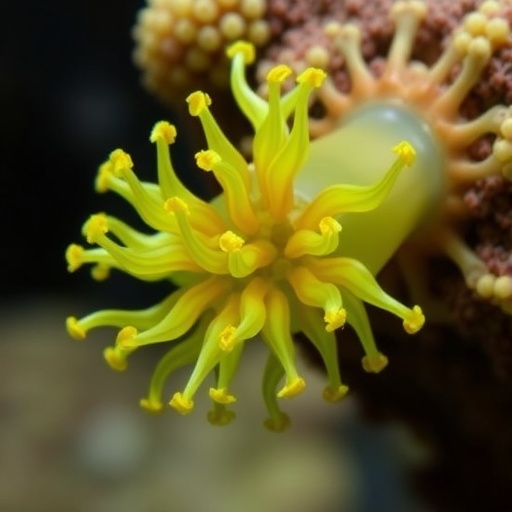
In the turbulent intertidal zones where ocean waves crash relentlessly against rocky shorelines, certain marine organisms have perfected the art of adhesion, clinging tenaciously to surfaces despite the unyielding force of water currents. Among these remarkable creatures are sea squirts, or tunicates, whose ability to anchor themselves steadfastly has baffled scientists for years. Recent groundbreaking research conducted at Pohang University of Science and Technology (POSTECH) has uncovered an intricate nano-scale delivery mechanism that sea squirts employ to secure their foothold underwater, revealing a sophisticated biological innovation that goes beyond mere secretion of sticky substances.
The study, led by Professor Dong Soo Hwang, delves deeply into the unique rhizoid root structures of sea squirts, elucidating the cellular and molecular orchestration behind their adhesive prowess. Unlike traditional adhesives that rely on immediate secretion and adhesion, sea squirts manufacture their adhesive proteins intracellularly and package them into nano-sized condensates fortified by metal ions such as iron, chromium, and vanadium. This nano-condensation serves a dual purpose: it stabilizes the adhesive molecules and shields them from premature environmental degradation during transport within the organism’s body.
Through an intricate process resembling a nanoscale logistics system, these bioadhesive condensates are ferried within specialized cellular compartments to the rhizoid tips, the organ responsible for physical anchorage to submerged substrates. Electron microscopy images reveal that the adhesive materials persist as tightly bound solid particulates rather than diffuse liquids, a stark contrast to the dispersal strategies observed in other marine adhesive systems. This structural rigidity afforded by metal ion coordination ensures the adhesive proteins maintain their efficacy upon reaching the site of deployment.
When the nanocondensates reach the rhizoid’s outer cuticle, a remarkable transformation occurs. The metal-ion-mediated condensate undergoes rearrangement, effectively “unpacking” the adhesive proteins and activating their binding capabilities. The research highlights a dynamic shift in the role of metal ions: these elements act as protective stabilizers during intracellular transport but are subsequently released during adhesion, allowing the proteins to interact directly with the external surface and form a robust bioadhesive bond.
This nuanced adhesion delivery strategy sharply contrasts with the well-studied adhesion mechanisms of mussels, which rely primarily on the amino acid 3,4-dihydroxyphenylalanine (DOPA) to form direct metal ion chelation for immediate adhesion. In sea squirts, however, metallic ions primarily facilitate the safe and efficient transport of adhesive materials rather than directly mediate adhesion, underscoring a distinct evolutionary solution to the challenges posed by underwater attachment.
The implications of this discovery extend far beyond marine biology. The detailed understanding of sea squirts’ bioadhesive nanocondensate delivery opens new avenues for biomimetic development of underwater adhesives and coatings, potentially revolutionizing marine biotechnology. Current challenges in restoration of underwater vegetation, notably the early-stage attachment of seaweed to rocky substrates, may find innovative remedies inspired by this biological model. As ocean desertification intensifies due to climate change, the ability to enhance seaweed cultivation holds significance for ecological sustainability and carbon sequestration efforts.
Furthermore, the elucidation of this nanocondensate delivery mechanism enriches the scientific community’s grasp of bioadhesion signaling pathways and molecular material engineering. The seamless integration of environmental ion coordination and protein complex packaging presents promising templates for advanced biomaterials with tailored adhesion properties adaptable to wet and dynamic environments. Such materials could have broad applications, spanning biomedical implants, industrial coatings, and environmental engineering solutions.
Professor Hwang emphasized the transformative potential of this research, highlighting that understanding the rhizoid adhesion system transcends mere academic interest: it could serve as a cornerstone in the fight against marine ecosystem degradation, climate change mitigation, and global food security. By bridging molecular biology, environmental science, and materials engineering, this work exemplifies the interdisciplinary approach required to tackle complex ecological challenges.
The study, poised to appear in the prestigious Proceedings of the National Academy of Sciences, represents a significant leap in comprehending the biological sophistication underpinning marine bioadhesion. These findings not only fill a critical knowledge gap about sea squirt rhizoid structure and function but also chart a promising course for the synthesis of environmentally friendly bioadhesives that emulate nature’s ingenuity.
Supported by the Korea Institute of Marine Science & Technology Promotion (KIMST) under the Ministry of Oceans and Fisheries, this pioneering research underscores the importance of continued exploration at the intersection of marine biology, nanotechnology, and environmental sustainability. Such integrative studies are indispensable as humanity seeks innovative tools to restore oceanic habitats and sustain marine biodiversity amid escalating environmental threats.
In conclusion, the revelation of a metal–catechol coordination-based nanocondensate bioadhesive delivery system in tunicate rhizoid holdfasts challenges conventional paradigms of underwater adhesion. This discovery highlights sea squirts’ evolutionary innovation in solving the dilemma of adhesive transport and deployment, offering a novel blueprint for designing next-generation bioadhesives with profound implications for marine ecology and materials science.
News Publication Date:
April 8, 2026
Web References:
http://dx.doi.org/10.1073/pnas.2526665123
Keywords
Applied sciences and engineering, Materials engineering, Signal transduction, Adhesion signaling, Biomedical engineering, Biomaterials, Microstructures, Nanomaterials, Nanostructures, Environmental sciences, Environmental management, Natural resources management, Ocean engineering, Pollution, Environmental engineering
Cite Scienmag News
Denise Maddox. (May 15, 2026). Could Sea Squirts’ Nano-Packaging Unlock a New Era in Sea Forest Restoration? Scienmag. https://scienmag.com/could-sea-squirts-nano-packaging-unlock-a-new-era-in-sea-forest-restoration/
Denise Maddox. "Could Sea Squirts’ Nano-Packaging Unlock a New Era in Sea Forest Restoration?" Scienmag, 15 May 2026, https://scienmag.com/could-sea-squirts-nano-packaging-unlock-a-new-era-in-sea-forest-restoration/. Accessed 3 September 2026.
Denise Maddox. "Could Sea Squirts’ Nano-Packaging Unlock a New Era in Sea Forest Restoration?" Scienmag. May 15, 2026. https://scienmag.com/could-sea-squirts-nano-packaging-unlock-a-new-era-in-sea-forest-restoration/


