


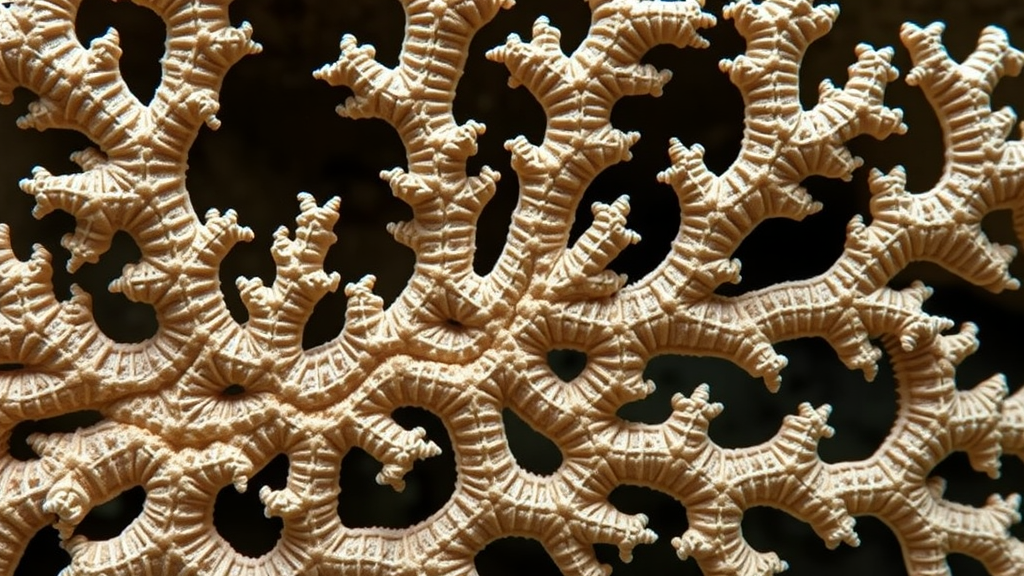
Buried in the massive skeleton of a coral colony growing off west Maui is an archive far older than any water-quality monitoring program: a year-by-year chemical diary stretching back to 1760, decades before Captain Cook arrived in the Hawaiian Islands. In a study published in the journal Coral Reefs, researchers led by S. A. H. Kekuewa of the University of Hawai’i at Mānoa have extracted that diary and used it to reconstruct, with unprecedented length and detail, how land-use change and climate variability have shaped the waters flowing onto the Olowalu reef. The result is one of the longest pre-colonial to modern records of ridge-to-reef connectivity ever assembled for the main Hawaiian Islands, and it tells a story that is both surprising and sobering.
Coral skeletons are built from aragonite, a crystalline form of calcium carbonate, laid down in seasonal growth bands like tree rings. As the coral grows, it incorporates trace elements dissolved in the surrounding seawater, and the ratios of those elements to calcium locked into each band preserve a snapshot of environmental conditions at the time of deposition. Barium, yttrium, iron and manganese are largely carried to the coast by rivers and groundwater after being weathered from volcanic soils, so their concentrations in coral skeletons serve as proxies for sediment and terrigenous input. Phosphorus, recorded through the phosphorus-to-calcium ratio, is a well-established tracer of nutrient pollution. Strontium, meanwhile, varies with water temperature, giving researchers a thermometric handle on past climate.
The team drilled a core from a massive coral at Olowalu, on Maui’s leeward coast, and analyzed the skeleton along its growth axis. The record spans 253 years, from 1760 to 2013, and captures an extraordinary arc of human history: pre-colonial Hawaiian stewardship of the land, the rise and fall of the sugarcane plantation economy, large-scale diversion of stream water for irrigation, and modern coastal development. Using computed tomography-based methods, including the CoralCT platform developed by researchers at Tulane University, the team quantified annual extension rates, skeletal density, and the product of the two, calcification, which is the most direct measure of how much calcium carbonate the coral actually produces each year.
The geochemical data reveal a clear, persistent signature of watershed disturbance. Averaged over the record, the ratios of barium, phosphorus and iron relative to calcium increased by between 17 and 55 percent from the eighteenth century to the late twentieth century. The single largest jump occurred in the mid-1900s, precisely when Maui’s sugarcane plantations reached their maximum extent. Plantation agriculture stripped hillsides of vegetation, loosened volcanic soils, and diverted enormous volumes of freshwater, all of which conspired to push more sediment, more nutrients and more dissolved terrestrial metals toward the reef. The coral recorded every step of that transformation in its skeleton.
Superimposed on this long-term pollution trend, the researchers found a rhythmic pulse in the trace element record. Variations in the terrigenous proxies oscillated at annual to decadal frequencies that match the El Niño-Southern Oscillation and the Pacific Decadal Oscillation, the two great engines of Pacific climate variability. El Niño years in Hawai’i bring distinctive rainfall anomalies, and decadal shifts in Pacific climate modulate both precipitation and groundwater recharge across the islands. In other words, the reef’s chemical record does not simply track what humans did to the land; it also tracks how climate controlled when and how much of that land-based material reached the ocean, delivered by both storm runoff and the submarine groundwater discharge that seeps through volcanic aquifers along Maui’s coast.
The most dramatic finding, and the one with the most troubling implications for reef conservation, concerns coral calcification itself. From the pre-colonial baseline, calcification rates rose by roughly 30 percent until about 1970, a period that included the plantation era. That initial increase may reflect an early nutrient subsidy: moderate inputs of sediment and dissolved nutrients can fertilize reef food webs, and corals that feed more heterotrophically can sometimes build skeleton faster, even under rising carbon dioxide levels. But after approximately 1970, coinciding with peak sugarcane production and maximum terrigenous loading, the trend reversed and calcification declined. The coral’s own chemistry records the moment when land-based inputs crossed from helpful to harmful.
The statistical case for that reversal is strong. The researchers found a negative correlation between calcification rate and the terrigenous proxies, including barium-to-calcium, yttrium-to-calcium, phosphorus-to-calcium and iron-to-calcium. Years with the heaviest terrestrial inputs were years of depressed skeletal growth. Laboratory and field studies have long suggested mechanisms for this relationship: suspended sediment clouds reduce light available to the coral’s photosynthetic symbionts, phosphate interferes directly with the crystal chemistry of aragonite precipitation, and episodic smothering events damage tissue and divert energy away from skeleton building. What the Olowalu core adds is the century-scale confirmation that these mechanisms operate over decades, not just during individual floods.
Timing matters here, because the mid-twentieth century was also a period of warming oceans, and the global decline in coral calcification is often attributed primarily to ocean acidification and thermal stress. The Maui record complicates that picture. It shows that local land-use change produced measurable growth declines decades before modern bleaching crises, and that the trajectory of coral growth at any single reef may be as much a story about the watershed behind it as about the seawater in front of it. This supports a growing body of evidence that managing local stressors, particularly sediment and nutrient runoff, can buy reefs time against the global stressors they cannot escape. The paper’s authors and collaborators, including conservation groups working in Olowalu, have pointed to sediment-reduction projects in the watershed as concrete steps informed by exactly this kind of baseline.
Perhaps the most valuable contribution of the study is its baseline. Without a pre-colonial reference point, managers have had to guess what a healthy reef’s water chemistry should look like, and debates over causation devolve into arguments about which measured decline is natural and which is anthropogenic. The 253-year Olowalu record shows, unambiguously, that barium, phosphorus and iron levels at the reef were substantially lower before industrial agriculture, that the enrichment tracks the documented history of plantation expansion and water diversion, and that this enrichment coincides with a measurable suppression of coral growth. The reef has been keeping score all along; the researchers have simply learned to read the scorecard.
For the reefs of west Maui, whose importance to Hawai’i’s tourism economy, shoreline protection and Native Hawaiian cultural practice is difficult to overstate, the message of the core is clear. The geochemical imprint of land-use decisions made more than a century ago is still legible in the reef today, and the declines in coral calcification that began around 1970 are a warning recorded in stone. As climate change intensifies both extreme rainfall and drought across the Hawaiian Islands, the coupling between ridge and reef documented here will only tighten. The coral at Olowalu will keep writing its diary regardless; the study demonstrates that what it writes next depends, in large measure, on how the land above it is managed now.
Subject of Research: Historical coral core geochemistry linking land-use change and climate variability to reef calcification in west Maui
Article Title: Effect of land-use change and climate on coral calcification and geochemistry: a 253-year time series from west Maui
Article References: Kekuewa, S. A. H., Prouty, N. G., Nalley, E. M., Hawco, N. J., Nelson, C. E., & Kealoha, A. K. (2026). Effect of land-use change and climate on coral calcification and geochemistry: a 253-year time series from west Maui. Coral Reefs. https://doi.org/10.1007/s00338-026-02950-8
Image Credits: AI Generated
DOI: 10.1007/s00338-026-02950-8
Keywords: coral reefs, coral cores, geochemistry, land-use change, sugarcane agriculture, sediment runoff, nutrient pollution, calcification, Maui, El Niño-Southern Oscillation, Pacific Decadal Oscillation, ridge-to-reef
Cite Scienmag News
Violet Maxwell. (September 24, 2026). Coral skeleton from Maui reveals how sugarcane plantations left a 250-year pollution fingerprint on the reef. Scienmag. https://scienmag.com/coral-skeleton-from-maui-reveals-how-sugarcane-plantations-left-a-250-year-pollution-fingerprint-on-the-reef/
Violet Maxwell. "Coral skeleton from Maui reveals how sugarcane plantations left a 250-year pollution fingerprint on the reef." Scienmag, 24 September 2026, https://scienmag.com/coral-skeleton-from-maui-reveals-how-sugarcane-plantations-left-a-250-year-pollution-fingerprint-on-the-reef/. Accessed 4 October 2026.
Violet Maxwell. "Coral skeleton from Maui reveals how sugarcane plantations left a 250-year pollution fingerprint on the reef." Scienmag. September 24, 2026. https://scienmag.com/coral-skeleton-from-maui-reveals-how-sugarcane-plantations-left-a-250-year-pollution-fingerprint-on-the-reef/


