


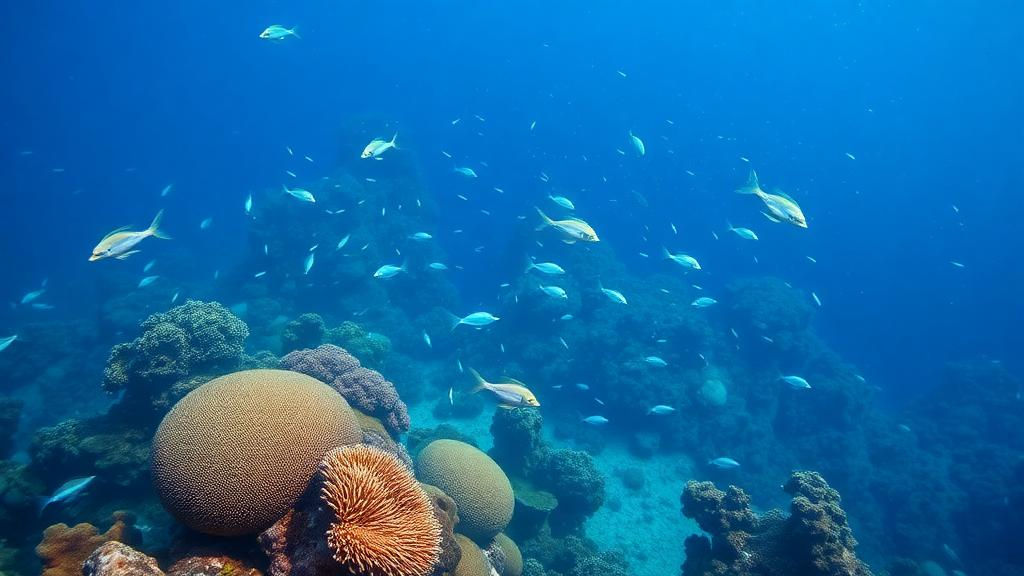
In the most ambitious attempt yet to count the reproductive output of an entire ocean realm, researchers have estimated that the coral reefs of the Indo-Pacific produce roughly three quintillion eggs — that is, 3.46 × 10^18 eggs — during a single hypothetical spawning period. The figure, derived from a new study published in Ecology and Evolution, represents the first semi-global estimate of coral fecundity and offers a striking measure of the regenerative capacity of the most biodiverse reef region on Earth. Behind that staggering number lies a more nuanced story: reproductive output varies enormously across species, genera and growth forms, and the corals that dominate egg production at the scale of a single square centimeter of tissue are not necessarily the ones that dominate the region’s total reproductive potential.
The research team, drawing on the Coral Traits Database, compiled fecundity-related data for 277 coral species across 55 genera. Direct empirical measurements of egg production existed for only ten of those species, so the authors turned to trait-based imputation, using the R package funspace and principal components analysis to estimate missing values for polyp density, eggs per polyp, and colony area. Where empirical values could be checked against imputed ones, the estimates followed the same general trends, although the method tended to overestimate at the very high end of the fecundity spectrum. The authors are candid that the resulting figures are first-order approximations rather than precise predictions, and they stress that the extensive infilling of sparse trait data carries a real danger of overgeneralization.
The analysis was conducted at three hierarchical levels. At the finest scale, fecundity per square centimeter was calculated by multiplying polyp density by the number of eggs per polyp. Colony-level fecundity was then derived by scaling that value to an average-sized colony for each species. Finally, total fecundity across the Indo-Pacific was estimated by combining species-level fecundity with geographic range sizes and mean coral cover data from the Status of Coral Reefs of the World: 2020 report, which put Indo-Pacific coral cover at approximately 189,498 square kilometers. Each step required simplifying assumptions, including that egg production per polyp remains constant as colonies grow and that most species reproduce during a single annual spawning event, an assumption broadly consistent with the broadcast-spawning behavior of the majority of coral species.
The results reveal a remarkable spread in reproductive output. Fecundity per square centimeter ranged from 276 eggs in the genus Stylophora to 24,046 eggs in the mushroom coral Polyphyllia, with a mean of 6,877 eggs per square centimeter. Other members of the family Fungiidae, including Ctenactis and Danafungia, recorded similarly enormous per-area values of more than 23,000 eggs per square centimeter. At the colony level, estimates ranged from about 34,000 eggs per average colony in Stylophora to nearly 3.75 million eggs in Polyphyllia, with a cross-species mean of roughly 1.13 million eggs per colony. These differences among genera were statistically significant at both the per-area and colony scales.
Perhaps the most counterintuitive finding is that per-area fecundity correlates only weakly with total fecundity across the Indo-Pacific, with an R-squared of just 0.217. Genera such as Pachyseris, Isopora and Coeloseris topped the regional rankings, each producing on the order of 4 × 10^16 eggs per square kilometer of reef, even though their per-area fecundity was comparatively modest. The explanation lies in abundance: total reproductive potential is driven as much by how much area a genus occupies as by how many eggs its polyps produce. This decoupling between local and regional scales has important implications, because it suggests that a coral’s contribution to reef recovery cannot be judged from tissue-level measurements alone.
When the authors ranked genera by their share of total reproductive potential, a familiar cast of reef-builders emerged. Acropora alone accounted for 28.6 percent of estimated total fecundity across the Indo-Pacific, or about 9.92 × 10^17 eggs, followed by Porites at 12.2 percent and Montipora at 8.1 percent. Together these three genera contributed nearly half of the region’s reproductive output. At the smaller spatial scales, however, the picture was more diverse: massive and branching growth forms each made up roughly half of total reproductive potential across the three levels, with massive corals dominating per-area and per-colony fecundity while branching corals led at the regional scale, likely reflecting their rapid growth rates, wide distributions and high abundance.
The study also uncovered substantial variation within genera. Among Acropora species, fecundity per square centimeter ranged from 233 eggs in Acropora nana to 2,642 eggs in A. fastigata and A. insignis. Montipora species spanned 468 to 14,170 eggs per square centimeter, while Porites ranged from 661 to 13,713. Such within-genus variation means that genus-level classifications can obscure ecologically meaningful differences among species, and it complicates efforts to predict reef resilience from taxonomy alone. The authors note that reproductive mode adds a further layer of complexity: six of the 277 species in the dataset are brooders that release developed larvae multiple times a year, and the single-spawning-event assumption likely underestimates their contribution, although the effect appears relatively minor given the timing of their larval release.
The implications for conservation are significant. Because total reproductive potential is shaped by abundance and range size as much as by per-colony fecundity, protecting highly fecund species at local scales may not translate into regional benefits. The authors argue that conservation efforts should prioritize fecund species across multiple spatial levels, and that identifying reproductive hotspots could enhance reef resilience in the face of climate change and habitat loss. The work also provides a baseline for modeling population dynamics, forecasting recovery after disturbances such as bleaching, cyclones and crown-of-thorns outbreaks, and designating marine protected areas as larval sources that sustain connectivity across the seascape.
There are sobering caveats. The coral cover data underpinning the regional extrapolation were collected between 1997 and 2006, meaning the estimates describe reproductive potential roughly two decades ago, before the repeated severe marine heatwaves of recent years. Elevated temperatures that cause bleaching have been repeatedly linked to reduced egg production, and ongoing losses of adult colonies directly undercut the reproductive capacity of reefs. The authors caution that even a reproductive output measured in quintillions may not be sufficient to counteract the rapid degradation driven by climate change, which has already produced significant declines in coral recruitment in the Caribbean and on the Great Barrier Reef. Whether the Indo-Pacific’s extraordinary fecundity can keep pace with warming oceans remains one of the defining questions for the future of the world’s reefs.
What the study makes unmistakably clear is that reproduction, long a neglected corner of coral science, deserves a central place in reef research and management. The authors hope their first-order estimates will invigorate the collection of empirical data on egg numbers, egg sizes and colony size-frequency distributions, filling the gaps that currently force researchers to rely on imputation. As bleaching events intensify, knowing which species and regions supply the larvae that rebuild reefs may prove as important as knowing which corals bleach first. The three quintillion eggs of the Indo-Pacific represent both a measure of what these ecosystems can still do and a benchmark against which their decline can be tracked.
Subject of Research: Estimation of coral fecundity and reproductive potential across Indo-Pacific reef species, genera and growth forms
Article Title: Patterns in Coral Fecundity Across the Indo‐Pacific
Article References: Bilodeau, M. M., & Quigley, K. M. (2026). Patterns in Coral Fecundity Across the Indo‐Pacific. Ecology and Evolution, 16(10), Article e74441. https://doi.org/10.1002/ece3.74441
Image Credits: AI Generated
DOI: 10.1002/ece3.74441
Keywords: coral reefs, fecundity, Indo-Pacific, Acropora, spawning, trait imputation, reef resilience, climate change, coral reproduction, biodiversity, conservation, Coral Traits Database
Cite Scienmag News
Margaret Porter. (October 5, 2026). Coral Reefs of the Indo-Pacific Release Three Quintillion Eggs in a Single Spawning Season. Scienmag. https://scienmag.com/coral-reefs-of-the-indo-pacific-release-three-quintillion-eggs-in-a-single-spawning-season/
Margaret Porter. "Coral Reefs of the Indo-Pacific Release Three Quintillion Eggs in a Single Spawning Season." Scienmag, 5 October 2026, https://scienmag.com/coral-reefs-of-the-indo-pacific-release-three-quintillion-eggs-in-a-single-spawning-season/. Accessed 5 October 2026.
Margaret Porter. "Coral Reefs of the Indo-Pacific Release Three Quintillion Eggs in a Single Spawning Season." Scienmag. October 5, 2026. https://scienmag.com/coral-reefs-of-the-indo-pacific-release-three-quintillion-eggs-in-a-single-spawning-season/


