

Tuesday, October 20, 2026
Science
No Result
View All Result
  • Login
  • HOME
  • SCIENCE NEWS
  • CONTACT US
  • HOME
  • SCIENCE NEWS
  • CONTACT US
No Result
View All Result
Scienmag
No Result
View All Result
Home Science News Biology

Continuous and asymmetric dorsal–ventral abundance associations along the wing in feather mite communities

October 20, 2026
in Biology
Drew Townsend
By Drew Townsend Scienmag Editorial Profile - Cell Biology
Reading Time: 3 mins read
0
Continuous and asymmetric dorsal–ventral abundance associations along the wing in feather mite communities

Continuous and asymmetric dorsal–ventral abundance associations along the wing in feather mite communities

65
SHARES
587
VIEWS
Share on FacebookShare on Twitter
ADVERTISEMENT

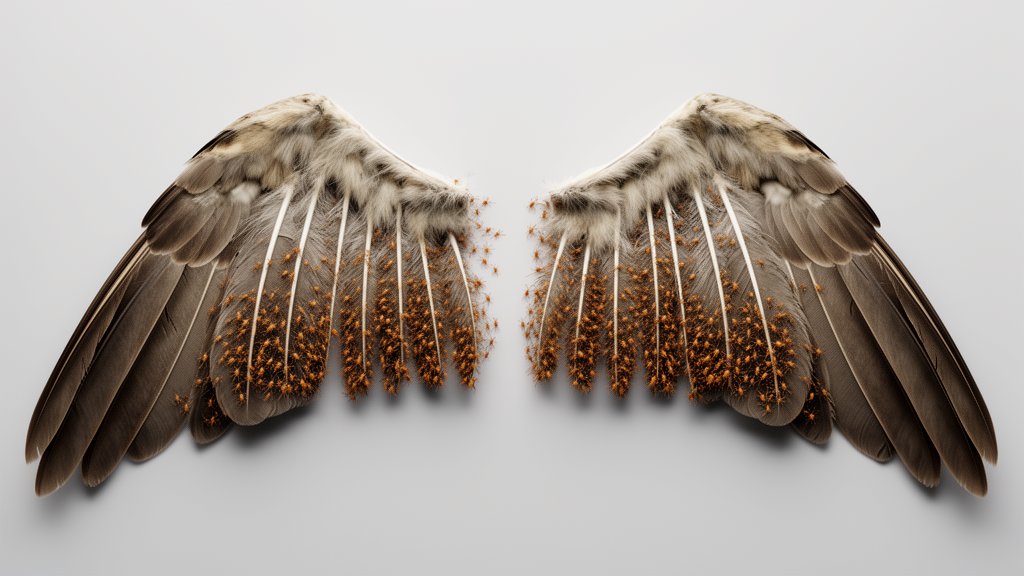
Feather mite communities on the wings of Siberian Rubythroats showed different patterns of dorsal and ventral abundance depending on position along the wing. An analysis of individual feathers found that the dorsal mite Trouessartia calliope was largely absent from the distal outer remiges, or flight feathers, and increased toward remiges closer to the body. The ventral mite Proctophyllodes sp. also exhibited a positional gradient.

When all positions were averaged, dorsal and ventral abundances were only weakly associated, but position-specific models revealed a stronger and changing relationship. The researchers examined feather-level spatial abundance associations along the proximodistal axis of the wing in Siberian Rubythroat, Calliope calliope . This axis extends from the innermost feathers near the body toward the outermost flight feathers.

Using nonlinear mixed-effects models, they assessed how the abundance of the two mite taxa varied among positions and whether mites on the dorsal and ventral surfaces followed associated patterns. The study addressed continuous variation within a host rather than dividing the wing into separate regions, allowing the relationship between the two surfaces to be assessed at multiple locations. The fitted dorsal–ventral slope was positive in the distal outer remiges, declined toward positions in the middle of the wing, and approached a weakly negative value in the innermost secondaries.

The authors caution that positive slopes in the distal outer remiges should not be taken as evidence of stable coexistence between the mite taxa. Because dorsal abundance was minimal in that region, the pattern may reflect responses to environmental constraints associated with distal wing positions rather than a persistent association between the two mites. This position-dependent pattern was detected in breeding adult birds but not in juveniles.

The researchers suggest that the difference may reflect age-related variation in within-host spatial organization. Juvenile birds may have had less time since mite transmission for their communities to assemble, whereas the pattern in adults may be more established. The analysis does not establish age as the direct cause or identify the mechanisms responsible.

In both age groups, mite abundances were bilaterally symmetrical, indicating broadly similar abundance on corresponding feathers of the left and right wings. The study also found no consistent effects of sex, date, or year. Together, the findings show that feather mite assemblages can be spatially heterogeneous even within a single host.

Pooling positions across the wing produced only weak overall dorsal–ventral associations, while the position-specific analysis revealed a relationship that ranged from positive to weakly negative. The results do not demonstrate that either mite taxon benefits from the presence of the other, nor do they show that one taxon causes changes in the abundance of the other. Instead, the study identifies wing position and bird age as important factors to consider when analyzing within-host mite communities, while bilateral symmetry and the absence of consistent date, year, or sex effects suggest a relatively stable spatial template associated with the host’s wing morphology.

Subject of Research: Spatial variation in dorsal and ventral feather mite abundance across Siberian Rubythroat wings

Article Title: Continuous and asymmetric dorsal–ventral abundance associations along the wing in feather mite communities

Article References: Takagi, M., Iwasaki, M., Yasuda, N., Shiraiwa, S., Katoh, T., & Takaku, G. (2026). Continuous and asymmetric dorsal–ventral abundance associations along the wing in feather mite communities. The Science of Nature, 113(6), Article 137. https://doi.org/10.1007/s00114-026-02182-4

Image Credits: AI Generated

DOI: 10.1007/s00114-026-02182-4

Keywords: feather mites, Siberian Rubythroat, spatial ecology, host-parasite relationships, wing morphology, mixed-effects models, community assembly, ectosymbionts, bird parasites, Continuous, asymmetric, dorsal

Cite Scienmag News

Drew Townsend. (October 20, 2026). Continuous and asymmetric dorsal–ventral abundance associations along the wing in feather mite communities. Scienmag. https://scienmag.com/continuous-and-asymmetric-dorsal-ventral-abundance-associations-along-the-wing-in-feather-mite-communities/


Drew Townsend. "Continuous and asymmetric dorsal–ventral abundance associations along the wing in feather mite communities." Scienmag, 20 October 2026, https://scienmag.com/continuous-and-asymmetric-dorsal-ventral-abundance-associations-along-the-wing-in-feather-mite-communities/. Accessed 20 October 2026.

Drew Townsend. "Continuous and asymmetric dorsal–ventral abundance associations along the wing in feather mite communities." Scienmag. October 20, 2026. https://scienmag.com/continuous-and-asymmetric-dorsal-ventral-abundance-associations-along-the-wing-in-feather-mite-communities/

Tags: asymmetricasymmetry in feather mite communitiesbird parasitescommunity assemblycontinuouscontinuous within-host parasite variationDorsaldorsal and ventral surface mite relationshipsdorsal-ventral abundance associationsectosymbiontsfeather mite distribution patternsfeather mite spatial distributionfeather mitesfeather remiges and mite ecologyhost individual variation in mite distributionhost-parasite relationshipsmixed-effects modelsnonlinear mixed-effects models in parasitologypositional variation in mite abundanceSiberian RubythroatSiberian Rubythroat feather mitesspatial ecologywing morphologywing position gradient in mites
Share26Tweet16
Previous Post

Research report: Nonlinear electrodynamics and stability of spherically symmetric space-times in scalar-tensor gravity

Next Post

Can radon help to improve methane emission estimates? Results from a dual-tracer inversion

Related Posts

Scanning microscopy maps conserved sensory structures in basal caddisfly palps
Biology

Scanning microscopy maps conserved sensory structures in basal caddisfly palps

October 20, 2026
Responses and assembly mechanisms of planktonic bacterial and fungal communities in the upper Chishui River during dry and wet seasons
Biology

Responses and assembly mechanisms of planktonic bacterial and fungal communities in the upper Chishui River during dry and wet seasons

October 20, 2026
Psyttalia carinata confirmed in China as sea buckthorn fly parasitoid
Biology

Psyttalia carinata confirmed in China as sea buckthorn fly parasitoid

October 20, 2026
Camera traps estimate male ocelot ranges in one Brazilian forest reserve
Biology

Camera traps estimate male ocelot ranges in one Brazilian forest reserve

October 20, 2026
Jeju survey describes two Cuprininae species and records three in Korea
Biology

Jeju survey describes two Cuprininae species and records three in Korea

October 20, 2026
Interactions between circular RNAs (circRNAs) and the Hippo pathway in cancer
Biology

Interactions between circular RNAs (circRNAs) and the Hippo pathway in cancer

October 20, 2026
Next Post
Can radon help to improve methane emission estimates? Results from a dual-tracer inversion

Can radon help to improve methane emission estimates? Results from a dual-tracer inversion

  • Mothers who receive childcare support from maternal grandparents show more optimized

    Mothers who receive childcare support from maternal grandparents show more parental warmth, finds NTU Singapore study

    27656 shares
    Share 11059 Tweet 6912
  • University of Seville Breaks 120-Year-Old Mystery, Revises a Key Einstein Concept

    1061 shares
    Share 424 Tweet 265
  • Bee body mass, pathogens and local climate influence heat tolerance

    682 shares
    Share 273 Tweet 171
  • Researchers record first-ever images and data of a shark experiencing a boat strike

    546 shares
    Share 218 Tweet 137
  • Groundbreaking Clinical Trial Reveals Lubiprostone Enhances Kidney Function

    531 shares
    Share 212 Tweet 133
Science

Embark on a thrilling journey of discovery with Scienmag.com—your ultimate source for cutting-edge breakthroughs. Immerse yourself in a world where curiosity knows no limits and tomorrow’s possibilities become today’s reality!

RECENT NEWS

  • Research report: Is a cost-optimal wind farm also carbon-optimal? A layout optimization and control co-design study
  • Trial links added care to lower bilirubin in preterm infants
  • Physics-Constrained Ka-Band Radar Retrieval Tested for Coastal Fog Visibility
  • Can radon help to improve methane emission estimates? Results from a dual-tracer inversion

Categories

  • Agriculture
  • Anthropology
  • Archaeology
  • Athmospheric
  • Biology
  • Biotechnology
  • Blog
  • Bussines
  • Cancer
  • Chemistry
  • Climate
  • Earth Science
  • Editorial Policy
  • Marine
  • Mathematics
  • Medicine
  • Pediatry
  • Policy
  • Psychology & Psychiatry
  • Science Education
  • Science News
  • Social Science
  • Space
  • Technology and Engineering

Subscribe to Blog via Email

Enter your email address to subscribe to this blog and receive notifications of new posts by email.

Join 5,150 other subscribers

© 2025 Scienmag - Science Magazine

Welcome Back!

Login to your account below

Forgotten Password?

Retrieve your password

Please enter your username or email address to reset your password.

Log In
No Result
View All Result
  • HOME
  • SCIENCE NEWS
  • CONTACT US

© 2025 Scienmag - Science Magazine

Discover more from Science

Subscribe now to keep reading and get access to the full archive.

Continue reading