


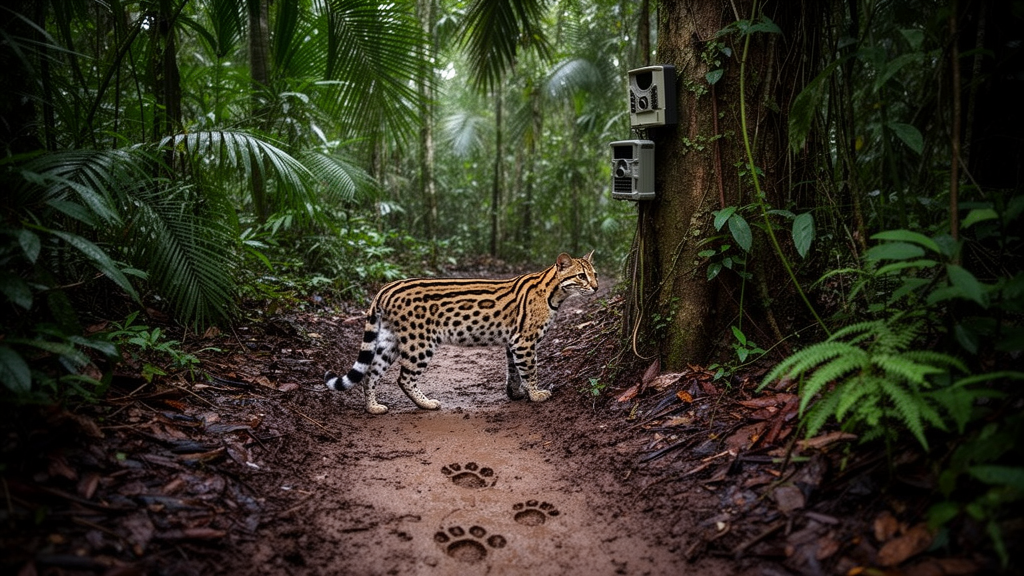
A year-long camera-trap study in a remnant of Brazil’s Lowland Atlantic Forest estimated the home ranges of three adult male ocelots at Vale Natural Reserve in Espírito Santo. Depending on the spatial method used, the three estimates ranged from 6.19 to 38.92 square kilometres. The mean was 12.08 ± 4.43 square kilometres with a 100% minimum convex polygon and 19.95 ± 9.49 square kilometres with a 95% adaptive kernel density estimator. The study identified 22 ocelots in total, but home ranges could be calculated only for males recorded at more than two of the eight monitored latrines, meaning the estimates describe a small subset of the population and only part of the area used by those animals.
The research was conducted at Vale Natural Reserve, a 22,711-hectare protected area between the municipalities of Linhares and Jaguaré in northern Espírito Santo. The reserve forms part of the Linhares-Sooretama Forest Block, which covers more than 53,000 hectares and represents about 11% of the forest remaining in the state. Most of Vale Natural Reserve consists of dense lowland forest on flat terrain, classified as perennial seasonal forest. The landscape also includes a locally named sandy-soil forest type called Mussununga, native grasslands, flooded swamps and areas affected by human uses. The climate is tropical with a dry winter, with a mean annual temperature of 24.3 °C and mean annual rainfall of 1,214 millimetres, although rainfall varied considerably among years.
Researchers collected data at eight ocelot latrines distributed across the reserve. These sites were identified through active searches and characterized by the repeated accumulation of feces and urine in the same location. One Bushnell Trophy Cam HD Agressor digital camera trap was installed on a tree stem facing each latrine. The cameras operated continuously for 24 hours a day from March 2018 to February 2019. At each trigger, they recorded two photographs and a 20-second video, with a 10-second interval between consecutive capture events. The design concentrated observations on sites that ocelots used for scent marking and that the source identifies as places of direct and indirect interaction within and between the sexes.
Ocelots were identified individually from their distinctive coat patterns, including spots and stripes. External sexual characteristics visible in males, together with relative body size, allowed the researchers to classify individuals by sex and age category. The records included eight adult males, 12 adult females and two cubs whose sex was not determined. Both flanks were recorded for six adult males, while only the right flank was available for two; all adult females were recorded on both flanks. Adult males appeared at every latrine, whereas females appeared at all but one. Seven of the eight latrines registered individuals of both sexes, and the two cubs were recorded at one of the eight sites.
Repeated detections at multiple latrines distinguished the spatial records of males from those of females. Six of the eight adult males were recorded at more than one latrine, and three males were each recorded at three sites, qualifying them for home-range estimation. All adult females were recorded at only one site, including the female observed with her two cubs. Males also shared latrines more frequently: the mean number of males recorded per latrine was 2.1, compared with 1.5 females, and five latrines contained more males than females. The observed adult sex ratio was 1.0 male to 1.5 females, unlike an earlier survey at the same reserve that registered more males. The authors suggested that the difference may partly reflect sampling design, because latrines are used for interactions and may have favored the recording of females, but the study did not directly establish the population’s true sex ratio.
Home-range size was estimated in two ways so the results could be compared with published studies that used different analytical approaches. The 100% minimum convex polygon, abbreviated MCP, produced estimates of 6.19 square kilometres for male Lp26, 20.76 square kilometres for Lp44 and 9.28 square kilometres for Lp65. The 95% adaptive kernel density estimator, abbreviated 95%K and calculated with a standard biweight or quartic kernel, produced respective estimates of 10.10, 10.83 and 38.92 square kilometres. The mean 95%K estimate was 1.6 times the mean MCP estimate. The 38.92-square-kilometre kernel estimate for Lp65 was also the largest individual value, showing that the range across the three males and the two methods extended from 6.19 to 38.92 square kilometres rather than being confined to the narrower interval between the smallest and largest polygon estimates.
Vale Natural Reserve’s estimates fell within the range reported for ocelots elsewhere. The source describes published home ranges across the species’ distribution as varying from 2 to 39 square kilometres and cites a meta-analysis with a species-wide mean of 17.4 ± 3.7 square kilometres and a male mean of 20.7 ± 6.1 square kilometres. Previous Atlantic Forest studies using MCP produced mean male estimates of 7.5 ± 4.8 square kilometres in Caraguatá Ecological Reserve in Santa Catarina, 13.4 ± 8.0 square kilometres in the Green Corridor of Misiones in Argentina, and 32.9 ± 10.9 square kilometres in Iguaçu National Park in Paraná. One previous study using 95%K reported a male mean of 45.2 ± 4.9 square kilometres at Iguaçu National Park. The Vale polygon estimate was near the middle of the MCP values reported for the biome, while its kernel estimate was almost half the previously reported kernel mean for male ocelots in Atlantic Forest.
Home-range estimates can vary with sex, age, population density, season, food availability and habitat conditions, but the present study did not measure all of these variables directly. The authors placed the perennial seasonal forest at Vale Natural Reserve between dense ombrophilous forest and dense subtropical semideciduous forest in a vegetation gradient, noting that the reserve’s polygon estimate was intermediate between the lower values reported for ombrophilous forest and the higher value reported for semideciduous forest. They suggested that vegetation structure could affect productivity and prey availability, with smaller ranges potentially associated with greater food availability. That interpretation was based on the reserve’s result together with published values from other sites; the study did not measure prey abundance or establish a general inverse relationship between food availability and ocelot home-range size.
Behavioral interpretations were likewise presented in the context of previous ocelot research. The broader overlap among male records and the lower overlap among female records were consistent with studies in which males occupy larger ranges, although access to females can also influence male movement. The authors cited observations that pregnant and lactating females may increase patrolling and scent marking, potentially making them less tolerant of territorial overlap with other females. Relaxed territoriality among familiar females outside breeding periods, or possible family relationships, were proposed as possible explanations for four adult females using the same latrine, including the female with cubs. These explanations were not tested directly, so they remain interpretations rather than measured causes of the observed distribution.
The study’s central contribution is a paired set of home-range estimates for three adult male ocelots in Lowland Atlantic Forest, accompanied by population and spatial records for 22 identified animals at eight latrines. Its limitations are substantial: only males appearing at more than two latrines received range estimates, the sample comprised three individuals, and the eight monitoring points did not cover the full landscape available to them. The authors therefore described the calculated areas as portions of the total ranges used by the males. Within that scope, the results show that estimates from the same three animals varied markedly with method and place Vale Natural Reserve within the range of previously published ocelot home-range measurements. They also identify latrines as effective monitoring locations for gathering information on ocelot population and spatial ecology, providing reference values for this reserve, the wider Linhares-Sooretama block and comparable lowland forest.
Subject of Research: Camera-trap estimation of male ocelot home ranges in southeastern Brazil’s Lowland Atlantic Forest
Article Title: Ocelot, Leopardus pardalis ( Mammalia , Carnivora , Felidae ), home range in the Lowland Atlantic Forest of Southeastern Brazil
Article References: Magalhães, L. M., & Srbek-Araujo, A. C. (2022). Ocelot, Leopardus pardalis (Mammalia, Carnivora, Felidae), home range in the Lowland Atlantic Forest of Southeastern Brazil. Neotropical Biology and Conservation, 17(4), 229-237. https://doi.org/10.3897/neotropical.17.e93828
Image Credits: AI Generated
DOI: 10.3897/neotropical.17.e93828
Keywords: ocelot, Leopardus pardalis, home range, camera traps, Atlantic Forest, spatial ecology, wildlife monitoring, Espírito Santo, latrines, kernel density estimation, Leopardus, pardalis
Cite Scienmag News
Margaret Porter. (October 20, 2026). Camera traps estimate male ocelot ranges in one Brazilian forest reserve. Scienmag. https://scienmag.com/camera-traps-estimate-male-ocelot-ranges-in-one-brazilian-forest-reserve/
Margaret Porter. "Camera traps estimate male ocelot ranges in one Brazilian forest reserve." Scienmag, 20 October 2026, https://scienmag.com/camera-traps-estimate-male-ocelot-ranges-in-one-brazilian-forest-reserve/. Accessed 20 October 2026.
Margaret Porter. "Camera traps estimate male ocelot ranges in one Brazilian forest reserve." Scienmag. October 20, 2026. https://scienmag.com/camera-traps-estimate-male-ocelot-ranges-in-one-brazilian-forest-reserve/


