


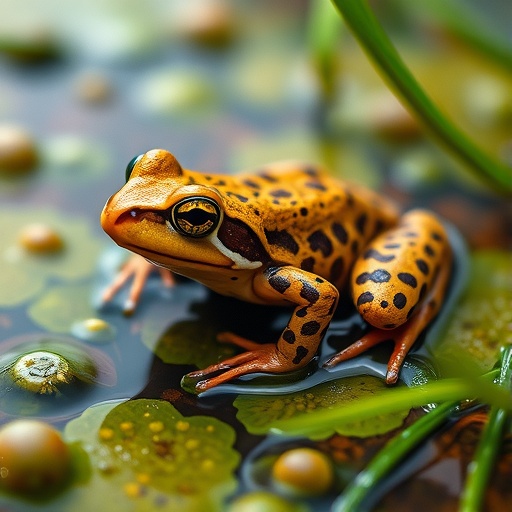
The intricate relationship between environmental connectivity and disease resistance in amphibians has emerged as a crucial topic in conservation biology, drawing significant attention from researchers aiming to halt the alarming decline of amphibian populations worldwide. Recent discoveries highlight that habitat fragmentation not only diminishes overall biodiversity but also disrupts the intricate balance of microbial communities essential for amphibians’ health. In particular, the spatial arrangement of habitats plays a pivotal role in shaping the defensive capabilities of amphibian skin microbiomes against lethal pathogens.
Amphibians are among the most vulnerable groups affected by emerging infectious diseases, notably the chytrid fungus Batrachochytrium dendrobatidis (Bd). This fungal pathogen has been implicated in the decline and extinction of over 500 amphibian species globally across the past five decades. The amphibian skin microbiome, composed of diverse bacterial species, is known to exert important antibacterial and antifungal effects, offering a natural defense mechanism against pathogens like Bd. However, alterations in habitat structure and landscape connectivity may severely impair this microbial shield.
A multi-institutional research team from the Smithsonian Tropical Research Institute (STRI), Pennsylvania State University, and international collaborators undertook an extensive field study across 40 distinct locations in Brazil’s Atlantic Forest, a biodiversity hotspot characterized by significant habitat fragmentation. These sites included both forest fragments, isolated patches degraded by anthropogenic activities, and continuous forest tracts showcasing varied degrees of habitat disturbance. By quantifying metrics such as natural land cover, forest edge density, and a novel parameter described as habitat split—measuring the distance between forest fragments and aquatic habitats—the researchers probed correlations with amphibian skin microbiome composition and function.
The study focused on four frog species exhibiting diverse aquatic habitat dependencies, particularly reflecting differences in their exposure to Bd’s infectious zoospores released into water bodies. Species with aquatic larval stages necessitate migration across fragmented and often hostile landscapes, such as pastures or agricultural fields, to find breeding sites. This movement exposes them to both environmental challenges and alterations in microbial communities that are critical for their disease defense.
Data analysis revealed a pronounced negative correlation between habitat split and the capacity of amphibian skin bacterial communities to inhibit Bd. In highly fragmented landscapes where connectivity between terrestrial and aquatic habitats was compromised, microbial communities exhibited reduced functional diversity and protective capacity. This finding underscores the essential role of habitat connectivity not only for animal movement but also for maintaining symbiotic microbial assemblages crucial for host survival and disease resistance.
Lead author Daniel Medina from STRI emphasized that habitat connectivity sustains multiple tiers of biodiversity, extending from macro-organisms to microbial symbionts with specific defensive functions. This connectivity cultivates resilient microbiomes capable of producing bioactive compounds that suppress pathogenic fungi, thereby reducing disease prevalence and associated mortality in amphibians. Such ecological insight redefines the consequences of habitat fragmentation beyond the conventional focus on species loss.
Senior author Gui Becker from Pennsylvania State University highlighted that the implications of disrupted habitat connectivity transcend amphibians. Many animal taxa—including migratory birds, Pacific salmon, and large mammals—rely on interconnected habitats to complete their life cycles. When landscape fragmentation disrupts these connections, it can alter host-microbe interactions, potentially diminishing the animals’ capacity to engage beneficial microbiomes that protect against infectious agents.
This research advances current understanding by linking habitat spatial structure with host-associated microbial ecology and disease dynamics. It reveals that the conservation of habitat corridors and the mitigation of habitat split are critical not only for facilitating animal dispersal but also for preserving beneficial microorganism communities that underpin health and resist pathogen invasion.
The findings bear profound conservation implications. Preserving and restoring habitat connectivity represents a viable strategy to sustain amphibian populations by fortifying their natural microbial defenses. Without such interventions, isolated populations may suffer compounded risks from both environmental stressors and increased susceptibility to diseases such as chytridiomycosis, accelerating population declines and extinctions.
Moreover, this research supports a paradigm shift wherein conservation actions must encompass microbial biodiversity as an integral component of ecosystem and animal health management. The study suggests that microbial communities are vulnerable to landscape changes in ways that mirror those of macrofauna, thus broadening the scope of biodiversity conservation.
Interestingly, parallels can be drawn between amphibians and humans regarding environmental microbiome exposure. Recent research indicates that diverse microbial exposure, especially in natural and biodiverse settings, benefits human immune system development, particularly in children. This convergence hints at fundamental ecological principles governing host-microbe interactions across taxa, reinforcing the significance of preserving microbial diversity within natural habitats.
In summary, this groundbreaking study published in the Proceedings of the National Academy of Sciences (PNAS) elucidates how spatial connectivity of habitats enhances the amphibian skin microbiome’s ability to defend against harmful fungal pathogens. By integrating ecological, microbiological, and conservation sciences, the study elevates our understanding of how habitat fragmentation drives disease vulnerability and offers actionable insights for biodiversity preservation in fragmented landscapes.
News Publication Date: 20-Apr-2026
Web References:
– https://www.pnas.org/doi/10.1073/pnas.2520745123
References:
Medina, D., Martins, R. A., Prist, P., Lyra, M. L., Kearns, P. J., Woodhams, D. C., Buttimer, S., Neely, W. J., Schuck, L. K., Greenspan, S. E., Bletz, M. C., São‑Pedro, V. A., Haddad, C. F. B., & Becker, C. G. (2026). Connecting habitats, boosting disease resistance: Spatial connectivity enhances amphibian microbiome defenses against fungal pathogen. Proceedings of the National Academy of Sciences, 123(17), e2520745123.
Cite Scienmag News
Morgan Morrow. (April 22, 2026). Connected habitats promote diverse frog microbiomes that help prevent disease. Scienmag. https://scienmag.com/connected-habitats-promote-diverse-frog-microbiomes-that-help-prevent-disease/
Morgan Morrow. "Connected habitats promote diverse frog microbiomes that help prevent disease." Scienmag, 22 April 2026, https://scienmag.com/connected-habitats-promote-diverse-frog-microbiomes-that-help-prevent-disease/. Accessed 3 September 2026.
Morgan Morrow. "Connected habitats promote diverse frog microbiomes that help prevent disease." Scienmag. April 22, 2026. https://scienmag.com/connected-habitats-promote-diverse-frog-microbiomes-that-help-prevent-disease/


