


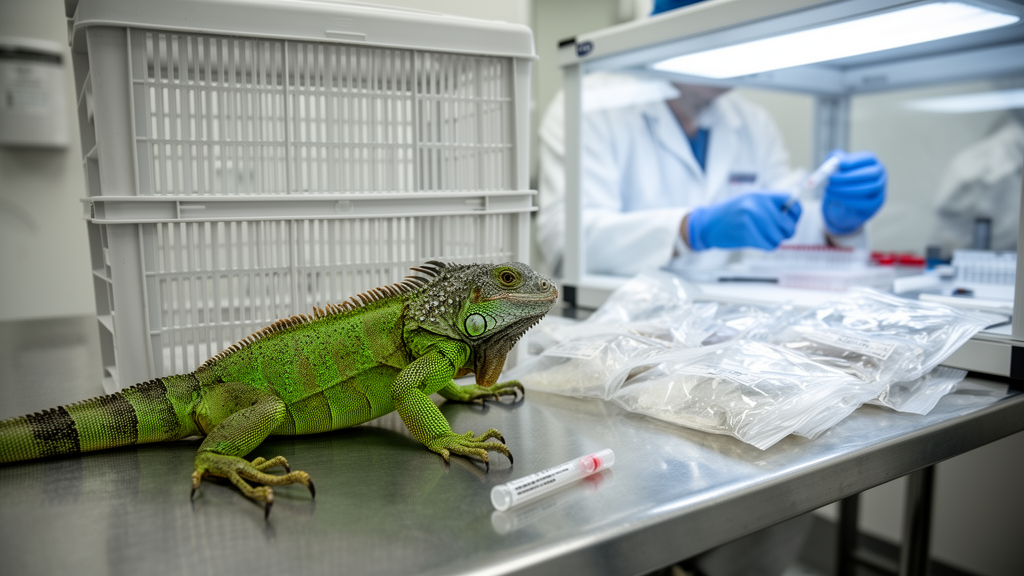
In May 2025, Honduran Border Police made a seizure at an official border crossing to Nicaragua that would end up stumping scientists. Among the confiscated animals were dozens of spiny lizards of the genus Sceloporus, a group prized in the illegal pet trade and notoriously difficult to identify. When researchers later ran DNA barcodes from seven of those lizards through public genetic databases, the results were startling: the animals did not properly match anything scientists have on record. The closest available reference sequences, labeled as the emerald spiny lizard Sceloporus malachiticus, topped out at just 93.7 percent identity, a gap far too wide for a confident species-level match.
The study, published in Frontiers in Conservation Science, represents what the authors believe is the first forensic genetic assessment of confiscated Sceloporus lizards in Honduras. Led by Manfredo A. Turcios-Casco of the Asociación Para La Sostenibilidad e Investigación Científica en Honduras and Mauricio Hernández of the National Autonomous University of Honduras, the team set out to close a knowledge gap that has real consequences for wildlife law enforcement. Central America remains dramatically underrepresented in genetic reference databases, particularly for reptiles, and that shortfall means authorities often cannot determine what species they have seized, where the animals came from, or whether they belong to lineages science has never documented.
The genus Sceloporus is one of the most diverse groups of lizards in the Americas, comprising more than 117 species distributed from southern Canada to western Panama. These spiny lizards occupy an extraordinary range of habitats, from lowland deserts and shrublands to rocky xeric landscapes and high-elevation alpine forests. Despite extensive research in the United States and Mexico, comparatively little molecular work has been done in Central America, where the scarcity of reference sequences in repositories such as GenBank and the Barcode of Life Data System (BOLD) makes accurate identification and delimitation genuinely challenging. Morphological traits, including femoral pore counts, scalation, and coloration patterns, have traditionally been used for diagnosis within the genus, but substantial uncertainty remains regarding species boundaries, largely due to extensive morphological variation, morphological convergence, and cryptic diversity.
Honduras is a case study in that uncertainty. Three Sceloporus species have been reported in the country, along with two recently described endemic taxa within the S. malachiticus complex. Herpetologist James McCranie noted in 2018 that the S. malachiticus population from La Tigra National Park more closely resembled Costa Rican populations than those from geographically closer La Esperanza, highlighting the taxonomic tangle. McCranie even proposed the existence of three putative species within the complex in Honduras, including one from Ocotepeque and Celaque National Park characterized by irregular head scales and males with bright lime-green dorsal coloration and cobalt-blue abdominal markings. Populations from western Honduras are currently considered conspecific with Guatemalan and Salvadoran animals identified as S. acanthinus, yet six Honduran specimens near the Guatemalan border that molecular data assign to the S. acanthinus clade lack the diagnostic morphological characters that define that species.
The seven lizards in the new study were part of a much larger seizure that also included alligator lizards, spiny-tailed iguanas, a snake, and salamanders. The Sceloporus animals, categorized nationally as Endangered, were placed under the custody of the Instituto de Conservación Forestal, Áreas Protegidas y Vida Silvestre and transferred to the El Ocotal rescue center in Sabanagrande. Their geographic origin remains unknown, a reflection of the clandestine nature of wildlife trafficking. Only adult individuals, with snout-vent lengths between 59.1 and 84 millimeters, were considered to avoid biases related to body proportions, scalation patterns, and coloration. Tissue samples were obtained from 18 adult lizards by removing approximately one centimeter of the distal tail tip, a minimally harmful but invasive procedure performed by trained personnel and authorized by the national wildlife authority.
Morphological examination identified three distinct morphotypes based on frontal scale configuration and ventral semeion morphology. The absence of dorsolateral pale stripes allowed the team to exclude S. squamosus and S. variabilis, both of which possess that character. Morphotype 1 displayed a divided anterior frontal scale together with clearly separated ventral semeia, corresponding to the morphology traditionally attributed to S. schmidti. Morphotype 2 exhibited an undivided anterior frontal scale and well-separated ventral semeia, consistent with the published diagnosis of S. hondurensis. Morphotype 3 showed irregular frontal scale configurations that did not conform to the published diagnoses of either species, though all individuals possessed well-defined black abdominal bars that allowed the exclusion of S. esperanzae.
Then came the molecular twist. Nine specimens, three from each morphotype, were selected for balanced representation, and seven yielded high-quality bidirectional COI reads with final consensus lengths between 658 and 678 base pairs. Despite the morphological criteria used for assignment, the sequences showed very low nucleotide divergence, with mean pairwise identity of 99.4 percent, and formed a single strongly supported COI cluster with 100 percent bootstrap support in the Neighbor-Joining analysis. No cluster corresponded uniquely to any specific morphotype. The discordance between morphological assignment and mitochondrial variation was the most consistent pattern recovered, suggesting that frontal scale configuration, traditionally used as a diagnostic character within the S. malachiticus complex, may exhibit greater intraspecific variation than currently assumed, or may be of limited diagnostic value within this group.
When the seven confiscated sequences were analyzed together with an expanded reference dataset of 69 sequences spanning 16 Sceloporus species, the confiscated specimens again formed a strongly supported cluster showing its closest mitochondrial affinity to sequences labeled as S. malachiticus. But the identity values remained low, never exceeding 93.7 percent in GenBank and 93.42 percent in BOLD. The top GenBank match in all cases corresponded to accession MH274629.1, a record reported from Colón, Honduras, though at this level of similarity the locality cannot be taken as an indication of the geographic origin of the confiscated specimens. The authors are careful to note that the reference dataset represents only 16 of the more than 117 recognized species in the genus, so the result should be read as the absence of a closer match within the currently available reference framework rather than as evidence that incomplete reference sampling can be excluded.
Several non-mutually exclusive explanations may account for the pattern, including erroneous taxonomic assignments of reference sequences, low-quality or incomplete reference data, unsampled variation within the S. malachiticus complex, or the possibility that the confiscated specimens belong to a taxonomically distinct lineage not currently represented in public repositories. The present data cannot discriminate among these alternatives. A single mitochondrial locus is generally insufficient on its own for evaluating gene flow, hybridization, or robust species delimitation, and the authors emphasize that the Neighbor-Joining dendrograms should be interpreted as barcode-based clustering analyses rather than definitive phylogenetic reconstructions. Resolving the taxonomic status of these animals will require additional nuclear and mitochondrial markers, broader geographic sampling, more specimens, voucher-based reference sequences, and integrative morphological analyses.
From a wildlife forensic perspective, the inability to confidently assign confiscated specimens to a described taxon underscores the current limitations of regional reference databases. Illegal wildlife trade continues to represent a major conservation challenge in Central America, where weaknesses in enforcement capacity and legal frameworks may facilitate the movement of wild-caught animals through commercial networks. The authors are equally careful to distinguish empirical documentation from inference: while the confiscation of these lizards during a wildlife trafficking seizure is documented, their geographic provenance and trafficking route remain unknown, and the molecular data do not establish whether the animals are native to Honduras or were imported from elsewhere. What the findings do establish is that specimens with unresolved taxonomic affinities were recovered during a trafficking seizure, and that the mitochondrial variation they carry is not adequately represented in public databases. Expanding validated, voucher-based genetic reference datasets will be essential for improving species identification and may ultimately facilitate more reliable assessments of geographic origin, strengthening the capacity of conservation and law-enforcement authorities to investigate and address wildlife trafficking across the region.
Subject of Research: Conservation Genetics
Article Title: Molecular assessment of confiscated Sceloporus lizards (Squamata: Phrynosomatidae) reveals unresolved taxonomic affinities and genetic reference gaps in Honduras
Article References: Turcios-Casco, M. A., Hernández, M., Bautista Alcantara, L. F., Velásquez, A., & Fontecha, G. (2026). Molecular assessment of confiscated Sceloporus lizards (Squamata: Phrynosomatidae) reveals unresolved taxonomic affinities and genetic reference gaps in Honduras. Frontiers in Conservation Science, 7, Article 1879593. https://doi.org/10.3389/fcosc.2026.1879593
Image Credits: AI Generated
DOI: 10.3389/fcosc.2026.1879593
Keywords: Sceloporus, wildlife forensics, DNA barcoding, Honduras, illegal wildlife trade, COI gene, conservation genetics, reptiles, Molecular, assessment, confiscated, lizards
Cite Scienmag News
Juliet Wilcox. (October 17, 2026). Confiscated Lizards in Honduras Leave DNA Databases Stumped. Scienmag. https://scienmag.com/confiscated-lizards-in-honduras-leave-dna-databases-stumped/
Juliet Wilcox. "Confiscated Lizards in Honduras Leave DNA Databases Stumped." Scienmag, 17 October 2026, https://scienmag.com/confiscated-lizards-in-honduras-leave-dna-databases-stumped/. Accessed 17 October 2026.
Juliet Wilcox. "Confiscated Lizards in Honduras Leave DNA Databases Stumped." Scienmag. October 17, 2026. https://scienmag.com/confiscated-lizards-in-honduras-leave-dna-databases-stumped/


