


Canine cognitive dysfunction syndrome, the dog equivalent of human dementia, has become one of the most pressing welfare challenges of modern pet ownership. As dogs live longer, questionnaire surveys indicate that 3.4 percent of dogs aged 10 to 12 years meet the criteria for the disorder, rising to 18.6 percent among those aged 12 to 14 years and 31 percent among dogs over 14 years. Affected animals show disorientation, disrupted sleep-wake cycles, anxiety, house soiling, and altered social behavior, imposing growing burdens on both the dogs and their owners. With no curative treatment established, management currently relies on symptomatic approaches such as environmental enrichment, dietary therapy, and drugs like selegiline and propentifylline. Against this backdrop, a research team from Azabu University, Tsubota Laboratory, Keio University School of Medicine, and Nihon University tested an unconventional candidate: violet light, the short-wavelength band of visible sunlight between 360 and 400 nanometers.
The rationale rests on a photoreceptor called OPN5, or neuropsin, a non-visual, violet-light-sensitive opsin that is widely conserved across mammals. The OPN5 gene has been identified in the canine genome, and the receptor is expressed in the retina, the preoptic area of the hypothalamus, and the skin. In mice, violet light exposure has been shown to suppress myopia by inhibiting hyaloid vasculature, to photoentrain local circadian oscillators in the retina and cornea, and to modulate thermogenesis through hypothalamic OPN5 neurons. Most intriguingly, studies in aged mice revealed that violet light exposure improves memory, increases hippocampal neuronal activity, and alleviates depressive-like behaviors, apparently by projecting to the medial subdivision of the dorsal habenula, a brain region that regulates depression, fear, memory, and anxiety. Because violet light is abundant outdoors but blocked by window glass and conventional indoor lighting, the researchers hypothesized that indoor-housed dogs may suffer a deficiency of this wavelength, and that supplementation could mitigate age-related brain changes even without outdoor access.
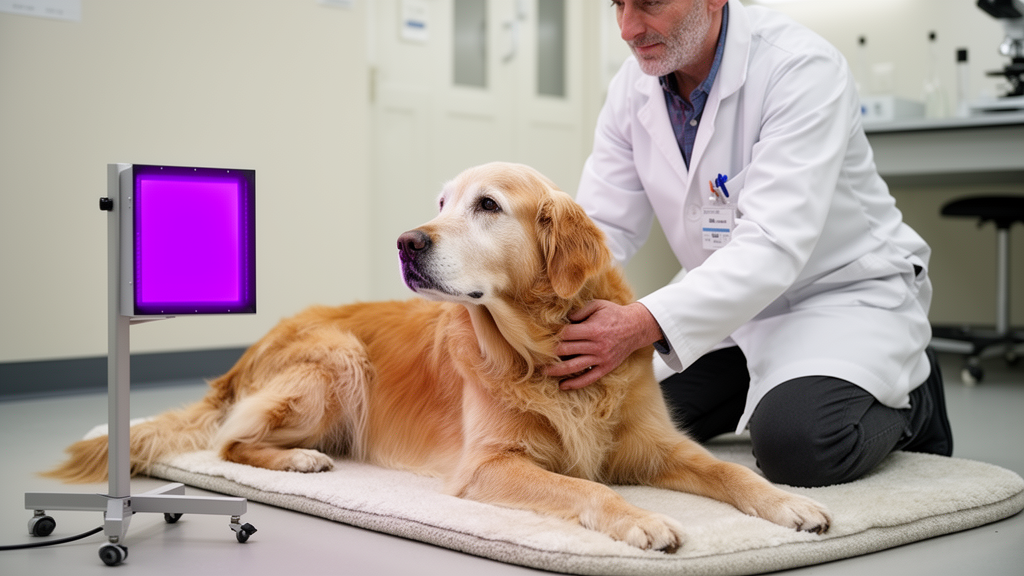
To test this, the team developed a novel violet light irradiation device and conducted a pilot study at Animal Care House, a specialized nursing facility for elderly dogs in Aichi, Japan. Seven geriatric dogs, four males and three females with a mean age of 15.5 plus or minus 0.71 years, were enrolled after screening by veterinarians. The subjects included Toy Poodles, Shibas, and a mixed-breed dog, all selected for being active with no visual impairments. Two dogs discontinued midway due to poor physical condition and were excluded from statistical analysis. The study employed an ABA intra-individual design over approximately two months: a one-month violet light exposure phase preceded and followed by two-week non-exposure periods, allowing each dog to serve as its own control. During the exposure phase, dogs spent two hours daily, between 11:00 and 14:00, inside a cage fitted with four violet light sources, with peak wavelengths of 400 nanometers in the first cycles and 375 nanometers thereafter.
Physical activity was measured continuously around the clock using three-axis Bluetooth accelerometers attached to the dogs’ collars, sampling at 12.5 Hz and transmitting data to Android smartphones. The raw acceleration data were processed in MATLAB, where the three-axis signals were combined into a scalar value and the standard deviation was calculated every 30 seconds. A decision-tree classifier then categorized each 30-second interval into seven activity clusters, with higher scores indicating greater activity. Cognitive function was assessed using two validated questionnaires, the Canine Cognitive Dysfunction Rating Scale and the DISHAA scale, completed by experienced facility staff at five time points spanning the pre, light, and post periods. Safety was monitored through general physical examinations, including body temperature, heart and respiratory rates, cardiac auscultation, and palpation, as well as full ophthalmic examinations covering pupillary light reflexes, intraocular pressure, tear production, fluorescein staining, and fundus assessment. All procedures were approved by the Animal Ethics Committee of Azabu University.
The overall results were statistically null. Friedman tests comparing activity levels across the pre, light, and post periods found no significant differences for daytime activity (chi-squared = 4.22, p = 0.12) or nighttime activity (chi-squared = 1.58, p = 0.45), nor for morning and afternoon blocks. Similarly, no significant overall effects emerged for either questionnaire (DISHAA: chi-squared = 1.60, p = 0.45; CCDR: chi-squared = 1.56, p = 0.46). Even after excluding two dogs with severe cognitive dysfunction at baseline, and after applying a generalized linear mixed model to account for one dog completing three experimental sessions, no significant differences were observed for any item. The veterinarians identified no overt clinical abnormalities associated with the violet light irradiation, meaning the intervention appeared safe.
Yet beneath the null statistics, the individual data told a more nuanced story. A trend toward cognitive improvement, reflected in declining questionnaire scores, was observed in six out of seven dogs. An upward trend in activity levels, suggesting improved physical function, was noted in two out of seven dogs. In one dog, the total DISHAA score decreased from the pre to the light and post periods, with similar trends in house soiling, learning and memory, and activity items, while the CCDR score was highest at baseline and declined thereafter. Another dog showed a progressive decrease in total DISHAA and CCDR scores throughout the study. The researchers suggest that violet light may exert distinct effects on cognitive and physical functions independently, implying that changes in physical function and central nervous system function are not necessarily causally linked, a dissociation also reported in bright-light treatment studies in mouse models of Parkinson’s disease.
The authors propose that indoor-housed dogs may be susceptible to what they call indoor diseases. In humans, a close correlation between outdoor activity and health outcomes such as myopia prevalence and depression risk is well established, and the present results indicate that the lack of outdoor exposure may significantly impact the overall health and quality of life of indoor dogs. Because violet light is filtered out by glass and standard indoor lighting, dogs kept permanently indoors may lack a wavelength that their photoreceptive systems evolved to use, a deficiency that could contribute to circadian disruption, mood instability, and cognitive decline in old age.
The study also candidly acknowledged its limitations, which are substantial for a pilot of this scale. Only two of the subjects met the diagnostic criteria for cognitive dysfunction syndrome at baseline, making it impossible to draw definitive conclusions about efficacy specifically for the disorder. The sample of seven dogs, heavily biased toward very geriatric animals aged 14 to 16 years, precluded comparative analyses by severity, age, breed, or body size, even though small breeds carry a higher risk of cognitive dysfunction. Several dogs presented with nuclear sclerosis, an age-related lens change that may have altered ocular light transmittance and thus the amount of violet light reaching retinal OPN5. Moreover, the exposure window between 11:00 and 14:00 coincided with a period when geriatric dogs tend to rest with their eyes closed, so some subjects may have been asleep during irradiation, and the brightness may have caused squinting. The one-month exposure duration is also short compared with the six months or more typically used in human dementia trials.
The authors conclude that while this pilot study did not demonstrate a clear overall effect, the potential efficacy of violet light irradiation was observed in a subset of individuals, and the study identified improvable aspects of the experimental protocol, including subject selection criteria and irradiation methodology. Future research should prioritize exposure during periods of confirmed wakefulness, select subjects with uniform ocular status, and directly evaluate OPN5 expression and pathway activation in canines, since the receptor’s role was not assessed in this study. Larger-scale trials controlling for variables such as breed, neuter status, and disease stage, particularly in senior dogs during the pre-onset or early stages of cognitive dysfunction, will be needed for a more definitive evaluation. For now, the idea that a missing slice of sunlight might matter for the aging canine brain remains an intriguing hypothesis, one that this small pilot has kept alive without proving.
Subject of Research: Violet light exposure in aging dogs: pilot study results
Article Title: Effects of violet light exposure on aging dogs: a pilot study
Article References: Miyamoto, K., Ono, N., Kondo, S., Miwa, Y., Tsubota, K., Ozawa, M., & Kikusui, T. (2026). Effects of violet light exposure on aging dogs: a pilot study. Frontiers in Veterinary Science, 13, Article 1890157. https://doi.org/10.3389/fvets.2026.1890157
Image Credits: AI Generated
DOI: 10.3389/fvets.2026.1890157
Keywords: dogs, aging, cognitive dysfunction, violet light, OPN5, light therapy, veterinary science, pilot study, canine health, neuroscience, Effects, violet
Cite Scienmag News
Beatrice Stafford. (October 17, 2026). Violet Light Shows Hints of Cognitive Benefit in Aging Dogs, Pilot Study Finds. Scienmag. https://scienmag.com/violet-light-shows-hints-of-cognitive-benefit-in-aging-dogs-pilot-study-finds/
Beatrice Stafford. "Violet Light Shows Hints of Cognitive Benefit in Aging Dogs, Pilot Study Finds." Scienmag, 17 October 2026, https://scienmag.com/violet-light-shows-hints-of-cognitive-benefit-in-aging-dogs-pilot-study-finds/. Accessed 17 October 2026.
Beatrice Stafford. "Violet Light Shows Hints of Cognitive Benefit in Aging Dogs, Pilot Study Finds." Scienmag. October 17, 2026. https://scienmag.com/violet-light-shows-hints-of-cognitive-benefit-in-aging-dogs-pilot-study-finds/


