


In the realm of otologic surgery, addressing pulsatile tinnitus—a condition characterized by rhythmic noise synchronized with the patient’s heartbeat—remains a persistent challenge. Despite advances in diagnostic imaging and surgical techniques, crucial gaps continue to exist in understanding short-term symptom dynamics and recovery processes post-intervention. The recent study by researchers at Fudan University, published in the spring of 2026 in the journal ENT Discovery, delivers pivotal insights into these issues, particularly concerning the application of bone cement in modified sigmoid sinus wall reconstruction (SSWR) procedures.
Pulsatile tinnitus often stems from vascular anomalies involving the sigmoid sinus or nearby osseous structures. The modified SSWR technique aims to reconstruct the sigmoid sinus wall to alleviate the aberrant hemodynamic forces responsible for the auditory disturbance. Yet, until now, surgeons have grappled with the unpredictable short-term fluctuation of symptoms and the lack of consensus on optimal reconstructive materials, contributing to inconsistent postoperative outcomes. This study meticulously charts the postoperative symptom trajectory, delineating a clearer roadmap for patient prognosis.
Investigators followed a cohort of 26 patients who underwent the modified SSWR with bone cement—a biomaterial chosen for its osteoconductivity, malleability, and potential for durable cranial vault remodeling. Utilizing standardized tinnitus evaluation scales alongside advanced imaging modalities spanning computed tomography and magnetic resonance venography, the team conducted rigorous monitoring of symptom patterns during the crucial first month following surgery.
Remarkably, the findings demonstrate a high overall success rate of 96.2%, denoting near-complete remission or resolution of pulsatile tinnitus symptoms in the majority of patients. Most notably, these improvements predominantly manifested within the initial four weeks, emphasizing the acute recovery window as a period of critical clinical focus. This suggests that careful postoperative assessment during this timeframe can provide essential prognostic indicators and inform tailored patient management.
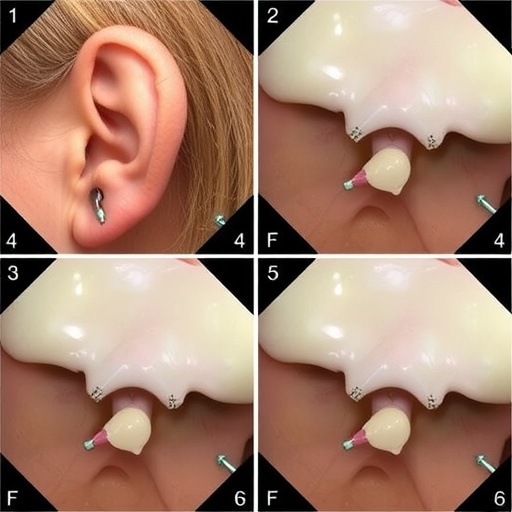
The surgical nuances detailed include precise calibration of bone-cement depth, strategically dictated by the individual anatomical parameters such as the mastoid air-cell volume and proximity of the sigmoid sinus. The study’s accompanying high-resolution imaging clearly delineates how these anatomic considerations govern the intraoperative cement application, balancing the need for robust reconstruction against the preservation of adjacent vascular structures. This represents a significant advance in surgical planning, ensuring that intervention is both effective and safe.
Furthermore, bone cement’s role as a reconstructive material is underscored by its biocompatibility and ability to integrate with host bone, minimizing postoperative complications related to infection or implant failure. By providing a solid yet conformable interface, it supports the sigmoid sinus wall structurally and mitigates aberrant pulsatile blood flow, which aligns well with the targeted pathophysiology of this form of tinnitus.
The study’s quantitative approach to symptom tracking, employing validated psychometric scales and audiologic assessments, lends objectivity to what has historically been a subjectively reported ailment. The short-term fluctuations—often experienced as transient recurrences or mild symptom intensifications—are now better contextualized within a recovery timeline, improving the surgeon’s ability to counsel patients on expected postoperative courses.
This research bridges a critical knowledge gap by substantiating bone cement’s effectiveness in modified SSWR and by providing empirical evidence that refines surgical technique. The implications extend broadly to clinical otology, offering a replicable model for personalized intervention strategies aimed at pulsatile tinnitus. It also sets a precedent for future investigations into biomaterial selection and surgical customization informed by patient-specific anatomy.
Moreover, the study’s results resonate with the overarching need for standardization in operative and postoperative protocols. By defining a typical recovery trajectory, the research furnishes benchmarks against which future treatments can be compared, thus fostering enhanced surgical quality assurance and outcome reproducibility.
While the immediate benefits for patients suffering from pulsatile tinnitus are clear, this work stimulates further inquiry into the pathophysiological underpinnings of vascular-origin tinnitus and the potential for adjunctive or alternative reconstruction materials. It encourages a multidisciplinary dialogue integrating otologic surgery, neuroradiology, and biomaterials science to optimize patient-centric care pathways.
In conclusion, the publication titled “Short-Term Fluctuations to Complete Resolution in Pulsatile Tinnitus Following the Modified Sigmoid Sinus Wall Reconstruction Surgical Technique Using Bone Cement” marks a watershed moment in pulsatile tinnitus management. By rigorously analyzing symptom progression and validating bone cement as a superior reconstruction medium, this study empowers surgeons with evidence-based guidance for improved clinical outcomes. As a tangible outcome of meticulous research and surgical innovation, it highlights the promise of precision medicine in otologic surgery and offers renewed hope for patients afflicted by this challenging condition.
Cite Scienmag News
Ophelia Keating. (May 29, 2026). Complete Resolution of Pulsatile Tinnitus Achieved with Modified Sigmoid Sinus Wall Reconstruction Using Bone Cement. Scienmag. https://scienmag.com/complete-resolution-of-pulsatile-tinnitus-achieved-with-modified-sigmoid-sinus-wall-reconstruction-using-bone-cement/
Ophelia Keating. "Complete Resolution of Pulsatile Tinnitus Achieved with Modified Sigmoid Sinus Wall Reconstruction Using Bone Cement." Scienmag, 29 May 2026, https://scienmag.com/complete-resolution-of-pulsatile-tinnitus-achieved-with-modified-sigmoid-sinus-wall-reconstruction-using-bone-cement/. Accessed 4 September 2026.
Ophelia Keating. "Complete Resolution of Pulsatile Tinnitus Achieved with Modified Sigmoid Sinus Wall Reconstruction Using Bone Cement." Scienmag. May 29, 2026. https://scienmag.com/complete-resolution-of-pulsatile-tinnitus-achieved-with-modified-sigmoid-sinus-wall-reconstruction-using-bone-cement/


