Thursday, October 29, 2026
Science
No Result
View All Result
  • Login
  • HOME
  • SCIENCE NEWS
  • CONTACT US
  • HOME
  • SCIENCE NEWS
  • CONTACT US
No Result
View All Result
Scienmag
No Result
View All Result
Home Science News Chemistry

Coconut Shell Carbon Outperforms Kluwak Shell in Supercapacitor Electrodes

October 29, 2026
in Chemistry
Bethany Barker
By Bethany Barker Scienmag Editorial Profile - Catalysis
Reading Time: 2 mins read
0
Coconut Shell Carbon Outperforms Kluwak Shell in Supercapacitor Electrodes

Coconut Shell Carbon Outperforms Kluwak Shell in Supercapacitor Electrodes

65
SHARES
587
VIEWS
Share on FacebookShare on Twitter
ADVERTISEMENT

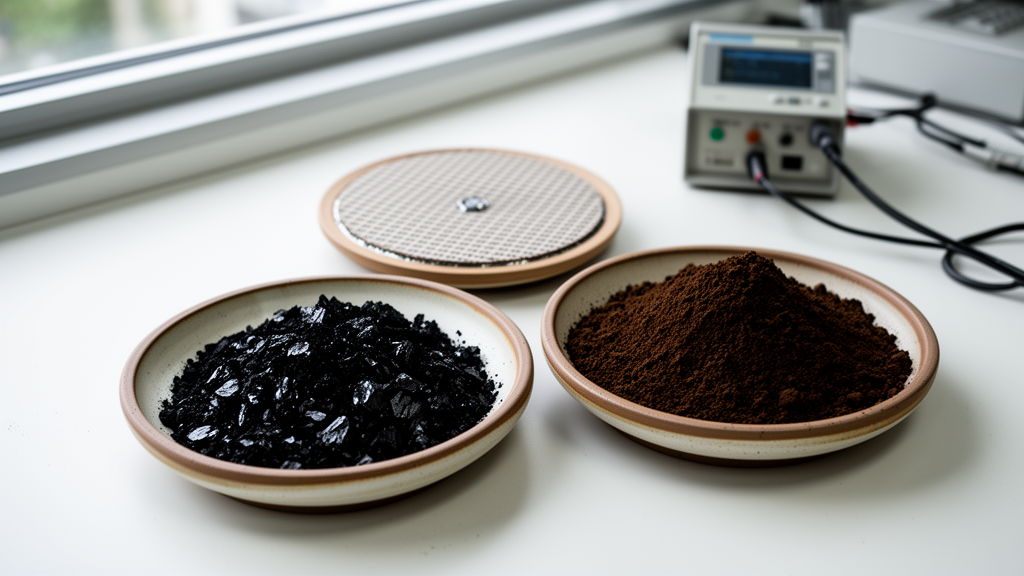
Waste shells from coconuts and kluwak nuts can be turned into carbon electrodes for electrical double-layer capacitors, and a new study shows the two biomasses perform very differently. Researchers converted both materials into activated carbon and then into partially reduced graphene oxide, testing how microwave treatment conditions shaped the resulting electrodes.

The team first produced activated carbon from each shell type. The activated carbon was then oxidized to graphite oxide using a modified Hummer’s method, and the graphite oxide was reduced in ethylene glycol through microwave-assisted solvothermal treatment to yield partially reduced graphene oxide, abbreviated p-rGO.

The novelty of the work lies in using kluwak shell as an alternative carbon precursor and systematically comparing its electrochemical performance with coconut shell-derived materials under controlled microwave conditions. For coconut shell-derived p-rGO, microwave power was varied at 100, 180, and 300 watts, while for kluwak shell-derived p-rGO, irradiation times of 15, 30, and 45 minutes were applied.

Structural characterization showed that increasing microwave intensity reduced the interlayer spacing and enhanced pore development, indicating improved reduction and structural ordering of the carbon material.

Electrochemical testing used three complementary techniques: cyclic voltammetry, galvanostatic charge-discharge, and electrochemical impedance spectroscopy. Together these measurements demonstrated superior performance for the coconut shell-derived materials across the tested conditions.

The numbers highlight the gap between the two precursors. Coconut shell activated carbon reached a specific capacitance of 130.83 farads per gram, and its p-rGO counterpart reached 103.58 farads per gram, with electrical conductivities of 0.78 and 0.30 siemens per meter respectively at 300 watts of microwave power.

Kluwak shell-derived materials lagged far behind. After 45 minutes of irradiation, kluwak shell activated carbon and p-rGO exhibited specific capacitances of only 1.39 and 3.73 farads per gram, with conductivities of 0.063 and 0.157 siemens per meter respectively. The results demonstrated a strong correlation between electrical conductivity and electrochemical performance, with the more conductive coconut-derived carbons storing substantially more charge.

Overall, the study concluded that coconut shell was the more favorable precursor for supercapacitor electrodes, while kluwak shell remained a promising sustainable alternative for biomass-derived carbon electrodes. Because both feedstocks are agricultural wastes, the approach points toward low-cost, sustainable electrode materials for energy storage devices, with precursor choice and microwave processing conditions as key levers for performance.

Subject of Research: Converting coconut shell and kluwak shell waste into activated carbon and partially reduced graphene oxide electrodes for electrical double-layer capacitors

Article Title: Biomass-derived carbon from coconut shell and kluwak shell for electrical double-layer capacitor applications

Article References: Susanti, D., Rindiani, N. A., Mubarok, R., Purwaningsih, H., Bahfie, F., Nurdiansah, H., Pramata, A. D., Pradesar, Y., Rohmanuddin, T. N., Fajarin, R., Rakhmawati, Y. W., Sagadevan, S., & Kusuma, G. E. (2026). Biomass-derived carbon from coconut shell and kluwak shell for electrical double-layer capacitor applications. BMC Chemistry. https://doi.org/10.1186/s13065-026-01947-2

Image Credits: AI Generated

DOI: 10.1186/s13065-026-01947-2

Keywords: supercapacitor, electrical double-layer capacitor, biomass-derived carbon, coconut shell, kluwak shell, activated carbon, reduced graphene oxide, microwave-assisted reduction, specific capacitance, electrical conductivity, cyclic voltammetry, sustainable materials

Cite Scienmag News

Bethany Barker. (October 29, 2026). Coconut Shell Carbon Outperforms Kluwak Shell in Supercapacitor Electrodes. Scienmag. https://scienmag.com/coconut-shell-carbon-outperforms-kluwak-shell-in-supercapacitor-electrodes/

Bethany Barker. "Coconut Shell Carbon Outperforms Kluwak Shell in Supercapacitor Electrodes." Scienmag, 29 October 2026, https://scienmag.com/coconut-shell-carbon-outperforms-kluwak-shell-in-supercapacitor-electrodes/. Accessed 29 October 2026.

Bethany Barker. "Coconut Shell Carbon Outperforms Kluwak Shell in Supercapacitor Electrodes." Scienmag. October 29, 2026. https://scienmag.com/coconut-shell-carbon-outperforms-kluwak-shell-in-supercapacitor-electrodes/
Tags: activated carbonactivated carbon from coconut shellsbiomass-derived carbonbiomass-derived supercapacitor materialscoconut shellCoconut shell carbon electrodescomparison of coconut and Kluwak shell carboncyclic voltammetryelectrical conductivityelectrical double-layer capacitorelectrochemical impedance spectroscopy in supercapacitorselectrochemical performance of bio-based electrodeskluwak shellKluwak shell biomass conversionmicrowave-assisted reductionmicrowave-assisted reduction of graphene oxidepartially reduced graphene oxide synthesispore development in activated carbonreduced graphene oxidespecific capacitancestructural analysis of biomass carbonsupercapacitorsustainable materialswaste shell conversion for energy storage
Share26Tweet16
Previous Post

Childhood sexual abuse linked to poorer diabetes medication adherence in small cross-sectional study

Next Post

Mapping where Uganda’s sickle cell services fall short of need

Related Posts

Organic Pigment Derivative Powers Stable Light-Driven Sulfoxide Synthesis
Chemistry

Organic Pigment Derivative Powers Stable Light-Driven Sulfoxide Synthesis

October 29, 2026
Review Charts Design of Metal-Free Oxide–Graphene Catalysts for Seawater Electrolysis
Chemistry

Review Charts Design of Metal-Free Oxide–Graphene Catalysts for Seawater Electrolysis

October 29, 2026
Chronic D-serine at 200 mg/kg shows kidney toxicity signs in Parkinson’s disease rats
Chemistry

Chronic D-serine at 200 mg/kg shows kidney toxicity signs in Parkinson’s disease rats

October 29, 2026
Zinc Single Atoms Turn Water Pollutants Into Hydrogen Peroxide Fuel
Chemistry

Zinc Single Atoms Turn Water Pollutants Into Hydrogen Peroxide Fuel

October 29, 2026
Water erosion primes soil microbes to break down carbon faster
Chemistry

Water erosion primes soil microbes to break down carbon faster

October 29, 2026
Machine Learning Screens Malaysian Kelulut Honey Compounds Against Allergy Receptor
Chemistry

Machine Learning Screens Malaysian Kelulut Honey Compounds Against Allergy Receptor

October 29, 2026
Next Post
Mapping where Uganda’s sickle cell services fall short of need

Mapping where Uganda's sickle cell services fall short of need

  • Mothers who receive childcare support from maternal grandparents show more optimized

    Mothers who receive childcare support from maternal grandparents show more parental warmth, finds NTU Singapore study

    27656 shares
    Share 11059 Tweet 6912
  • University of Seville Breaks 120-Year-Old Mystery, Revises a Key Einstein Concept

    1061 shares
    Share 424 Tweet 265
  • Bee body mass, pathogens and local climate influence heat tolerance

    682 shares
    Share 273 Tweet 171
  • Researchers record first-ever images and data of a shark experiencing a boat strike

    546 shares
    Share 218 Tweet 137
  • Groundbreaking Clinical Trial Reveals Lubiprostone Enhances Kidney Function

    531 shares
    Share 212 Tweet 133
Science

Embark on a thrilling journey of discovery with Scienmag.com—your ultimate source for cutting-edge breakthroughs. Immerse yourself in a world where curiosity knows no limits and tomorrow’s possibilities become today’s reality!

RECENT NEWS

  • Canning Mahi-Mahi Boosts Protein and Lipid Quality Scores While Heavy Metals Stay Low
  • Rare leukemia skin lesion fooled doctors treating a Tanzanian child
  • Deep Learning and IoT Framework Records, Preserves and Recreates Traditional Music
  • Smarter Satellite Mapping Shows How Urban Green Space Shapes City Heat Comfort

Categories

  • Agriculture
  • Anthropology
  • Archaeology
  • Athmospheric
  • Biology
  • Biotechnology
  • Blog
  • Bussines
  • Cancer
  • Chemistry
  • Climate
  • Earth Science
  • Editorial Policy
  • Marine
  • Mathematics
  • Medicine
  • Pediatry
  • Policy
  • Psychology & Psychiatry
  • Science Education
  • Science News
  • Social Science
  • Space
  • Technology and Engineering

Subscribe to Blog via Email

Enter your email address to subscribe to this blog and receive notifications of new posts by email.

Join 5,151 other subscribers

© 2025 Scienmag - Science Magazine

Welcome Back!

Login to your account below

Forgotten Password?

Retrieve your password

Please enter your username or email address to reset your password.

Log In
No Result
View All Result
  • HOME
  • SCIENCE NEWS
  • CONTACT US

© 2025 Scienmag - Science Magazine

Discover more from Science

Subscribe now to keep reading and get access to the full archive.

Continue reading