


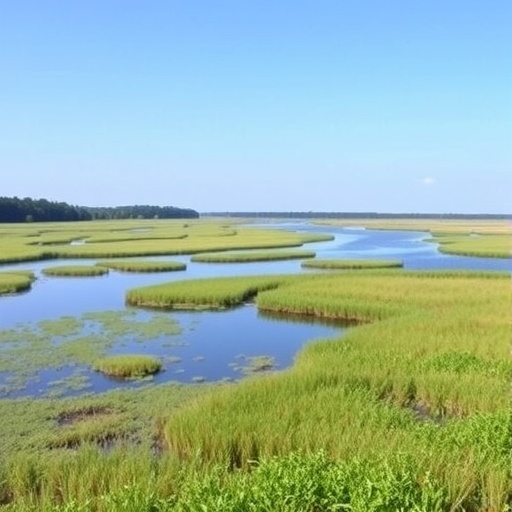
A groundbreaking new study conducted by scientists at William & Mary’s Batten School of Leadership and Public Policy, in collaboration with researchers at the Virginia Institute of Marine Science (VIMS), has shed unprecedented light on the substantial economic and ecological benefits provided by tidal marshes across Virginia’s Middle Peninsula. These coastal wetlands, both natural and artificially sustained via living shorelines, play a critical role in supporting local communities while championing environmental resilience. The research reveals that these marsh ecosystems generate close to $90 million in annual economic value, underscoring their significance not only as ecological havens but also as vital contributors to regional economies.
Published in the journal Nature-Based Solutions, and supported by funding from the National Oceanic and Atmospheric Administration’s Chesapeake Bay Fisheries Research Program, this study uniquely integrates multifaceted scientific approaches. It combines ecological field data, spatial modeling techniques, rigorous economic valuation, and comprehensive stakeholder surveys, producing a holistic understanding of marsh benefits. This convergence of methodologies allows researchers to capture both measurable ecological functions and the often intangible socio-economic services that coastal marshes provide, thus bridging science with practical community applications.
The research team’s multifarious approach enabled the creation of SHORE-BET (Shoreline Benefit Estimation Tool), an innovative, user-friendly online resource poised to revolutionize coastal management. SHORE-BET empowers community planners, environmental managers, and property owners by quantifying the tangible economic and ecological values of marsh ecosystems and living shorelines. Users can input site-specific data, tailoring projections to their unique landscapes and planning objectives. This pioneering tool provides forecasted benefits extending to 2050, enabling strategic decision-making that accounts for long-term environmental stewardship and community prosperity.
At the core of this study lies a comprehensive valuation of the ecosystem services offered by tidal marshes and their engineered counterparts, living shorelines. These services encompass pivotal natural functions such as storm surge mitigation, nutrient filtration and removal, carbon sequestration, habitat provision for diverse fish and wildlife species, and fostering recreation and tourism opportunities. The cumulative effect of these services accounts for approximately 3.3% of the Middle Peninsula’s gross domestic product. Projections incorporate potential marsh expansion and broader adoption of living shorelines, estimating that these values could surge to an impressive $168 million annually by mid-century.
This magnitude of economic valuation aligns with ecological performance, reaffirming the functionality of living shorelines as viable alternatives to traditional hard infrastructure. Living shorelines—engineered, vegetated buffers designed to reduce erosion and promote habitat health—have demonstrated effectiveness in maintaining biodiversity and providing ecosystem services comparable to those of natural wetlands. In Virginia, regulatory frameworks mandate living shoreline adoption for suitable erosion control projects, bolstering landscape resilience and enhancing coastal ecosystems.
The study’s sociological dimension, addressed through stakeholder surveys, unearths divergent perceptions among key community groups. Policymakers predominantly prioritize storm risk reduction and environmental sustainability as primary benefits of marshes, reflecting policy imperatives and risk management priorities. In contrast, local residents and recreational fishers place notable emphasis on recreational access and fisheries resources, highlighting the social and cultural dimensions of tidal marsh ecosystems. This plurality of values underscores the necessity for inclusive, multidisciplinary planning processes that address diverse stakeholder priorities.
SHORE-BET emerges as a vital decision-support platform that synthesizes these complex datasets and social inputs. By integrating ecological metrics with economic analyses and spatially explicit geodata, the tool presents a comprehensive perspective on marsh benefits. Importantly, it facilitates scenario modeling, allowing users to explore the outcomes of various conservation, restoration, or development strategies. This capacity to forecast ecological and economic dynamics promotes adaptive management and enhances community resilience in the face of accelerating climate change and sea-level rise.
Ecologically, tidal marshes contribute significantly to coastal defense by attenuating wave energy and reducing shoreline erosion. Their dense vegetation dissipates storm surges, mitigating flood risks to adjacent populations and infrastructure. Additionally, their role in nutrient cycling is crucial in combating eutrophication; by filtering excess nitrogen and phosphorus, marshes preserve water quality vital to aquatic life and human health. The incorporation of carbon sequestration services within the valuation reflects an advanced understanding of marshes as blue carbon sinks, which can offset greenhouse gas emissions and contribute to climate mitigation efforts.
The economic implications of these ecosystem services extend beyond immediate environmental benefits. Recreational and tourism activities linked to thriving marsh habitats generate income and employment opportunities, fostering economic diversification in coastal regions. Fisheries supported by marsh nurseries are integral to commercial and subsistence livelihoods, reinforcing food security and cultural heritage. By quantifying these benefits, the study equips policy frameworks with the rigor to advocate for investment in marsh conservation and living shoreline expansion.
The potential scale of marsh enhancement is significant. The study estimates that over 2,500 hectares of tidal marsh could be restored or augmented through increased implementation of living shoreline projects. Such restoration not only replenishes vital habitats but also multiplies the associated economic and ecological benefits. The authors emphasize that these investments serve as cost-effective measures compared to conventional hard infrastructure, offering layered benefits that reinforce ecosystem services and community well-being.
In essence, this research underscores a redefinition of coastal resilience, merging ecological integrity with socio-economic vitality. It advocates for watershed-scale planning that transcends parcel-level decisions, promoting collaborative stewardship that aligns science, policy, and community values. SHORE-BET and associated findings usher in a paradigm where decision-making is both data-driven and participatory, enabling shared benefits and sustainable futures for coastal populations.
As climate change accelerates the urgency to protect vulnerable shorelines, studies like this provide indispensable insights and tools. The synthesis of scientific rigor with stakeholder engagement exemplifies modern environmental management, positioning tidal marshes and living shorelines not merely as natural assets but as foundational components of resilient, prosperous communities. This work affirms the critical imperative to prioritize coastal ecosystems in policy agendas globally, leveraging natural infrastructure as a linchpin for ecological and economic sustainability.
To explore the details of the research and utilize SHORE-BET for site-specific benefit assessments, interested parties can visit the Center for Coastal Resources Management’s dedicated webpage, providing access to data, publications, and community resources. This engagement fosters informed dialogue and action, driving forward adaptive solutions that harmonize environmental conservation and human livelihoods in coastal zones worldwide.
News Publication Date: 7-Jul-2025
Web References:
- Study article: https://www.sciencedirect.com/science/article/pii/S2772411525000321
- SHORE-BET tool: https://cmap22.vims.edu/ShoreBet/
- CCRM website: https://www.vims.edu/ccrm/research/climate_change/adaptation/eco-services/
Cite Scienmag News
Violet Maxwell. (August 19, 2025). Coastal Wetlands Contribute $90 Million Annually to Virginia Communities, Study Reveals. Scienmag. https://scienmag.com/coastal-wetlands-contribute-90-million-annually-to-virginia-communities-study-reveals/
Violet Maxwell. "Coastal Wetlands Contribute $90 Million Annually to Virginia Communities, Study Reveals." Scienmag, 19 August 2025, https://scienmag.com/coastal-wetlands-contribute-90-million-annually-to-virginia-communities-study-reveals/. Accessed 4 September 2026.
Violet Maxwell. "Coastal Wetlands Contribute $90 Million Annually to Virginia Communities, Study Reveals." Scienmag. August 19, 2025. https://scienmag.com/coastal-wetlands-contribute-90-million-annually-to-virginia-communities-study-reveals/


