A sweeping synthesis of nearly two decades of research on coastal Bangladesh has found that farmers confronting rising salinity, waterlogging and violent storms are reshaping their fields in five distinct ways, from rice-shrimp ponds to floating gardens, but that the gains from these adaptations flow unevenly, favouring households with capital to invest. The systematic review, published in Regional Environmental Change, analysed 95 studies published between 2006 and November 2025 and organised the evidence through the Driver-Pressure-State-Impact-Response framework, a systems tool that traces how underlying causes produce environmental stresses, alter ecosystem conditions, generate impacts and provoke responses that can themselves create new problems.
The review, led by Md. Hayder Khan Sujan and colleagues, followed the PRISMA 2020 guidelines for systematic reviews. The team searched Scopus, Web of Science and the first ten pages of Google Scholar results, then screened reference lists for additional studies. From 1,085 initial records, 652 remained after de-duplication, 119 survived title and abstract screening, and 30 were excluded at full text, leaving 89 database studies plus six identified through citation chaining. The final corpus was overwhelmingly primary research: 96 percent of the included publications were original research articles, and 66 percent relied solely on primary data, with quantitative and mixed-method designs each accounting for 47 percent of the sample.
Geographically, the evidence is heavily skewed. Seventy-nine of the 95 studies covered the southwest coast, the zone most severely affected by salinity intrusion, while 35 addressed the south-central coast and only nine examined the southeast, where cyclones, flash floods, landslides and coastal erosion dominate the hazard profile. Khulna district appeared in 43 studies and Satkhira in 40, whereas several southeastern districts featured in a handful of papers or none at all. The authors caution that this concentration may leave policymakers with an evidence base that disproportionately supports aquaculture-centric interpretations of coastal adaptation, without knowing whether strategies validated in the southwest transfer to the cyclone-prone and hilly southeast.
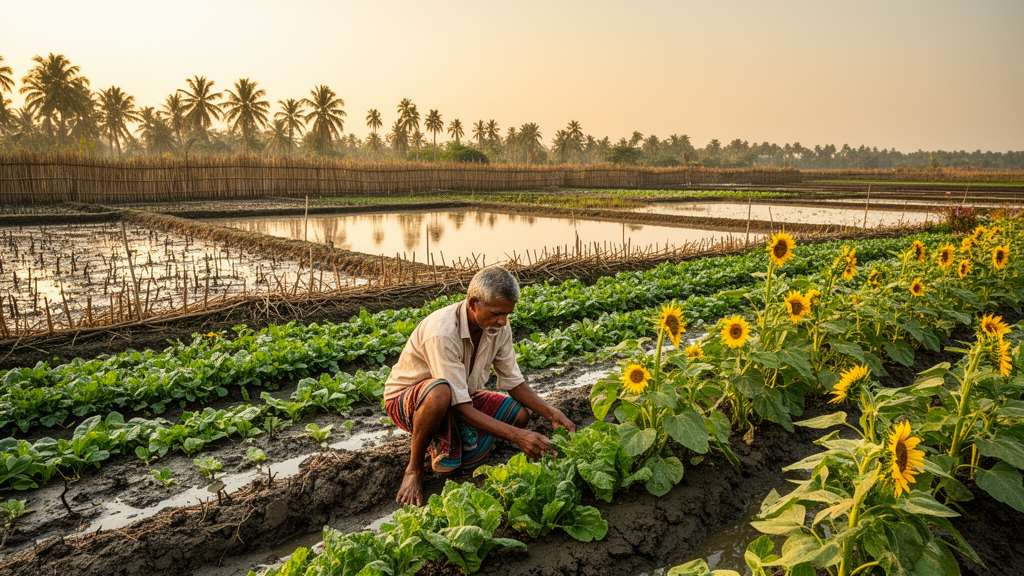
Across the corpus, five recurrent strategy groups emerged. Integrated agriculture-aquaculture and farm-enterprise diversification was the most frequently reported, appearing in 48 percent of studies, with rice-shrimp combinations cited in 14 documents, rice-fish in 12, rice-prawn in 9, rice-non-rice rotations in 8 and fish-shrimp systems in 7. Aquaculture-driven land-use change and farming-system diversification followed at 47 percent, and stress-tolerant crop adaptation at 42 percent, led by saline-tolerant crops in 30 studies, early-maturing varieties in 15, drought-tolerant varieties in 11, submergence-tolerant crops in 8 and heat-tolerant varieties in 3. Community-based agroecological diversification, including sorjan raised-bed farming, dike cropping, homestead gardening, floating farming and agroforestry, appeared in 41 percent, while cropping-pattern and management adjustments such as shifted sowing dates, rotation, intercropping and relay cropping appeared in 23 percent.
Applying the DPSIR framework, the reviewers found that climate variability was the most frequently reported driver, cited in 70 of the studies that identified drivers, far ahead of market access at 15. Salinity intrusion was the most frequently reported pressure, named in 43 studies, followed by shrimp-driven land-use change at 27 and drought and flooding at 18. The prevailing state of the agroecosystem, described in 64 studies, was dominated by the expanding footprint of shrimp, crab and fish aquaculture, reported in 41 studies, alongside waterlogged and impeded drainage in 23 and poor soil fertility in 8. Impacts, documented in 57 studies, centred on reduced farm productivity, income and employment in 39 studies, soil and water quality deterioration in 24 and decreased food and nutrition security in 16. The authors stress that these frequencies describe the distribution of reported evidence, not the prevalence of any practice among coastal farmers.
The pattern of drivers leads to one of the review’s central conclusions: diversification in coastal Bangladesh is characterised in the literature primarily as defensive adaptation rather than market-driven development. Farmers are, in the main, responding to environmental stress rather than pursuing opportunity. Yet the co-reporting of economic incentives in 56 studies suggests a more nuanced picture, including cases where farmers convert saline constraints into productive advantages, as in rice-shrimp and rice-fish systems that exploit brackish water rather than fight it. The Government of Bangladesh has itself identified crop diversification as a climate-smart strategy, but the review notes that progress towards sustainable diversification remains limited despite multiple policies and projects targeting coastal regions.
The most sobering finding concerns who benefits. Although diversification was broadly associated with income stability, higher cropping intensity and reduced reliance on a single income source, the evidence indicates these gains are unevenly distributed, with access mediated by capital constraints. Infrastructure-intensive strategies such as aquaculture conversion, sorjan beds and gher pond-dike systems require upfront earthmoving, labour and investment that resource-poor smallholders often cannot mobilise, and studies have reported such transitions displacing rice-dependent smallholders and reducing productivity, income and employment among some poorer households. A smaller body of work documented marginalisation and exclusion in 4 studies, out-migration in 9 and social conflict in 2, though the authors urge caution because these figures rest on few studies and no formal quality appraisal was performed.
The DPSIR lens also exposes feedback loops that linear adaptation models tend to miss. A response to one pressure, such as converting salt-affected cropland to shrimp aquaculture, produces a new system state, expanding aquaculture area, which can co-occur with fresh pressures including waterlogging, impeded drainage, disease outbreaks and market concentration, and with impacts such as reduced ecosystem services, reported in only 7 studies and therefore interpreted cautiously. Greater reliance on shrimp and crab may also heighten vulnerability to disease, price swings and climate shocks. In the reviewers’ framing, an ostensibly adaptive response can be associated with new vulnerabilities through ecological degradation and social marginalisation, and unplanned aquaculture-oriented diversification may put long-term sustainability at risk.
Not all strategies carry the same barriers. Research attention to community-based agroecological diversification rose sharply, from 4 studies during 2006-2015 to 30 during 2021-2025, with similar growth for stress-tolerant crop adaptation, from 5 to 27 studies, and aquaculture-driven land-use change, from 9 to 19. Seed-based technologies and low-input practices such as homestead gardening, reported in 14 studies, and floating agriculture, in 13, may offer more accessible alternatives for capital-constrained households, and adjusting sowing and harvesting times or rotating crops provides relatively low-risk options. However, the review flags a tension: reported soil and water quality deterioration and poor soil fertility raise concerns that improved varieties alone may not deliver lasting benefits without complementary resource-management investments, and sorjan and floating systems remain largely restricted to waterlogged areas.
The authors identify clear gaps for future research. Locally led adaptations lack longitudinal evidence on long-term performance, scalability and adoption dynamics under prolonged climatic stress. The cumulative landscape-scale effects of uncoordinated diversification, particularly shrimp and crab expansion, remain poorly quantified. Land tenure and property rights, which shape incentives for long-term investment, appeared in only 3 studies, and common-property resources such as khash land and canals in just 2. Research and policy also lean heavily toward export-oriented shrimp, prawn and crab systems, potentially overlooking subsistence and vegetable-based pathways that may be more inclusive and environmentally sustainable. The review’s limitations, including an English-language-only search, screening primarily by a single reviewer and no formal methodological quality appraisal, mean conclusions drawn from small numbers of studies warrant particular caution. Even so, the synthesis argues that strengthening coastal resilience will require context-specific, systems-oriented approaches that combine farmer innovation, appropriate technology, institutional support and equitable access to credit and markets, lessons the authors suggest are transferable to other deltaic, climate-vulnerable coastal regions worldwide.
Subject of Research: Systematic review of crop and farming-system diversification strategies for agricultural resilience in coastal Bangladesh using the DPSIR framework
Article Title: Crop and farming-system diversification strategies for coastal agricultural resilience: a systematic review through DPSIR lens
Article References: Sujan, M. H. K., Kotir, J. H., Abdul Aziz, A., & Akber, M. A. (2026). Crop and farming-system diversification strategies for coastal agricultural resilience: a systematic review through DPSIR lens. Regional Environmental Change, 26(4), Article 221. https://doi.org/10.1007/s10113-026-02709-5
Image Credits: AI Generated
DOI: 10.1007/s10113-026-02709-5
Keywords: coastal Bangladesh, crop diversification, farming systems, salinity intrusion, DPSIR framework, systematic review, aquaculture, climate adaptation, smallholder farmers, social-ecological systems, PRISMA, Regional Environmental Change
Cite Scienmag News
Sloane Callahan. (October 24, 2026). Coastal Bangladesh farmers diversify crops to survive salt, but benefits are unevenly shared. Scienmag. https://scienmag.com/coastal-bangladesh-farmers-diversify-crops-to-survive-salt-but-benefits-are-unevenly-shared/
Sloane Callahan. "Coastal Bangladesh farmers diversify crops to survive salt, but benefits are unevenly shared." Scienmag, 24 October 2026, https://scienmag.com/coastal-bangladesh-farmers-diversify-crops-to-survive-salt-but-benefits-are-unevenly-shared/. Accessed 24 October 2026.
Sloane Callahan. "Coastal Bangladesh farmers diversify crops to survive salt, but benefits are unevenly shared." Scienmag. October 24, 2026. https://scienmag.com/coastal-bangladesh-farmers-diversify-crops-to-survive-salt-but-benefits-are-unevenly-shared/