


By fueling the growth of plants that become kindling, carbon dioxide is driving an increase in the severity and frequency of wildfires, according to a UC Riverside study.

Credit: James Gomez/UCR
By fueling the growth of plants that become kindling, carbon dioxide is driving an increase in the severity and frequency of wildfires, according to a UC Riverside study.
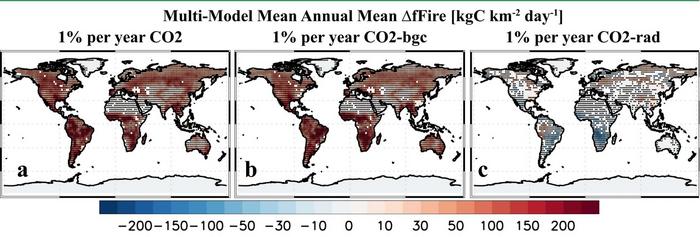
The worldwide surge in wildfires over the past decade is often attributed to the hotter, drier conditions of climate change. However, the study found that the effect of increasing levels of carbon dioxide (CO2) on plants may be a bigger factor.
“It’s not because it’s hotter that things are burning, it’s because there’s more fuel, in the form of plants,” said UCR doctoral student in Earth and planetary sciences and study author James Gomez.
This conclusion, and a description of the eight model experiments that produced it, have been published in Communications Earth & Environment.
To convert light into food in a process called photosynthesis, plants require CO2. Burning fossil fuels for heat, electricity, and transportation is adding increasing levels of CO2 into the atmosphere. Plants use the extra CO2 to make carbohydrates that help them grow, leading to an increase in biomass that burns.
Certainly, heat waves and drought occur more frequently in today’s climate than they did 50 years ago. These are conditions that cause plants to wither and die. As they dry out and die, they burn more easily. The models accounted for these effects on plants, as well as for different types of plants, and for the increase in atmospheric CO2.
“Warming and drying are still important fire factors. These are the conditions that make the extra plant mass more flammable,” said UCR professor of Earth sciences Robert Allen.
The models analyzed by the research team all assumed an idealized 1% per year increase in atmospheric CO2 concentrations since 1850. The idealized increase is meant to isolate the effects of the greenhouse gas on wildfire activity.
“These experiments are mainly looking at the contribution of CO2 to changes in wildfire activity,” Gomez said. “That’s the only thing that’s changing in these models. Other drivers of climate change and wildfire activity do not change through time,” Gomez said. “This includes, for example, changes in other greenhouse gases like methane, as well as changes in land use.”
Seasons are still important factors in promoting wildfires, and fires still occur more often during “fire seasons.” Dry, windy conditions help spread the flames faster, increasing the size of the burned area. “However, our study shows the increase in fires during hotter seasons is driven by fuel load rather than an increase in the number of what some consider ‘fire weather’ days,” Gomez said.
This means megafires can often happen outside of what is considered fire season. As an example, the biggest wildfire on record in Texas, with more than a million acres burned, occurred this past February.
The researchers hope that their results inspire others to conduct additional studies of the factors driving the increase in wildfires. In addition, they hope that policymakers recognize the urgent need to decrease the amount of CO2 that people release into the atmosphere.
“We do need to implement better fire control and have more prescribed burns to use up plant fuel. We need to get rid of the old stuff,” Gomez said. “But the best way to decrease wildfires is to mitigate our carbon dioxide emissions. We need more emission control now.”
Journal
Communications Earth & Environment
Article Title
Enhanced future vegetation growth with elevated carbon dioxide concentrations could increase fire activity
Article Publication Date
27-Jan-2024
Cite Scienmag News
Sloane Callahan. (April 16, 2024). CO2 worsens wildfires by helping plants grow. Scienmag. https://scienmag.com/co2-worsens-wildfires-by-helping-plants-grow/
Sloane Callahan. "CO2 worsens wildfires by helping plants grow." Scienmag, 16 April 2024, https://scienmag.com/co2-worsens-wildfires-by-helping-plants-grow/. Accessed 4 September 2026.
Sloane Callahan. "CO2 worsens wildfires by helping plants grow." Scienmag. April 16, 2024. https://scienmag.com/co2-worsens-wildfires-by-helping-plants-grow/

