


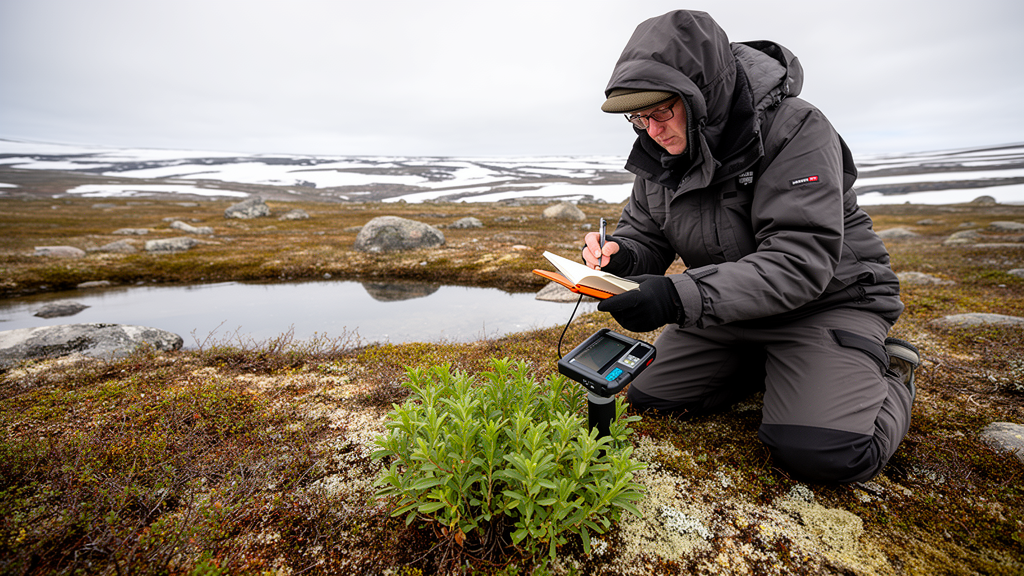
A data-driven horizon scan has identified 2,554 vascular plant taxa with climatic niches that overlap the terrestrial Arctic, suggesting that a broad range of currently alien plants could encounter suitable conditions if they reach the region. The analysis covered 8,448 taxa that met its occurrence and climate-data requirements and represented 30.2% of that filtered pool, or 18.3% of the original set of 13,939 naturalized or alien plants worldwide. Most candidates occupied a relatively small portion of the Arctic in the models, but six regions emerged as concentrations of potential arrivals: western Alaska, southwestern and southeastern Greenland, northern Iceland, northern Fennoscandia and Kanin–Pechora. The findings do not demonstrate that these plants have arrived, become established or caused ecological harm; they identify where climatic screening suggests biosecurity and further ecological assessment could be most valuable.
The Arctic has historically offered natural barriers to alien plant establishment, including short growing seasons, severe weather, limited human activity and relatively undisturbed soils. Those barriers are weakening as climate warming, infrastructure construction, resource extraction and increasingly connected transport networks alter terrestrial habitats. Disturbed ground can expose mineral surfaces, accelerate soil development and change microbial and chemical conditions, while settlements, ports, research stations and other hubs concentrate seeds and other propagules. An earlier Arctic inventory recorded 341 alien plant taxa, of which 188 had naturalized in at least one floristic province and 11 were classified as invasive. The new study focuses on potentially novel arrivals rather than further range expansion by plants already present, providing a prioritized set for pathways, impact and establishment assessments.
The researchers began with the Global Naturalized Alien Flora database and removed taxa native to the Arctic or already included in the Arctic alien flora inventory. Scientific names were harmonized through World Flora Online, with 120 unresolved names examined manually against taxonomic authorities; 27 invalid or unpublished names were discarded. Candidate names were matched to the Global Biodiversity Information Facility backbone, allowing records filed under accepted names and synonyms to be retrieved. The download produced 51,566,131 occurrences for 11,534 taxa from 1970 to 2024. Coordinates were cleaned, invalid and duplicate locations removed, and records thinned to one random point per 1-by-1-kilometre cell to reduce spatial autocorrelation. Taxa with fewer than 55 usable occurrences were excluded because their climatic niches could not be represented reliably in the four-dimensional model.
Climate space was defined using 19 bioclimatic variables, from which the researchers selected precipitation of the warmest quarter, mean temperature of the warmest quarter, isothermality and temperature seasonality. These variables represented growing-season water availability, limits on photosynthetic and reproductive activity, temperature stability and seasonal stress. Each plant’s global climate niche was constructed as a hypervolume using the box method and kernel density estimation. Inclusion tests determined whether a taxon’s observed climate points overlapped the Arctic climate space, after which geographic projections estimated where suitable conditions might occur. A probability analysis assigned a suitability density to each 1-by-1-kilometre Arctic cell, while a binary projection mapped potentially suitable area regardless of probability. As a validation exercise, the same process recovered climatic overlap for 1,061 of 1,157 known Arctic taxa that met the analysis criteria, a success rate of 91.7%.
The spatial projections reveal sharply unequal potential across the Arctic. Western Alaska contained the highest modelled richness, reaching 1,273 potential alien species per grid cell, compared with 248 across the northern Alaska–Yukon Territory. Southwestern Greenland ranked next with 1,055 species, followed by southeastern Greenland with 720. Northern Iceland and Kanin–Pechora each reached 622, while Fennoscandia contained up to 336. These are estimates of climatic opportunity rather than observed plant occurrences. Farther north, the models identified 45 possible alien species in Svalbard, 46 in Jan Mayen, six in Franz Joseph Land and seven on Wrangel Island. The concentration of candidates in warmer southern and western areas indicates that the lower-Arctic provinces currently offer more combinations of temperature and precipitation known to occur within the global ranges of alien plants.
Five plants stood out for the broadest projected climatic suitability. Arnica angustifolia could encounter suitable conditions across 95% of the terrestrial Arctic, followed by Koeleria spicata at 94%, Micranthes nelsoniana at 93%, Alnus alnobetula at 84% and Senecio nemorensis at 62%. Those rankings require careful interpretation. The first four belong to taxonomic complexes containing subspecies or varieties already recorded in the Arctic, so their high scores do not necessarily represent wholly novel species-level arrivals. Senecio nemorensis, by contrast, had no occurrence points in the Arctic within the filtered dataset. It is native to central Europe and Asia and is naturalized in several European countries. Nevertheless, climatic compatibility cannot establish whether a plant can reproduce, disperse, compete or spread after introduction.
Taxonomic comparisons showed that the candidate flora in most Arctic floristic provinces did not differ significantly from the global alien-plant baseline after false-discovery-rate correction. Franz Joseph Land was the exception, with a large compositional deviation driven mainly by an overrepresentation of Asterales, which represented 33.3% of its candidate taxa compared with 11.8% globally. Fabales, accounting for 9.4% of the global pool, was absent there. Wrangel Island had the next-largest effect, including elevated proportions of Asterales and Poales and no Fabales, but its adjusted p-value of 0.069 did not meet the study’s significance threshold. The scarcity of Fabales in high-Arctic islands and other provinces appears to reflect the order’s naturally limited Arctic distribution rather than a climatic barrier identified by the model.
Potential source regions extended across nearly all climate zones, with Germany, France, Sweden and Austria among the largest European contributors and Ontario, Colorado, New York and California prominent in North America. Kazakhstan, southeastern China and northeastern Argentina also supplied numerous candidates. The geographic spread underscores the role of global trade and transportation in Arctic introductions, but it does not establish that plants from every listed country are likely to travel to the Arctic. A separate statistical analysis showed that climate overlap increased with a taxon’s absolute median latitude. Higher-latitude distributions were associated with both a lower probability of zero overlap and a larger overlap when overlap occurred. The model estimated that the probability of any Arctic niche overlap approached 100% above 60 degrees, supporting the hypothesis that plants already occupying cold boreal or austral environments have a climatic advantage.
p>These results point to a practical need for geographically broad, early biosecurity rather than reliance on one dominant pathway. Historically important routes in Arctic alien plants include escape from confinement, transport stowaways, seed contaminants and vehicle transport, while 43% of introductions in a previous pathway analysis remained unknown. Ports, airports, research stations, settlements, tourist routes and soil or plant-material imports connect distant regions with the projected hotspots. Priority monitoring in western Alaska, southern Greenland, northern Iceland, northern Fennoscandia and Kanin–Pechora could complement targeted inspection of major entry points. Public participation may extend surveillance across sparsely populated territories, allowing managers to find localized introductions while they remain small. Yet the model cannot rank risks by ecological damage or identify the propagule pressure and disturbance conditions needed for establishment.
p>The analysis has clear limitations. It estimates climatic overlap under a 1970–2000 climate baseline rather than forecasting invasion outcomes under future warming, and it does not model propagule supply, dispersal, reproduction, competition or interactions with resident biodiversity. GBIF records can contain geographic and sampling bias, as illustrated by an erroneous Antarctic record that entered the workflow before being detected. Taxonomic harmonization also required precautionary decisions about subspecies, varieties and aggregates, meaning some nominally novel candidates may be close relatives of plants already in the Arctic. The researchers recommend adding climate scenarios, environmental variables, plant traits and weighted resampling methods in future assessments. Even with those limitations, the 2,554-taxon list offers a scalable screening tool: it cannot prove establishment, but it can direct limited surveillance and expert resources toward the taxa and Arctic locations where climatic preconditions are strongest.
Subject of Research: Climatic horizon scanning of potential new alien vascular plants across the terrestrial Arctic
Article Title: Horizon scanning of potential new alien vascular plant species and their climatic niche space across the Arctic
Article References: Ulsted, T. H., Westergaard, K. B., Dawson, W., & Speed, J. D. M. (2025). Horizon scanning of potential new alien vascular plant species and their climatic niche space across the Arctic. NeoBiota, 104, 1-26. https://doi.org/10.3897/neobiota.104.165054
Image Credits: AI Generated
DOI: 10.3897/neobiota.104.165054
Keywords: Arctic, alien plants, biological invasions, climate change, horizon scanning, biosecurity, climatic niches, hypervolume modelling, floristic provinces, early detection, Horizon, scanning
Cite Scienmag News
Patricia Pace. (October 20, 2026). Climate scan flags 2,554 potential new alien plants in the Arctic. Scienmag. https://scienmag.com/climate-scan-flags-2554-potential-new-alien-plants-in-the-arctic/
Patricia Pace. "Climate scan flags 2,554 potential new alien plants in the Arctic." Scienmag, 20 October 2026, https://scienmag.com/climate-scan-flags-2554-potential-new-alien-plants-in-the-arctic/. Accessed 20 October 2026.
Patricia Pace. "Climate scan flags 2,554 potential new alien plants in the Arctic." Scienmag. October 20, 2026. https://scienmag.com/climate-scan-flags-2554-potential-new-alien-plants-in-the-arctic/


