


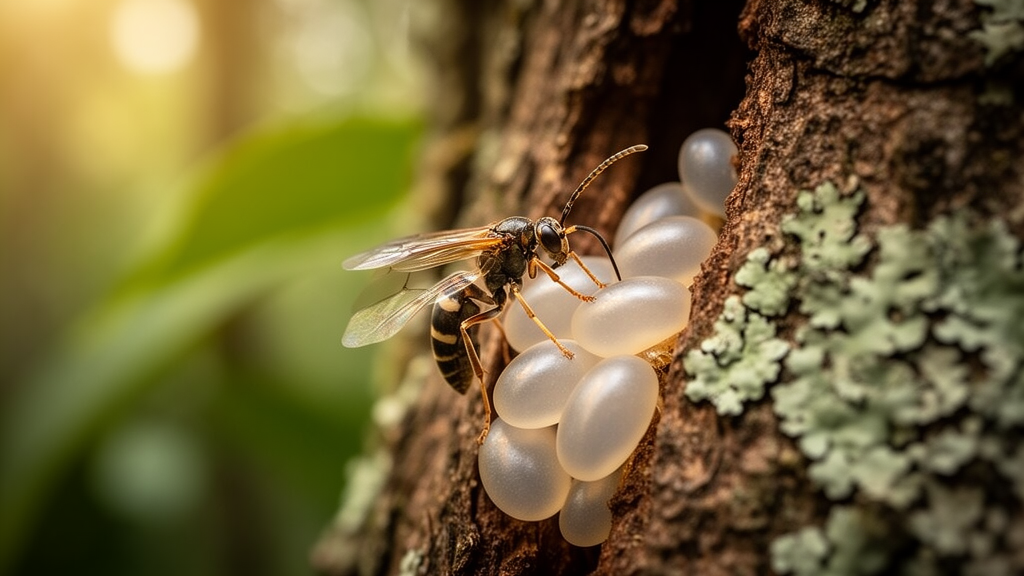
A new species of egg-parasitoid wasp has been described from eggs of the Neotropical bark bug Phloea subquadrata in São Paulo state, Brazil. The wasp, named Trissolcus adrianae Costa & Johnson, was characterized using adult anatomy, mitochondrial DNA and its host association. Females measured 2.18–2.44 mm and males 1.82–2.11 mm.
The discovery documents the first known association between a scelionid wasp and the bug family Phloeidae, and the first reported parasitism of Phloeidae eggs. The study followed work by Salomão and Vasconcellos-Neto, who collected P. subquadrata eggs while investigating the population structure and dynamics of the bug on Plinia cauliflora trees. The eggs had been found in clusters on the trunk of a tree in a fruit garden within the Reserva Ecológica da Serra do Japi, in Jundiaí, at 23°14′04″ south, 46°55′28″ west and 900 metres above sea level.
Parasitoid specimens were reared from the collected eggs, initially stored in 70% ethanol and later dried and mounted on paper points. The described material consisted of one female holotype and seven paratypes comprising six females and one male. Trissolcus is a cosmopolitan genus of egg parasitoids in the wasp family Scelionidae, with about 150 species described in the research article’s introduction.
The genus is divided into five species groups, and the new species was assigned to the flavipes group. Members of this group are especially abundant in the Neotropical Region and are characterized by features including a hyperoccipital carina, large setigerous punctures on the frons, a strongly bulging frons between the antennal insertions and inner orbits, well-developed notauli and the usual absence of sublateral setae on the first tergite. The authors also noted that the clypeus in the group bears four or fewer setae.
Although northern-hemisphere Trissolcus have received substantial attention in recent years, relatively few studies have addressed Neotropical species, and the flavipes group had not been treated since 1987. The new description therefore adds anatomical and biological information to a comparatively poorly studied group. The epithet adrianae honors Adriana Trevizoli Salomão, the collector of the host eggs, and is treated as a noun in the genitive case.
The species is known from São Paulo state, and the reported host is P. subquadrata. The most immediately apparent feature of T. adrianae is its conspicuously depressed, dorsoventrally flattened habitus. Its head is oblong in anterior view and strongly protrudes anteriorly in lateral view, while the frons bulges between the antennal insertions and inner orbits.
The mandible has two teeth, and the clypeus has four setae. A frontal depression is bordered dorsally by a carina. The orbital furrow is sculptured and constricted through most of its length by the lateral expansion of the frons, and the hyperoccipital carina is weakly developed.
The head also bears a preocellar pit, an angulate vertex and punctate lateral frontal microsculpture with large, well-defined setigerous punctures. Other diagnostic characters concern the mesosoma and metasoma. The new species lacks notauli, a median mesoscutal line and a median mesoscutal sulcus, while the mesoscutellum and mesoscutum are punctate with large, well-defined setigerous punctures and smooth interspaces.
The postacetabular sulcus is composed of cells, and there are three to five elongate, rounded episternal foveae extending ventrally to the postacetabular sulcus and dorsally toward the mesopleural pit. The speculum is transversely striate, and the propodeal depression has striae radiating from the propodeal foramen. Sublateral setae are absent from the first tergite.
The second tergite is distinctly striate in its basal half, whereas its apical half is smooth, and tergites two through six have subequal lengths. Detailed comparisons show why T. adrianae is distinguishable from T. decumbens, another flavipes-group species with an elongate and depressed body. The new species lacks the distinct median longitudinal carina on the mesoscutellum that occurs in T. decumbens.
The mesonotum of T. adrianae is nearly flat, with the posterior two-thirds of the mesoscutum and mesoscutellum in the same plane, and its punctures are well defined and irregularly distributed. The corresponding mesonotum of T. decumbens is convex and has coriaceous to reticulate microsculpture throughout. Coxae are yellow in T. adrianae but dark in T. decumbens.
The researchers examined specimens with a Leica M165C stereomicroscope fitted with a Leica DFC 420 digital camera and a dome for light dispersion. Stereomicroscope image stacks were combined in Leica Application Suite v3.8 to produce extended-focus images, while uncoated paratypes were examined under low vacuum with a Quanta 250 scanning electron microscope. Final images were edited in Adobe Illustrator and Photoshop v2025.
Surface-sculpture and other morphological terminology followed established hymenopteran references, and terms were matched to concepts in the Hymenoptera Anatomy Ontology. A color-distribution map was produced with SimpleMappr. For the molecular component, genomic DNA was destructively sampled from a single male or female, and a 586-base-pair fragment of the mitochondrial cytochrome c oxidase subunit I gene, COI, was amplified by polymerase chain reaction.
Amplicons were checked under ultraviolet light after electrophoresis on a 1.5% agarose gel stained with SYBR Safe, purified with Exonuclease I and FastAP, and bidirectionally sequenced by the Sanger method at the Agricultural Biotechnology Laboratory of ESALQ in Piracicaba, São Paulo. The sequence was checked, edited and aligned in Geneious Prime 2022.1 before deposition in GenBank under accession OQ720992. A maximum-likelihood analysis of COI sequences from Trissolcus and five related telenomine genera placed T. adrianae as the sister group to a clade containing T. urichi and an unidentified Trissolcus species.
Estimated interspecific distances were 14% and 16%, respectively. Searches of GenBank and the Barcode of Life Data System did not find a similar sequence at a similarity threshold of at least 85% or a closely related sequence, while the genetic distance from deposited sequences was reported as 15%. The authors treated the evolutionary placement cautiously because COI alone has limited utility for resolving relationships among these wasps, citing an earlier expanded analysis that combined morphology with the 18S, 28S, COI and wingless genes and recovered a different arrangement among related telenomine genera.
P. subquadrata belongs to Phloeidae, a small family described in the study as containing two genera and three species endemic to the Neotropical region. Its eggs form clusters on tree bark and are covered by the guarding female’s flattened body. Similar guarding behavior in the pentatomid Antiteuchus tripterus has been associated with defense against egg parasitism by the telenomine wasps Trissolcus bodkini and Phanuroopsis semiflaviventris.
The authors suggested that the markedly flattened body of T. adrianae may allow the female wasp to gain access to eggs protected by the bug. They also identified phoresy, in which the adult wasp may travel on the host, as another possible explanation for its form. Flattened bodies and elongated hind basitarsi also occur in other phoretic Trissolcus species and in Mantibaria, a genus of mantid egg parasitoids.
The available evidence establishes the new species and its host record but does not resolve which of these behavioral explanations applies.
Subject of Research: Taxonomic and molecular description of the egg-parasitoid wasp Trissolcus adrianae from Phloea subquadrata in Brazil
Article Title: A remarkable new species of Trissolcus Ashmead ( Hymenoptera , Scelionidae ), parasitoid of eggs of Phloea subquadrata ( Hemiptera , Phloeidae ) in Brazil
Article References: Costa, V. A., Johnson, N., Salomão, A., Vasconcellos-Neto, J., Wengrat, A., & Schoeninger, K. (2025). A remarkable new species of Trissolcus Ashmead (Hymenoptera, Scelionidae), parasitoid of eggs of Phloea subquadrata (Hemiptera, Phloeidae) in Brazil. Journal of Hymenoptera Research, 98, 405-417. https://doi.org/10.3897/jhr.98.144215
Image Credits: AI Generated
Keywords: Trissolcus adrianae, egg parasitoid, Scelionidae, Phloea subquadrata, Phloeidae, new species, São Paulo, insect morphology, mitochondrial DNA, parasitoid-host association, remarkable, species
Cite Scienmag News
Gavin Prescott. (October 20, 2026). New wasp species parasitizes Phloeidae bug eggs in Brazil. Scienmag. https://scienmag.com/new-wasp-species-parasitizes-phloeidae-bug-eggs-in-brazil/
Gavin Prescott. "New wasp species parasitizes Phloeidae bug eggs in Brazil." Scienmag, 20 October 2026, https://scienmag.com/new-wasp-species-parasitizes-phloeidae-bug-eggs-in-brazil/. Accessed 20 October 2026.
Gavin Prescott. "New wasp species parasitizes Phloeidae bug eggs in Brazil." Scienmag. October 20, 2026. https://scienmag.com/new-wasp-species-parasitizes-phloeidae-bug-eggs-in-brazil/


