


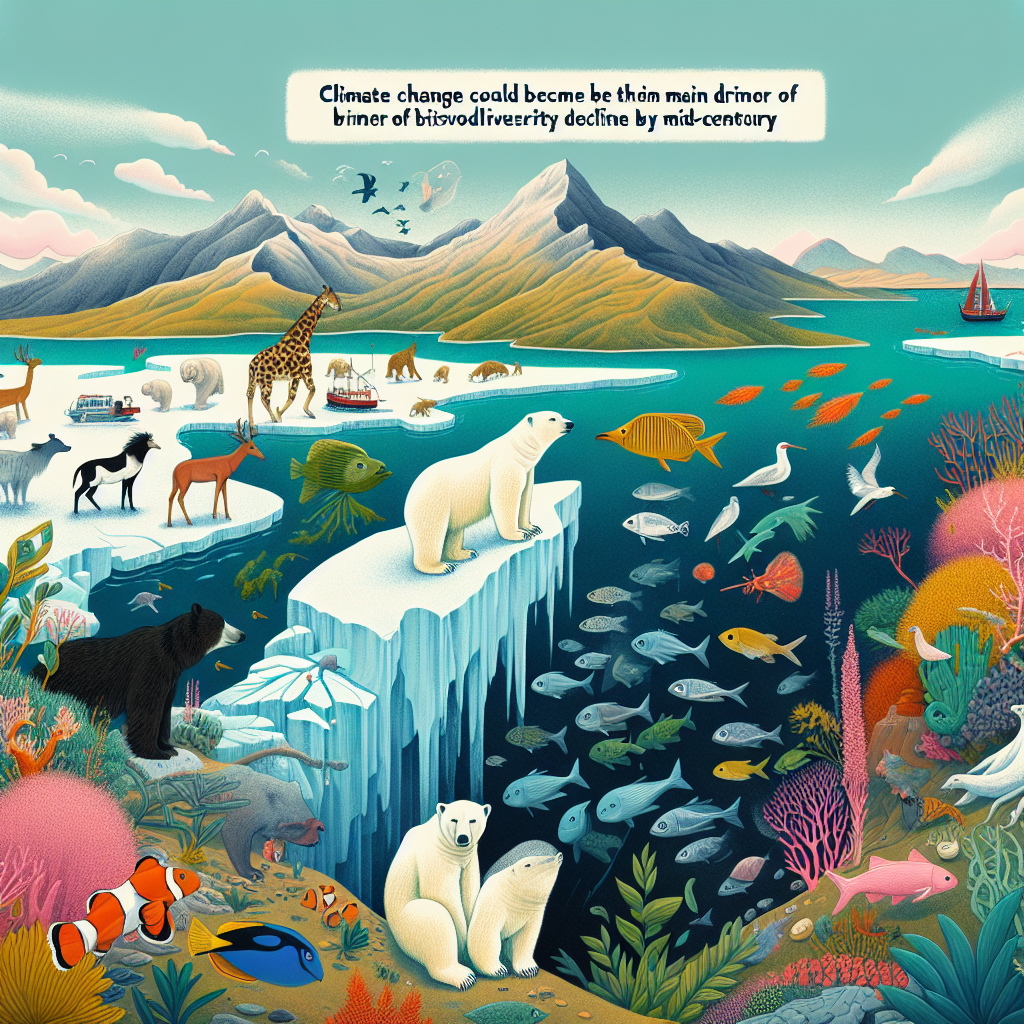
Global biodiversity has declined between 2% and 11% during the 20th century due to land-use change alone, according to a large multi-model study published in Science. The projections show that climate change could become the main driver of biodiversity decline by the mid-21st century.
Global biodiversity has declined between 2% and 11% during the 20th century due to land-use change alone, according to a large multi-model study published in Science. The projections show that climate change could become the main driver of biodiversity decline by the mid-21st century.
Land-use change is considered the largest driver of biodiversity change, according to the Intergovernmental Platform on Biodiversity and Ecosystem Services (IPBES). However, scientists are divided over how much biodiversity has changed in past decades. To better answer this question, an international team of researchers modeled the impacts of land-use change on biodiversity over the 20th century. They found global biodiversity may have declined by 2% to 11% due to land-use change alone. This span covers a range of four biodiversity metrics calculated by seven different models.
The analysis was led by the German Centre for Integrative Biodiversity Research (iDiv) and the Martin Luther University Halle-Wittenberg (MLU), with contributions by researchers from the IIASA Biodiversity and Natural Resources Program, and is the largest modeling study of its kind to date. The researchers compared thirteen models for assessing the impact of land-use change and climate change on four distinct biodiversity metrics, as well as on nine ecosystem services.
“By including all world regions in our model, we were able to fill many blind spots and address criticism of other approaches working with fragmented and potentially biased data,” says first author Henrique Pereira, research group head at iDiv and MLU. “Every approach has its ups and downsides. We believe our modeling approach provides the most comprehensive estimate of biodiversity trends worldwide.”
MIXED TRENDS FOR ECOSYSTEM SERVICES
Using another set of five models, the researchers calculated the simultaneous impact of land-use change on so-called ecosystem services, in other words, the benefits nature provides to humans. In the past century, they found a massive increase in provisioning ecosystem services, like food and timber production. By contrast, regulating ecosystem services, like pollination, nitrogen retention, or carbon sequestration, moderately declined.
CLIMATE AND LAND-USE CHANGE COMBINED MIGHT LEAD TO BIODIVERSITY LOSS IN ALL WORLD REGIONS
The researchers also examined how biodiversity and ecosystem services might evolve in the future. For these projections, they added climate change as a driver of biodiversity change to their calculations.
“We found that climate change poses an imminent threat to biodiversity and ecosystem services. While land-use change has historically been a significant factor, our findings indicate that climate change could overtake it as the primary driver of biodiversity loss by mid-century,” explains study coauthor and researcher in the IIASA Integrated Biosphere Futures Research Group, David Leclère.
The team evaluated three commonly used scenarios, ranging from sustainable development to high emissions, and found that regardless of the scenario, the combined effects of land-use change and climate change lead to biodiversity loss across all global regions. While the overall downward trend is consistent, there are considerable variations across world regions, models, and scenarios.
PROJECTIONS ARE NOT PREDICTIONS
The authors note that the purpose of long-term scenarios is not to predict what will happen, rather, it is to understand alternatives, and therefore avoid the trajectories that might be least desirable and select those that have positive outcomes. Trajectories depend on the policies chosen, and these decisions are made day by day.
“Our analysis shows that a truly integrated approach considering the different sustainability dimensions in a consistent framework is needed to reduce conflicts between policies and safeguard biodiversity in the coming decades. For instance, while bioenergy deployment is still a critical element of the majority of climate stabilization scenarios, it also poses a threat to species habitats,” notes IIASA Biodiversity and Natural Resources Program Director Petr Havlík, one of the study coauthors.
“Given the potentially synergistic negative effects of land use and climate change on biodiversity, our findings suggest that conservation and restoration efforts should be prioritized globally as necessary natural climate solutions. This underscores the importance of effectively implementing area-based conservation targets for integrated planning, ecological restoration, and protected areas under the Kunming-Montreal Global Biodiversity Framework,” adds Piero Visconti, a study coauthor and Biodiversity, Ecology, and Conservation Research Group leader at IIASA.
MODELS HELP IDENTIFY EFFECTIVE POLICIES
The authors conclude that assessing the impacts of concrete policies on biodiversity helps identify those policies most effective for safeguarding and promoting biodiversity and ecosystem services. While there are modeling uncertainties, the findings clearly show that current policies are insufficient to meet international biodiversity goals, emphasizing the need for renewed efforts to make progress against one of the world’s largest problems – human-caused biodiversity change.
Reference
Pereira, H.M., Martins, I.S., Rosa, I.M.D., Kim, H., Leadley, P., Popp, A., van Vuuren, D.P., Hurtt, G., et al. (2024). Global trends and scenarios for terrestrial biodiversity and ecosystem services from 1900-2050. Science DOI: 10.1126/science.adn3441
About IIASA:
The International Institute for Applied Systems Analysis (IIASA) is an international scientific institute that conducts research into the critical issues of global environmental, economic, technological, and social change that we face in the twenty-first century. Our findings provide valuable options to policymakers to shape the future of our changing world. IIASA is independent and funded by prestigious research funding agencies in Africa, the Americas, Asia, and Europe. www.iiasa.ac.at
Journal
Science
Article Title
Global trends and scenarios for terrestrial biodiversity and ecosystem services from 1900-2050
Article Publication Date
26-Apr-2024
Cite Scienmag News
Sloane Callahan. (April 25, 2024). Climate change could become the main driver of biodiversity decline by mid-century. Scienmag. https://scienmag.com/climate-change-could-become-the-main-driver-of-biodiversity-decline-by-mid-century/
Sloane Callahan. "Climate change could become the main driver of biodiversity decline by mid-century." Scienmag, 25 April 2024, https://scienmag.com/climate-change-could-become-the-main-driver-of-biodiversity-decline-by-mid-century/. Accessed 6 September 2026.
Sloane Callahan. "Climate change could become the main driver of biodiversity decline by mid-century." Scienmag. April 25, 2024. https://scienmag.com/climate-change-could-become-the-main-driver-of-biodiversity-decline-by-mid-century/


