Thursday, October 29, 2026
Science
No Result
View All Result
  • Login
  • HOME
  • SCIENCE NEWS
  • CONTACT US
  • HOME
  • SCIENCE NEWS
  • CONTACT US
No Result
View All Result
Scienmag
No Result
View All Result
Home Science News Earth Science

Clay batik artisans in West Sumatra link natural dyes to comfort and cleaner craft

October 28, 2026
in Earth Science
Violet Maxwell
By Violet Maxwell Scienmag Editorial Profile - Natural Hazards
Reading Time: 3 mins read
0
Clay batik artisans in West Sumatra link natural dyes to comfort and cleaner craft

Clay batik artisans in West Sumatra link natural dyes to comfort and cleaner craft

65
SHARES
587
VIEWS
Share on FacebookShare on Twitter
ADVERTISEMENT

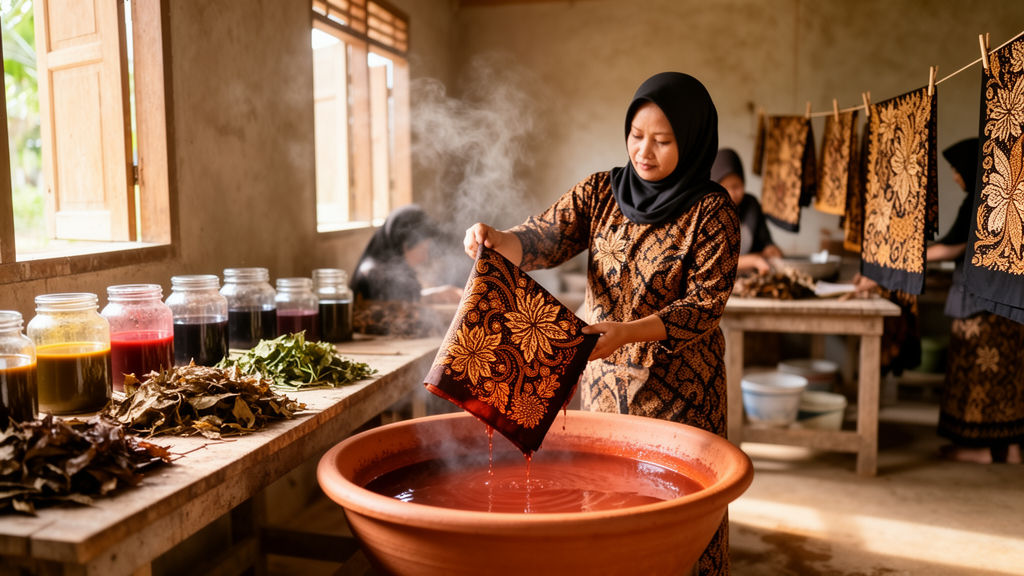
In the clay batik workshops of West Sumatra, artisans are turning to materials drawn directly from their surroundings: river clay, jengkol pods, mahogany bark, gambier resin, and pandan leaves. A new study of Minangkabau batik tanah liek, published in Discover Sustainability, documents how this earth-tone dyeing tradition connects textile production, cultural identity, and everyday health awareness in a small-scale craft setting. The research drew on focused narrative ethnographic fieldwork with twelve informants across Padang City, Solok Regency, and Pesisir Selatan Regency.

The participants included working artisans, one customary or cultural figure, one collection owner who also practises the craft, and supporting stakeholders. Rather than measuring dye chemistry in a laboratory, the study captured how practitioners themselves describe and transmit their knowledge of natural dyeing. According to the findings, the locally sourced materials contribute to a distinctive earth-tone aesthetic and support the transmission of Minangkabau motifs and place-based craft knowledge.

Batik tanah liek, literally clay batik, is bound up with cultural identity as well as livelihood, and the study frames natural dyeing as a bounded ecocultural practice rather than a general-purpose alternative to synthetic colourants. Participants associated natural dyeing with lower chemical odour, greater skin comfort, and reduced dependence on synthetic dyes. This matters because synthetic dyes in small-scale batik production can contribute to wastewater pollution and occupational exposure, particularly where protective equipment and wastewater treatment facilities remain limited.

The authors are careful to note that these artisan perceptions were not independently verified through environmental or biomedical testing. The study therefore does not treat natural materials as intrinsically sustainable, and it makes no claim of formal certification, measurable public-health improvement, or therapeutic effects. The reported benefits remain participant accounts within a specific craft community, not laboratory findings.

What the research does contribute is a picture of how environmental care, health awareness, cultural meaning, and market survival are negotiated together in one place. For the artisans involved, choosing natural dyes is not only a technical decision about colour but also a statement about caring for the land, protecting their own bodies, and keeping a culturally significant craft economically viable. The bounded nature of the study is part of its argument.

By focusing on a single tradition in three districts of West Sumatra, the researchers avoid generalising about natural dyeing worldwide. The same materials, in different industrial or regulatory settings, could carry very different environmental footprints, and the authors explicitly decline to claim sustainability benefits beyond what participants described. For readers following debates about textile pollution and artisan livelihoods, the study offers a grounded case rather than a headline solution.

The ethnographic approach also highlights how craft knowledge is transmitted. The materials themselves, from clay to pandan leaves, serve as anchors for teaching Minangkabau motifs and the place-based knowledge attached to them, so that dyeing practice and cultural continuity reinforce one another within the workshops studied.

It shows that in batik tanah liek, the choice of dye is woven into questions of identity, health, and survival, and that understanding those connections requires listening to the practitioners who keep the tradition alive.

Subject of Research: Natural dyeing practices and artisan health awareness in Minangkabau batik tanah liek

Article Title: Natural dyeing supports, environmental care, and artisan health awareness in Minangkabau batik tanah liek

Article References: Sunarti, S., Syahrul, N., Fakhriati, F., Atisah, A., Andriana, D., Fadlly, H., Yeh, L. H., Mohd Nor, N. B., & Aprijarni, D. N. (2026). Natural dyeing supports, environmental care, and artisan health awareness in Minangkabau batik tanah liek. Discover Sustainability. https://doi.org/10.1007/s43621-026-04508-8

Image Credits: AI Generated

DOI: 10.1007/s43621-026-04508-8

Keywords: batik tanah liek, natural dyes, Minangkabau, ethnography, West Sumatra, artisan health, textile craft, sustainability, cultural heritage, wastewater pollution, Discover Sustainability, Natural

Cite Scienmag News

Violet Maxwell. (October 28, 2026). Clay batik artisans in West Sumatra link natural dyes to comfort and cleaner craft. Scienmag. https://scienmag.com/clay-batik-artisans-in-west-sumatra-link-natural-dyes-to-comfort-and-cleaner-craft/


Violet Maxwell. "Clay batik artisans in West Sumatra link natural dyes to comfort and cleaner craft." Scienmag, 28 October 2026, https://scienmag.com/clay-batik-artisans-in-west-sumatra-link-natural-dyes-to-comfort-and-cleaner-craft/. Accessed 29 October 2026.

Violet Maxwell. "Clay batik artisans in West Sumatra link natural dyes to comfort and cleaner craft." Scienmag. October 28, 2026. https://scienmag.com/clay-batik-artisans-in-west-sumatra-link-natural-dyes-to-comfort-and-cleaner-craft/

Tags: artisan healthbatik tanah liekcommunity-based textile artscultural heritageDiscover Sustainabilityearth-tone aesthetic in Indonesian textilesearth-tone textile craftsmanshipenvironmentally friendly textile practicesethnographic study of batik artisansethnographyhealth benefits of natural dyeslocal craft sustainabilityMinangkabauMinangkabau cultural heritagenaturalnatural dye sources in West SumatraNatural dyeingnatural dyesSustainabilitysustainable batik productiontextile crafttraditional ecological knowledgewastewater pollutionWest Sumatra
Share26Tweet16
Previous Post

New Grid Scheduling Model Cuts Costs and Carbon While Extending Storage Life

Next Post

Perlite and silica fume mortar cuts thermal conductivity while keeping strength

Related Posts

Nested Data Assimilation Framework Sharpens Water-Quantity Monitoring on the Lower Lancang River
Earth Science

Nested Data Assimilation Framework Sharpens Water-Quantity Monitoring on the Lower Lancang River

October 28, 2026
Digital transformation in Gulf social enterprises: 14 key factors identified
Earth Science

Digital transformation in Gulf social enterprises: 14 key factors identified

October 28, 2026
Bukavu residents back waste automation but fear job losses, survey finds
Earth Science

Bukavu residents back waste automation but fear job losses, survey finds

October 28, 2026
Waste Rock Grids Reinforce Tailings Dams Against Earthquake Damage, Modeling Study Finds
Earth Science

Waste Rock Grids Reinforce Tailings Dams Against Earthquake Damage, Modeling Study Finds

October 28, 2026
Water Trapped in Olivine Crystals Reveals How Fast Kimberlites Carry Diamonds to the Surface
Earth Science

Water Trapped in Olivine Crystals Reveals How Fast Kimberlites Carry Diamonds to the Surface

October 28, 2026
Statistical Clocks for Mount Etna: New Models Quantify Eruption Odds
Earth Science

Statistical Clocks for Mount Etna: New Models Quantify Eruption Odds

October 28, 2026
Next Post
Perlite and silica fume mortar cuts thermal conductivity while keeping strength

Perlite and silica fume mortar cuts thermal conductivity while keeping strength

  • Mothers who receive childcare support from maternal grandparents show more optimized

    Mothers who receive childcare support from maternal grandparents show more parental warmth, finds NTU Singapore study

    27656 shares
    Share 11059 Tweet 6912
  • University of Seville Breaks 120-Year-Old Mystery, Revises a Key Einstein Concept

    1061 shares
    Share 424 Tweet 265
  • Bee body mass, pathogens and local climate influence heat tolerance

    682 shares
    Share 273 Tweet 171
  • Researchers record first-ever images and data of a shark experiencing a boat strike

    546 shares
    Share 218 Tweet 137
  • Groundbreaking Clinical Trial Reveals Lubiprostone Enhances Kidney Function

    531 shares
    Share 212 Tweet 133
Science

Embark on a thrilling journey of discovery with Scienmag.com—your ultimate source for cutting-edge breakthroughs. Immerse yourself in a world where curiosity knows no limits and tomorrow’s possibilities become today’s reality!

RECENT NEWS

  • Recalibrating Polygenic Risk Scores to Local Data Sharpens Disease Risk Prediction
  • MicroRNA miR-3663-3p emerges as diagnostic marker and driver of kidney disease vascular calcification
  • Plasma GDF15 Shows Diagnostic Potential in Biopsy-Indicated Prostate Cancer Cohort
  • Research report: Sickle cell disease in Germany – trends in epidemiology, healthcare utilization and disease burden from 2015 to 2024: a claims data analysis

Categories

  • Agriculture
  • Anthropology
  • Archaeology
  • Athmospheric
  • Biology
  • Biotechnology
  • Blog
  • Bussines
  • Cancer
  • Chemistry
  • Climate
  • Earth Science
  • Editorial Policy
  • Marine
  • Mathematics
  • Medicine
  • Pediatry
  • Policy
  • Psychology & Psychiatry
  • Science Education
  • Science News
  • Social Science
  • Space
  • Technology and Engineering

Subscribe to Blog via Email

Enter your email address to subscribe to this blog and receive notifications of new posts by email.

Join 5,151 other subscribers

© 2025 Scienmag - Science Magazine

Welcome Back!

Login to your account below

Forgotten Password?

Retrieve your password

Please enter your username or email address to reset your password.

Log In
No Result
View All Result
  • HOME
  • SCIENCE NEWS
  • CONTACT US

© 2025 Scienmag - Science Magazine

Discover more from Science

Subscribe now to keep reading and get access to the full archive.

Continue reading