


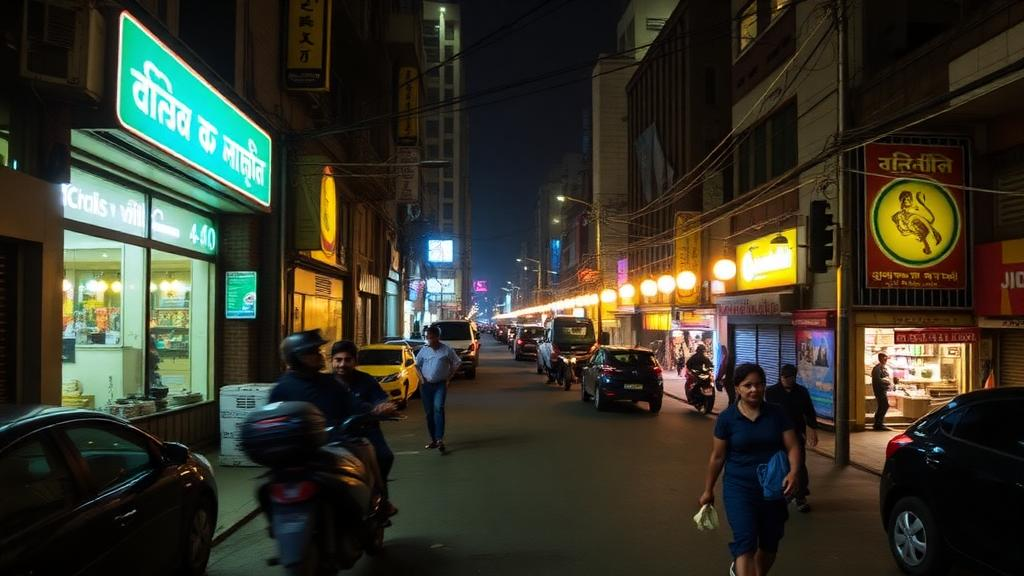
India’s cities have long been celebrated as engines of prosperity, drawing millions of people out of the countryside and into dense, economically vibrant urban centres. A new study suggests that this celebrated transformation carries a hidden nutritional cost. Researchers at the Indian Institute of Technology Kharagpur have found that while urbanisation initially improves the variety of foods that households can access, in the long run it is associated with a decline in dietary diversity among urban households themselves. The finding, published in the journal Discover Sustainability, challenges the comfortable assumption that city living automatically translates into better, more varied diets, and it reframes urbanisation as a process that reshapes food environments in ways that are neither simple nor uniformly beneficial.
The research, conducted by Rishika Raj and Bimal Kishore Sahoo, tackles a question that sits at the heart of food security policy: what happens to the quality of people’s diets when the societies they live in undergo rapid structural transformation? Food security is conventionally understood through several dimensions, including availability, access and utilisation. Dietary diversity, meaning the range of distinct food groups a household consumes, is widely used by nutrition scientists as a proxy for the utilisation and quality dimensions. A household that eats only rice and lentils may consume enough calories, but it misses the micronutrients, proteins and fats that come from fruits, vegetables, dairy, eggs, meat and other foods. Measuring diversity therefore offers a window into nutritional stability that calorie counts alone cannot provide.
What makes this study methodologically distinctive is the way it measures urbanisation. Rather than relying on a single administrative definition, the authors constructed a composite picture of urbanisation using three complementary dimensions. The first is economic urbanisation, captured through night-time lights, the glow that satellites record over human settlements and which economists have long used as a proxy for economic activity and electrification. The second is physical urbanisation, measured as built-up area, the actual footprint of concrete and asphalt that expands as towns grow. The third is demographic urbanisation, the share of a district’s population living in urban areas. Combining these dimensions allows the researchers to distinguish between districts that are merely administratively urban and those experiencing genuine economic and physical transformation.
On the dietary side, the authors drew on household consumption expenditure data to construct a dietary diversity score using Simpson’s Diversity Index, a measure borrowed from ecology that accounts both for the number of distinct food categories consumed and for how evenly expenditure is spread across them. A household spending heavily on one staple while buying only token amounts of other foods will score lower than one spreading its food budget across many categories. The analysis used district-level panel data spanning 2014 to 2020, allowing the researchers to track how rural and urban dietary diversity evolved together across hundreds of Indian districts over six years, a period that includes the disruptive years of the COVID-19 pandemic.
The headline result is stark: significant and persistent rural-urban disparities in dietary diversity exist across Indian districts, indicating that access to diverse and nutritious diets remains deeply unequal between countryside and city. Urban households, on average, consume a wider variety of foods than their rural counterparts, and this gap does not disappear over the study period. The finding matters because dietary diversity is not a luxury indicator; it is closely tied to micronutrient adequacy and long-term health outcomes. Persistent gaps suggest that the structural transformation pulling people into cities has not yet delivered equal nutritional quality to those left behind in rural areas, where agricultural households may still depend heavily on starchy staples and locally produced foods.
Yet the more provocative finding concerns what happens over time within urban areas. In the short run, the study finds, urbanisation is associated with improvements in dietary diversity for both rural and urban households. As districts urbanise, markets deepen, supply chains lengthen, incomes rise and consumers gain access to a broader basket of foods. This is the familiar, optimistic story of development. But the long-run picture inverts. The analysis reveals that higher levels of urbanisation are linked to declining dietary diversity among urban households, pointing to emerging risks to diet quality and nutritional stability precisely in the places where one would least expect them.
The authors interpret this as evidence of a non-linear and dynamic relationship between urbanisation and the nutritional dimension of food security. Several mechanisms could plausibly explain such a pattern, and the study’s framing points toward the transformation of food environments in dense cities. As urban areas mature, food systems may shift toward processed, convenience-oriented and calorie-dense products that crowd out fresh and varied foods, particularly for lower-income urban households facing high housing costs and time pressures. Urban diets may also become more monotonous as reliance on purchased foods replaces the seasonal variety that local and home production once provided. The study does not claim to identify a single causal mechanism, but its econometric results are consistent with the idea that the early gains from urban food markets eventually plateau and reverse for city dwellers.
The temporal dynamics of the rural-urban gap add another layer of nuance. The researchers found that urbanisation initially widens the divide in dietary diversity between rural and urban areas, as the benefits of urban food markets accrue first to city residents. Over time, however, these gaps narrow. This convergence is not necessarily good news for cities; the study’s long-run results suggest that part of the narrowing may reflect urban dietary diversity declining rather than rural diets catching up. For policymakers, this distinction is critical. A narrowing gap driven by rural improvement would represent genuine progress in food security, whereas convergence driven by urban decline would signal a broad deterioration in diet quality with serious public health implications.
Technically, the study’s use of panel econometrics across Indian districts gives it unusual analytical reach. By examining both short-run and long-run effects, the authors move beyond the static snapshots that dominate much of the food security literature. The use of night-time lights as an urbanisation proxy is particularly valuable in the Indian context, where administrative boundaries and official urban classifications can lag behind the reality of sprawling, economically integrated settlements. Satellite-observed luminosity captures economic dynamism wherever it occurs, including in peri-urban areas that census categories may miss. Pairing this with built-up land data and population shares creates a robustness that single-measure studies lack, and the Simpson’s Index approach to dietary diversity ensures that the food-side measure is sensitive to both variety and balance in household consumption.
The broader implications extend well beyond India. The country is home to hundreds of millions of people undergoing precisely the kind of structural transformation that much of the developing world is experiencing or will soon face. If urbanisation in India follows a trajectory in which early dietary gains give way to long-run erosion among urban households, other rapidly urbanising nations may confront similar dynamics. The authors argue that urbanisation should be viewed not only as a driver of economic growth but also as a process that reshapes food environments and the stability of access to nutritious diets. That reframing has concrete policy consequences: urban food policy cannot assume that market access alone guarantees diet quality, and rural development strategies must address the persistent diversity gap that leaves countryside households with narrower food baskets. As India’s cities continue to swell, the study suggests that the next frontier of food security will be fought not in the fields, but in the streets, markets and households of the cities themselves.
Subject of Research: The relationship between urbanisation and rural-urban differences in household dietary diversity across Indian districts
Article Title: Urbanisation and the rural urban dietary diversity divide across districts in India
Article References: Raj, R., & Sahoo, B. K. (2026). Urbanisation and the rural urban dietary diversity divide across districts in India. Discover Sustainability. https://doi.org/10.1007/s43621-026-04809-y
Image Credits: AI Generated
DOI: 10.1007/s43621-026-04809-y
Keywords: urbanisation, dietary diversity, food security, India, rural-urban gap, night-time lights, Simpson's Diversity Index, district-level panel data, nutrition, Discover Sustainability, food environments, structural transformation
Cite Scienmag News
Daisy Hatcher. (October 6, 2026). City Lights, Dimming Diets: India’s Urban Food Paradox Emerges. Scienmag. https://scienmag.com/city-lights-dimming-diets-indias-urban-food-paradox-emerges/
Daisy Hatcher. "City Lights, Dimming Diets: India’s Urban Food Paradox Emerges." Scienmag, 6 October 2026, https://scienmag.com/city-lights-dimming-diets-indias-urban-food-paradox-emerges/. Accessed 17 October 2026.
Daisy Hatcher. "City Lights, Dimming Diets: India’s Urban Food Paradox Emerges." Scienmag. October 6, 2026. https://scienmag.com/city-lights-dimming-diets-indias-urban-food-paradox-emerges/


