


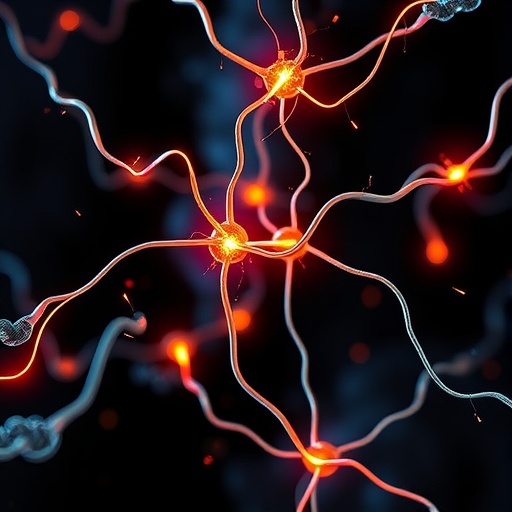
In a groundbreaking advance in neurobiology, researchers have illuminated the intricate interplay between acetylcholine (ACh) and dopamine (DA) release within the nucleus accumbens (NAc), delineating a critical mechanism that underlies effortful behavior. This new work reveals that cholinergic signaling is not merely a background modulator but is essential in shaping dopamine dynamics during high-effort tasks, a discovery that opens novel avenues for understanding motivation and potentially treating motivational deficits in neuropsychiatric disorders.
At the core of this study is the temporal relationship between ACh and DA release during reward-driven behavior. Employing sophisticated genetically encoded sensors capable of detecting neurotransmitter release with millisecond precision, the investigators demonstrated that in response to a reward, acetylcholine is released first, preceding dopamine release by approximately 400 milliseconds. This finding held consistently across various fixed ratio (FR) schedules where animals exerted increasing effort to obtain a sucrose reward, suggesting that cholinergic bursts may prime or gate subsequent dopaminergic signaling to facilitate motivated behavior.
The temporal precedence of acetylcholine challenges the traditional view that dopamine release solely drives reward-related motivation. Instead, it positions ACh as a critical upstream regulator that modulates dopamine dynamics in the NAc. Importantly, the researchers established that this is not a mere correlational relationship but a causative mechanism by functionally manipulating cholinergic signaling. Using a Cre-dependent tetanus toxin (TetTox) to chronically silence cholinergic interneurons specifically in ChAT-Cre mice, they observed a profound disruption of dopamine effort encoding. The effect intensified with increasing effort demands, revealing an essential role for acetylcholine in sustaining dopamine release patterns as effort escalates.
A key strength of this work lies in the combination of chronic and acute interventions to dissect cholinergic function. While chronic silencing via TetTox confirmed the necessity of cholinergic transmission, the authors complemented this approach with temporally precise optogenetics. By expressing the inhibitory opsin NpHR selectively in cholinergic interneurons and delivering red-light inhibition during reward consumption, the researchers acutely reduced ACh release. This manipulation led to a significant attenuation of dopamine release during high effort trials without disrupting low effort dopamine signaling. Such selective modulation elegantly demonstrates that cholinergic activity is causally required in real-time to maintain the dopaminergic drive needed for sustained effortful behavior.
These neurochemical manipulations had clear behavioral consequences. When nicotinic acetylcholine receptors were pharmacologically blocked within the NAc, animals exhibited reduced responding for sucrose rewards, particularly under high fixed ratio conditions requiring considerable effort. Conversely, when cholinergic signaling was intact, dopamine release scaled with effort, promoting motivation to persist in the task. This evidence firmly links the cholinergic gating of dopamine with the motivational drive to overcome physical work demands, implicating a finely tuned cholinergic-dopaminergic axis as a core substrate of effortful decision-making.
The findings advance current understanding of the heterogeneity and function of neuromodulatory systems by demonstrating that acetylcholine within the NAc exerts a gating influence on dopamine release and thereby the exertion of effortful behavior. This challenges simpler models positing dopamine as the sole motivational currency and highlights the importance of local cholinergic interneuron circuits in modulating dopaminergic reward signals. The research thereby expands the conceptual framework about how effort and reward valuation are integrated in the brain.
Moreover, the study harnesses cutting-edge biosensors—GRAB DA and GRAB ACh—to unravel temporal and causal relationships between neurotransmitter systems in vivo with unparalleled precision, revealing dynamics that traditional electrophysiology or microdialysis approaches could not resolve. The faster kinetics of GRAB dopamine signals compared to acetylcholine sensors further reinforce the relative timing, underscoring that the observed lag is biologically meaningful rather than an artifact of measurement.
Another innovative aspect of this research was the use of within-subject optogenetic inhibition to circumvent potential compensatory changes induced by chronic manipulations. By alternating red light exposure days to inhibit cholinergic neurons selectively, the authors demonstrated reversible modulation of dopamine effort encoding. This methodology strengthens causal claims by showing immediate effects within the same animals, minimizing confounds from developmental circuit adaptations or inter-animal variability.
The therapeutic implications of this research are profound. Many neuropsychiatric conditions characterized by motivational deficits—such as depression, schizophrenia, and Parkinson’s disease—feature dysregulated dopamine and acetylcholine systems. Understanding how local cholinergic interneurons modulate dopamine release to regulate effortful behavior could inspire novel interventions targeting nicotinic receptors or cholinergic transmission in the NAc to enhance motivation and functional outcomes in patients.
Additionally, this study highlights the nuanced role of acetylcholine beyond its classic functions in attention and learning, positioning it as a critical modulator of motivational states via dopamine. It redefines acetylcholine’s role within basal ganglia circuits and prompts reconsideration of its involvement in the effort-reward tradeoff computations governing goal-directed actions.
The multi-modal experimental design, combining precise neurotransmitter sensing, genetic silencing, optogenetics, and pharmacology, sets a new standard for dissecting the neural substrates of motivated behavior. It exemplifies how integration of modern neuroscience tools can decode complex neurochemical interactions that underlie fundamental behaviors, shaping future studies of brain function and dysfunction.
In summary, the researchers uncover a vital cholinergic gating mechanism that drives dopamine release proportional to effort demands, thereby sustaining effortful behavior. Their detailed characterization of the temporal and causal interplay between acetylcholine and dopamine in the nucleus accumbens not only deepens fundamental understanding of motivation circuits but potentially opens the door to innovative therapies aimed at motivational impairments. This seminal work heralds a new era in neuromodulation research, emphasizing the dynamic interplay rather than isolated roles of neurotransmitters in orchestrating behavior.
Cite Scienmag News
Denise Maddox. (January 28, 2026). Cholinergic Control of Dopamine Sparks Effort. Scienmag. https://scienmag.com/cholinergic-control-of-dopamine-sparks-effort/
Denise Maddox. "Cholinergic Control of Dopamine Sparks Effort." Scienmag, 28 January 2026, https://scienmag.com/cholinergic-control-of-dopamine-sparks-effort/. Accessed 3 September 2026.
Denise Maddox. "Cholinergic Control of Dopamine Sparks Effort." Scienmag. January 28, 2026. https://scienmag.com/cholinergic-control-of-dopamine-sparks-effort/


