


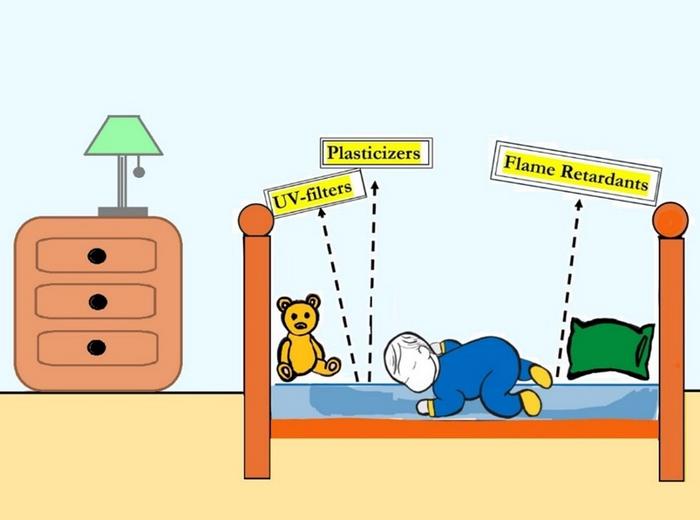
Recent peer-reviewed studies emerging from the University of Toronto have unveiled a troubling reality about the sleeping environments of babies and young children. These investigations reveal that children’s mattresses may act as significant sources of exposure to plasticizers, flame retardants, and ultraviolet (UV) filters—chemical compounds with known or suspected adverse health effects. Published in the prestigious journals Environmental Science & Technology and Environmental Science & Technology Letters, these studies highlight the presence of toxic substances in the very places children retreat for rest and development.
Through meticulous air sampling conducted in the bedrooms of children aged six months to four years, researchers quantified alarming concentrations of over two dozen harmful chemicals. The highest pollutant levels were recorded in proximity to children’s beds, implicating mattresses as a primary source. These findings were corroborated by companion laboratory experiments where newly purchased children’s mattresses were tested. When researchers simulated a child’s body heat and weight, emission rates of these chemicals multiplied substantially, demonstrating how typical sleeping conditions exacerbate chemical exposure risks.
Phthalates, a class of plasticizers utilized to impart flexibility in polymers, were detected among the most pervasive chemicals. Alongside them were organophosphate ester flame retardants, substances widely employed to retard ignition in consumer products. Noteworthy too were UV filters—additives used to protect materials from sunlight-induced degradation. What compounds this concern is that many of these chemical classes function as endocrine disruptors, capable of interfering with hormone systems, and are linked with neurological impairments, asthma development, and oncogenic outcomes in children.
The vulnerability of infants and toddlers to these exposures is underscored by their unique physiology and behavior. Developing organ systems, higher respiratory rates relative to body size—approximately tenfold that of adults—and frequent hand-to-mouth activity amplify their susceptibility to inhaled and dermally absorbed toxins. The more permeable nature of their skin further increases transdermal uptake. Collectively, these factors raise the stakes for young children’s health, given the critical window for brain maturation during early life stages, which is highly sensitive to environmental insults.
One particularly puzzling discovery from the study was the prevalence of flame retardants in mattresses despite no current regulatory requirement for their use to meet flammability standards in Canada and the United States. This raises important questions about manufacturing practices and the perpetuation of chemical usage driven by outdated or unnecessary safety paradigms. While flame retardants have long been employed with the intent of fire risk mitigation, accumulating evidence suggests many confer negligible fire safety benefits alongside significant health costs.
Flame retardants’ neurotoxic and endocrine-disrupting properties have been repeatedly documented, linked to reductions in IQ scores, behavioral anomalies, learning disabilities, and reproductive dysfunction. The presence of these substances in children’s sleep surfaces is especially disconcerting, given that sleep underpins cognitive function and overall developmental trajectories. Experts emphasize that parents rightly expect their children’s beds to be safe havens, free from substances that could sap cognitive potential or cause chronic illness.
Miriam Diamond, a professor and senior author of the research, remarks, “Sleep is vital for brain development, particularly in infants and toddlers. Our findings constitute a wake-up call for manufacturers and regulators alike to re-examine the chemical composition of children’s mattresses.” Echoing this sentiment, Arlene Blum, executive director of the Green Science Policy Institute and co-author, highlights the ongoing legacy of flame retardants in compromising children’s neurological health without justified fire safety benefits.
These revelations necessitate urgent action on multiple fronts. Regulatory frameworks need strengthening to curtail the integration of phthalates and hazardous flame retardants in children’s bedding products. Specifically, the research advocates for extending current restrictions on plasticizers—now applied primarily to toys and mouthed objects—to encompass mattresses and associated bedding materials. The call also includes enacting stringent measures against flame retardants that pose documented risks. The detection of banned or restricted chemicals in tested mattresses signals a glaring need for rigorous pre-market chemical assessments.
For caregivers concerned about immediate exposure risks, practical strategies can mitigate contact with these harmful substances. Researchers recommend minimizing bedroom clutter to reduce reservoirs of embedded chemicals; frequent laundering of bedding and sleepwear to refresh protective surfaces; and opting for fabrics without dyes or strong colors, which often contain additional UV-filters and chemical additives. Such measures, while not eliminating exposure, can help reduce cumulative toxic burdens during a critical stage of physiological development.
The geographic sourcing of materials deserves scrutiny as well. Though mattresses analyzed were purchased in Canada, many included components sourced from the United States, Mexico, and beyond. Given the integrated nature of mattress supply chains across North America, the issue transcends national borders, calling for multinational cooperation in setting product safety standards. Coordinated policy responses could ensure consistent protections for children across diverse markets.
This research advances a broader conversation about chemical safety in consumer products, particularly those intended for vulnerable populations like children. It highlights the essential role of science in guiding policy and the ethical imperative for manufacturers to prioritise health over expediency or cost-saving through the continued use of hazardous substances. The studies’ comprehensive chemical analyses provide a critical foundation on which sound regulatory decisions and safer product innovations can be built.
Both studies were conducted as part of Sara Vaezafshar’s doctoral thesis at the University of Toronto, with funding from the University of Toronto Fellowship, the Ontario Graduate Scholarship, and the Natural Sciences and Engineering Research Council of Canada. Their outcomes illuminate pressing concerns about everyday environmental exposures hitherto underappreciated in children’s health discourse and advocate for informed, proactive interventions that safeguard future generations.
News Publication Date: 15-Apr-2025
Web References:
Cite Scienmag News
Nathaniel Bowman. (April 15, 2025). Children’s Brains at Risk: The Hidden Danger of Exposure to Toxic Chemicals During Sleep. Scienmag. https://scienmag.com/childrens-brains-at-risk-the-hidden-danger-of-exposure-to-toxic-chemicals-during-sleep/
Nathaniel Bowman. "Children’s Brains at Risk: The Hidden Danger of Exposure to Toxic Chemicals During Sleep." Scienmag, 15 April 2025, https://scienmag.com/childrens-brains-at-risk-the-hidden-danger-of-exposure-to-toxic-chemicals-during-sleep/. Accessed 3 September 2026.
Nathaniel Bowman. "Children’s Brains at Risk: The Hidden Danger of Exposure to Toxic Chemicals During Sleep." Scienmag. April 15, 2025. https://scienmag.com/childrens-brains-at-risk-the-hidden-danger-of-exposure-to-toxic-chemicals-during-sleep/


