


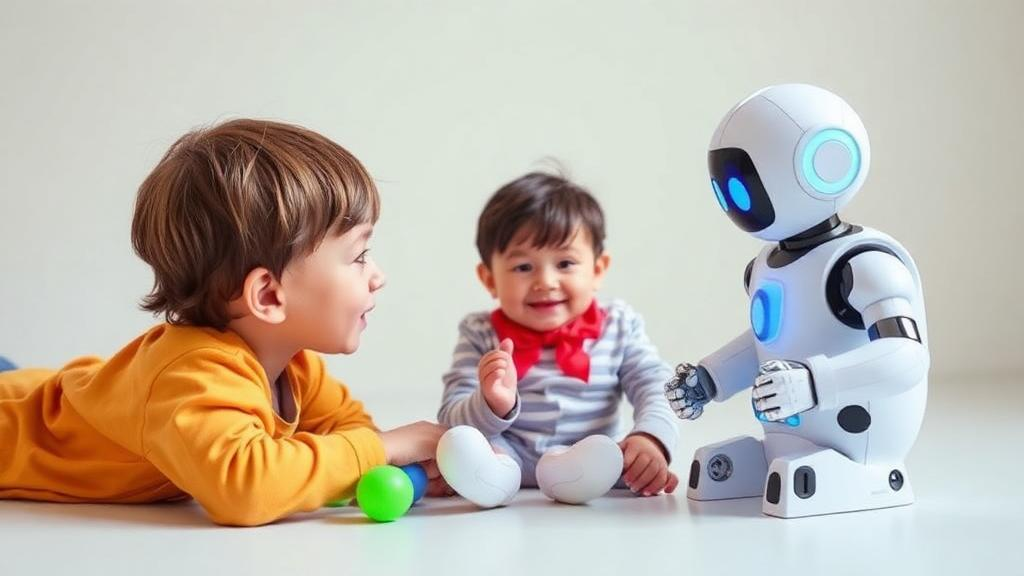
Children between the ages of five and ten tend to believe what a generative artificial intelligence toy tells them, and they approach the technology with an enthusiasm that stands in stark contrast to the anxiety many of their parents feel, according to new research from the University of Cincinnati. The study, presented by researchers in UC’s College of Arts and Sciences at the Comm Horizons conference at the University of California, Davis, offers one of the most direct looks yet at how young children actually behave around commercially available AI companions, and the findings suggest that the first generation to grow up with generative AI is adopting it faster and more willingly than the adults responsible for supervising them.
The research team, led by UC Assistant Professor Kelly Merrill Jr. and UC Niehoff Professor Nancy Jennings, both of whom teach in UC’s School of Communication, Film, and Media Studies, invited 41 children to play three interactive games with Miko, a commercially available robot toy powered by generative AI. The observational study allowed the researchers to watch, in real time, how children who had never before encountered such a device responded to it. What they observed was striking: the children were not merely curious about the robot but genuinely enthusiastic, engaging with it readily even when it was entirely unfamiliar to them, and they showed a marked tendency to accept the machine’s statements as true.
That trust is the detail that most concerns the researchers. Young children are still developing the critical thinking skills that adults use to evaluate sources, distinguish fact from fiction, and recognize when a technology might be wrong or misleading. When a conversational robot speaks in a confident, friendly voice, children may extend to it the same credibility they would offer a trusted adult. Merrill said the biggest takeaway for him was that the children were extremely excited about robots and AI, while AI can be a scary thing for parents. The gap between those two reactions, he suggested, is precisely where education needs to happen.
Jennings argued that the study demonstrates the need to build AI literacy at a young age so that children become aware of both the abilities and the limitations of this emerging technology. The new generation, she noted, will never know a world without artificial intelligence. Because AI is being integrated with every aspect of life, she said, families and educators will have to teach children to think critically about these tools from an early age and to talk through their experiences with their parents. In her view, AI literacy is not a niche technical skill but a foundational one, comparable in importance to media literacy for previous generations raised on television and the internet.
The researchers also pointed out that families with young children are typically quicker to adopt new technology than other populations, so it is not surprising that they would be among the first to bring social robots and AI agents into their homes. Jennings cautioned, however, that there are a lot of unknowns about being the first and having those initial experiences. The children in the study were, in effect, pioneers in an unregulated frontier, and their parents are navigating territory that no previous generation of caregivers has had to map. Interactive computer toys saw a surge in popularity during the COVID-19 pandemic, Jennings noted, when social distancing meant fewer group playdates and families looked for technology that could fill the social gap.
Despite the concerns, the study also identified genuine potential benefits. Interactive AI toys could help children practice conversation, improve vocabulary, and strengthen listening skills, and Jennings observed that such robots might appeal to children who have limited social outlets outside of school. The researchers asked the children after they played with Miko whether they considered it to be a toy, a friend, or something else. What was interesting, Jennings said, was that some of the children, particularly those who expressed that they had trouble making friends at school, said they really liked talking to Miko. They described it as a friend who would not judge them or make them feel bullied.
That finding cuts both ways. On one hand, a judgment-free conversational partner could offer comfort and conversational practice to a lonely child. On the other hand, if children who struggle socially begin substituting AI companionship for human relationships, the long-term developmental consequences remain unknown. Merrill emphasized that these AI tools are not replacements but complements, and that society should not be looking to replace people. His framing reflects a growing consensus among communication researchers that the value of AI for children depends on how it is positioned: as a supplement to human interaction rather than a substitute for it.
The study also documented how built-in safeguards behave in practice. While watching the children collaborate with Miko’s Story Maker program, the UC researchers observed the robot’s guardrails redirecting content that pushed into inappropriate territory. If a child started telling a story that was too scary or involved guns, Merrill said, Miko would redirect with a line like, that sounds scary, let’s do something else. Such guardrails matter because the AI toy industry has faced criticism for not doing enough to create age-appropriate protections. A risk assessment conducted this year by Common Sense Media found that AI toys regularly generated age-inappropriate content, and consumer advocates such as the nonprofit Public Interest Research Group have raised privacy concerns about devices designed to listen to and converse with children.
The researchers found that AI agents are already familiar fixtures in many of the children’s lives. Merrill said half of the children in the study regularly used AI agents at home, and the most common response he got was that they used AI for music, invoking phrases like hey Siri, play this song, or hey Alexa. The ubiquity of voice assistants means that for many children, conversing with an AI is not a novel or intimidating experience but an ordinary part of daily routine, one they absorb simply by living in households where smart speakers sit on kitchen counters and respond to casual requests.
Merrill’s own office offered a small, telling illustration of that ubiquity. From the phone on his desk, the familiar voice of Siri interrupted to announce that a song was now playing on Apple Music. Robots are always listening, he observed, a remark that captures both the convenience and the quiet unease that defines adult attitudes toward AI. The University of Cincinnati study suggests that children carry none of that unease into their interactions with the technology. Whether that fearlessness becomes a foundation for confident, critical use of AI or a vulnerability that industry safeguards and parental guidance must urgently address may depend on how seriously families, educators, and toymakers take the lessons of studies like this one in the years ahead.
Subject of Research: Children's trust in and enthusiasm for generative AI-powered interactive toys
Article Title: Unlike parents, children are fearless around AI
Article References: Unlike parents, children are fearless around AI. (n.d.). Original publication
Image Credits: AI Generated
DOI: Not provided
Keywords: artificial intelligence, AI toys, children, generative AI, AI literacy, social robots, University of Cincinnati, child development, parental concerns, privacy, Common Sense Media, voice assistants
Cite Scienmag News
Courtney Benton. (October 10, 2026). Children Trust AI Toys Without Fear, Study Finds, Raising Urgent Questions About AI Literacy. Scienmag. https://scienmag.com/children-trust-ai-toys-without-fear-study-finds-raising-urgent-questions-about-ai-literacy/
Courtney Benton. "Children Trust AI Toys Without Fear, Study Finds, Raising Urgent Questions About AI Literacy." Scienmag, 10 October 2026, https://scienmag.com/children-trust-ai-toys-without-fear-study-finds-raising-urgent-questions-about-ai-literacy/. Accessed 10 October 2026.
Courtney Benton. "Children Trust AI Toys Without Fear, Study Finds, Raising Urgent Questions About AI Literacy." Scienmag. October 10, 2026. https://scienmag.com/children-trust-ai-toys-without-fear-study-finds-raising-urgent-questions-about-ai-literacy/


