


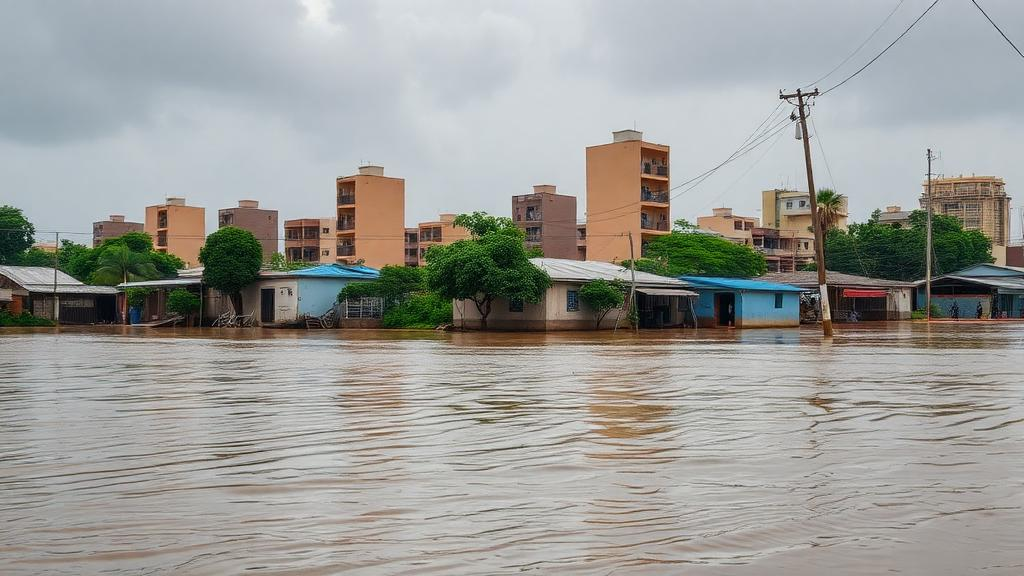
In the densely populated city of Butembo, in eastern Democratic Republic of Congo, floods are no longer rare emergencies but recurring threats shaped by climate change, rapid population growth and largely uncontrolled urbanization. A new study published in SN Social Sciences asks a deceptively simple question: when people live in harm’s way, what actually makes them prepare for the next flood? The answer, drawn from hundreds of households in the city’s most vulnerable neighborhoods, challenges one of the most common assumptions in disaster risk management — that raising awareness of risk is the key to triggering protective action.
The research, led by Moïse Musubao Kapiri of the University of Liège and the Université Catholique du Graben, together with colleagues in Belgium and the Democratic Republic of Congo, surveyed 249 households located in flood-prone areas of Butembo. Rather than simply asking residents whether they felt worried about flooding, the team built a formal statistical model of preparedness behavior, grounded in the Theory of Planned Behavior — a widely used psychological framework that explains actions through intention, attitudes and perceived control over one’s own behavior. To this core model they added four further cognitive and non-cognitive factors: flood risk perception, direct experience of flooding, indirect experience gained through traditional and social media, and the degree of community involvement.
The methodological engine of the study is covariance-based structural equation modeling, or CB-SEM, a statistical technique that allows researchers to test networks of cause-and-effect relationships between concepts that cannot be observed directly, such as intention, perceived control or risk perception. Instead of measuring preparedness as a single yes-or-no question, the approach models it as a latent variable inferred from multiple indicators, while estimating the strength of the pathways linking each psychological and social factor to the outcome. This makes it possible to ask not only whether a factor matters, but how much it matters relative to the others — a crucial distinction when policy budgets are limited.
The baseline results are instructive in their own right. The classic Theory of Planned Behavior factors alone accounted for 45.8 percent of the variance in household preparedness. In other words, whether residents intended to prepare, and whether they believed they had the means to do so, explained nearly half of the differences between households. When the researchers added flood risk perception, direct and media-mediated experience, and community involvement, the model’s explanatory power jumped to 68 percent — a substantial gain that signals how much of preparedness behavior lies outside the standard psychological playbook.
Within that expanded model, the strongest single driver of preparedness was direct experience of flooding, with a standardized coefficient of 0.51. Households that had lived through a flood were markedly more likely to have taken protective measures than those that had not. Indirect experience — encountering flood events through traditional and social media — also had a significant positive effect, at 0.19, suggesting that information channels do shape behavior even for people who have not been flooded themselves. Perceived behavioral control, which in this context includes access to financial and material resources as well as technical knowledge, contributed a coefficient of 0.15, and the intention to prepare added a smaller but still significant 0.05. All of these effects were statistically significant at the p < 0.05 level.
The most striking finding, however, is what did not predict preparedness. Flood risk perception — the degree to which residents felt their homes and families were threatened — showed no statistically significant effect on household preparedness, with a coefficient of 0.05 and a p-value above the conventional threshold for significance. The authors describe this as a paradox of flood risk perception in this southern city: a community can collectively feel a heightened sense of danger, yet that shared anxiety does not translate into individuals actually stocking supplies, reinforcing structures or drawing up evacuation plans. The finding echoes a broader debate in the disaster literature, sometimes called the risk perception paradox, in which high awareness coexists with low protective action.
Why might feeling at risk fail to produce action? The study’s structure offers clues. If perceived behavioral control — money, materials and technical know-how — is a significant pathway to preparedness, then residents who recognize the danger but lack the resources to act may rationally remain unprepared, however acute their worry. Fear, in other words, is not a substitute for capacity. This interpretation aligns with the study’s emphasis that preparedness is not merely a matter of information deficits but of enabling conditions, and it helps explain why awareness campaigns alone so often disappoint disaster managers in cities across the Global South.
The role of experience, both direct and mediated, points to a second practical lever. Because direct flood experience was by far the strongest predictor, programs that connect at-risk households with the lived experiences of flooded communities — through testimonials, local radio reporting or social media storytelling — may do more to spur action than abstract warnings. The significant effect of media-based experience also underscores the importance of clear, reliable information dissemination: in a city where many residents encounter floods secondhand, the quality and credibility of what circulates on airwaves and social platforms can shape real preparedness behavior.
The context makes these findings urgent. Cities of the Global South are expanding rapidly while climate change intensifies rainfall extremes, and uncontrolled urbanization pushes settlements onto vulnerable land. Butembo, like other cities in the Kivu region of eastern DR Congo, faces exactly this combination of hydrological hazard, demographic pressure and strained infrastructure. The study’s authors argue that flood risk management in such cities must move beyond awareness-raising toward integrating risk perception into public policy and promoting strong community engagement in preparedness activities — treating residents not as passive audiences for warnings but as participants in designing and sustaining protective measures.
For researchers, the study is also a demonstration of method. By extending the Theory of Planned Behavior with cognitive and non-cognitive factors and testing the full structure with covariance-based structural equation modeling, the team quantified precisely how much each ingredient contributes — and showed that the standard recipe leaves nearly a third of the story untold. For practitioners, the message is sharper still: in Butembo, the households most likely to be ready for the next flood are those that have been flooded before, those that hear credible accounts through the media, and those with the financial means, materials and technical knowledge to act. Worry alone, however widespread, will not build a resilient city.
Subject of Research: Cognitive and non-cognitive determinants of household flood preparedness in Butembo, eastern DR Congo
Article Title: Assessment of cognitive and non-cognitive factors in household flood preparedness in the city of Butembo (eastern DR Congo)
Article References: Kapiri, M. M., Kavingwa, E. K., Mathe, I. K., Mahamba, J. A., Sahani, W. M., de Longueville, F., & Ozer, P. (2026). Assessment of cognitive and non-cognitive factors in household flood preparedness in the city of Butembo (eastern DR Congo). SN Social Sciences, 6(10), Article 519. https://doi.org/10.1007/s43545-026-01819-5
Image Credits: AI Generated
DOI: 10.1007/s43545-026-01819-5
Keywords: flood preparedness, risk perception, Butembo, DR Congo, Theory of Planned Behavior, structural equation modeling, household behavior, disaster risk management, media experience, community involvement, urbanization, climate change
Cite Scienmag News
Violet Maxwell. (October 10, 2026). Feeling at Risk Is Not Enough: What Really Drives Flood Preparedness in a Fast-Growing African City. Scienmag. https://scienmag.com/feeling-at-risk-is-not-enough-what-really-drives-flood-preparedness-in-a-fast-growing-african-city/
Violet Maxwell. "Feeling at Risk Is Not Enough: What Really Drives Flood Preparedness in a Fast-Growing African City." Scienmag, 10 October 2026, https://scienmag.com/feeling-at-risk-is-not-enough-what-really-drives-flood-preparedness-in-a-fast-growing-african-city/. Accessed 10 October 2026.
Violet Maxwell. "Feeling at Risk Is Not Enough: What Really Drives Flood Preparedness in a Fast-Growing African City." Scienmag. October 10, 2026. https://scienmag.com/feeling-at-risk-is-not-enough-what-really-drives-flood-preparedness-in-a-fast-growing-african-city/


